IRS Refund Still Processing? What It Means and What to Do Next
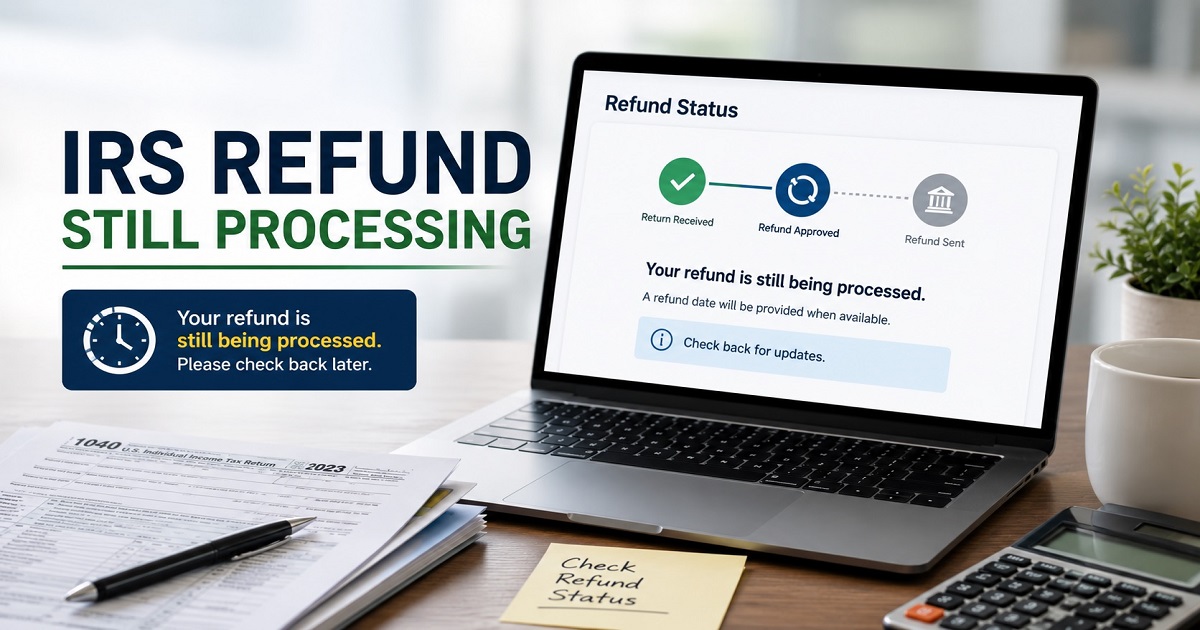
The IRS indicates that your tax return is being processed when the “Still Processing” status is listed in your IRS refund status. This can be due to lack of data, missing data or calculating certain credits. Generally, there is no need to take any action and the refund will be done automatically.
Important Tips to Control your Refund that is Late
1. Monitor Your Refund Status
-
- IRS Where’s My Refund?
- IRS2Go App
2. Check Your Tax Transcript for Codes
- Code 150: Indicates your return was filed.
- Code 806: Indicates payments made on your account.
- Code 570: Represents a temporary hold on your refund.
- Code 971: Means the IRS has mailed you a letter regarding the freeze.
- Code 846: The code you want to see; it signifies your refund is approved and scheduled.
3. Respond to IRS Notices
4. Hardship Exceptions
IRS Refund Still Processing?
- Your IRS refund is still processing when your IRS message doesn’t change, it normally means that your IRS has received your tax return, but has not yet reviewed and approved your IRS refund. It does not mean that you are being audited per se. The delay is often due to an error in the tax return, identity verification, missing information, filing on paper, processing of amended returns, problems with a direct deposit or possibly a refund offset.
- According to the IRS, you can usually access refund status 24 hours after you e-file a current year tax return, 3 days after you e-file a prior year return and 4 weeks following you’ve filed a paper return. The Where’s My Refund tracker indicates that there are three main phases: Return Receipted, Approved – Refund, Sent – Refund.
- This guide outlines the meaning of the message, why the tax refund “still processing” status might persist after 21 days and what you can do before calling the IRS.
IRS Refund Still Processing: Quick Answer
What does “still processing” mean?
- If the IRS states that your refund hasn’t been approved, it generally means that you haven’t yet received your refund.If the IRS reports that your refund is still processing, that typically indicates that your return is in the IRS system, but that the refund hasn’t been approved. The words IRS refund is still being processed or federal refund is still processing or a refund date will be provided when available can be seen.
- To put this into perspective, the IRS could still be verifying your income, your credits, your withholding, your identity, your dependent or even your direct deposit details. Tax Basics & Filling content can assist taxpayers to comprehend how the return is processed from the point that taxpayers file, to the point that taxpayers get their return.
Is “still processing” bad?
Not always. This message typically comes across many taxpayers’ screens for a brief time of the filing season. There are some instances when a refund delay is more concerning, such as after weeks and weeks there is no update on the refund, the IRS has sent you a notice letter, or Where’s My Refund requires you to call the IRS.
Does it mean an audit?
No. This is not an audit, it’s a processing delay. A return can be subjected to a review of accuracy without an “open audit. For instance, if someone claims the earned income tax credit, the additional child tax credit or business income, additional documentation may be required prior to the refund being issued.
How Long Does the IRS Usually Take to Process Refunds?
E-filed returns
- The IRS typically issues refunds in less than 21 calendar days, with the exception of those that need further review. In addition, the Taxpayer Advocate Service also states that the vast majority of IRS refunds are made within 21 calendar days.
- It’s not necessarily an issue if your IRS refund taking longer than 21 days message persists. It does not mean, however, that you should start to diligently monitor your refund status and keep an eye out for IRS mail.
Paper returns
- The process of paper returns is slower as they need to be manually handled. IRS claims that it typically provides refund status for a paper return 4 weeks after filing.
- Give the IRS more time if you mailed back — don’t presume the refund is gone. It’s possible to cause more confusion and delay by filing a duplicate return early.
Prior-year and amended returns
A prior year return or amended return typically will take longer to prepare than the current year return e-filed return. If you already filed Form 1040-X, it will take a different time to receive your refund than it would when you file a normal return. The reason for the refund delay on an amended return can be a manual review of the return, a change to a transcript and/or more IRS correspondence.
For readers that want to compare filing types and filing deadlines, Smart Tax Guides may be a helpful resource to grasp why the IRS processing time differs based on filing type.
Why Is My IRS Refund Still Processing After 21 Days?
Common reasons refunds are delayed
Your refund may be delayed because of:
- Math or filing errors
- Missing W-2 or 1099 forms
- Incorrect Social Security number or filing status
- EITC or ACTC review
- PATH Act timing rules
- Identity verification
- IRS notice letter
- Manual review
- Refund offset
- Direct deposit rejection
- Paper return backlog
For those readers who desire a more in-depth account of the delay causes, IRS Refund Delay Reasons can assist them.
IRS refund still processing after 30, 60, or 90 days
Check Where’s My Refund and your IRS Online Account after 21 days. Check with IRS for identity verification requests, transcript changes, or IRS notices after 30 days. It is possible that a CP05 or similar notice of review will remain after 60 days. If you don’t hear from the IRS in 90 days or you meet with a tax professional, you may need to give it another call.
An example of this would be a taxpayer with two jobs, but one employer reports wages late. The IRS may withhold the refund until they’ve matched up income and withholding records.
How to Check Your IRS Refund Status Online
Use Where’s My Refund
The easiest way to find out about IRS refunds is to use the IRS’ Where’s My Refund tool. The Social Security number, filing status and the exact amount of the refund from your tax return are required. The site will generate the date when the IRS should expect the return back after processing, once it has been approved for refund, according to the IRS.
Use the IRS2Go app
The IRS2Go app also contains a feature to check on the status of their tax refund without logging in. Your SSN or ITIN, filing status and exact amount of your refund as indicated on your tax return.
Check your IRS Online Account
Your IRS Online Account might contain tax records, amended return status, account information and refund status. When Where’s My Refund provides a minimal amount of information, this can be useful.
How to Read IRS Refund Status Messages
Return Received
Return received is a status that indicates that the IRS has received your tax return, but hasn’t yet approved your refund.
Refund Approved
If the IRS has approved your refund, they should list a date that it will be released, otherwise it’s not refund approved.
Refund Sent
Refund Sent: The Internal Revenue Service has sent the refund, but your bank or mail service could also impact when you receive the funds.
Status bar disappeared or no bars showing
It may be a system update or additional review, if your IRS refund status bar disappeared, Where’s My Refund shows no bars, or your IRS refund status did not change. IRS: Don’t check very often during the day – Where’s My Refund is updated, typically overnight, once every 24 hours.
IRS Identity Verification and Refund Delays
Why identity verification can delay a refund
The IRS could determine that it needs to verify your identity or combat tax identity theft and suspend a refund. This can cause an IRS identity verification refund delay, even if you filed your return in a proper manner.
Common IRS identity verification letters
- Some of the most common letters are Letter 5071C, Letter 4883C and Letter 5747C. Additionally, Form 14039 identity theft affidavit may be required if the IRS suspects that you are a victim of ID theft.
- Taxpayers who are getting verification letters from the IRS should recognize IRS language without losing out on a response deadline with the help of IRS Notices & Problems.
What to do if you receive an IRS verification letter
Carefully read the letter. Only contact the IRS through the IRS website or IRS phone number provided on the notice. Bring your current return, previous year’s return, W-2s and 1099s and photo ID. Fill out verification in a timely fashion and retain documentation of confirmation.
IRS Notice, CP05 Review, or Missing Information
What CP05 means
A CP05 notice is a notice from IRS for delayed verification of income, withholding, tax credits or business income. In most cases, the IRS will not require taxpayers to take any action right away; taxpayers should wait up to 60 days before reaching out to the IRS if they don’t get a refund or other notification.
An IRS Notice Deadlines Guide may be useful to you if your notice has a deadline or requests documents.
CP05A and requests for more information
A CP05A can ask for things like W-2s, 1099s, pay stubs, proof of withholding, credit documentation or business income records. This is typical if the IRS is looking to confirm the accuracy of returns before issuing a refund.
Small business and Freelancer Taxes topics are also relevant for self-employed taxpayers as they can have an impact on refund review, as can business records and estimated tax payments.
IRS Refund Approved But Not Deposited
Deposit date passed but no refund
If your bank account doesn’t have the IRS refund, but the tracker indicates that they’ve been sent, reach out to your bank. Not all banks are open on weekends and during holidays.
Direct deposit rejected
Rejected direct deposits may occur due to a closed bank account, an incorrect routing number, an incorrect account number or a mismatch of the taxpayer and account holder. A paper check is sent out after the IRS fails to deposit.
When to request a refund trace
Even if you’ve called your financial institution, the IRS has said if 5 calendar days went by without a deposit then you may need to file Form 3911 to begin a trace. The deadline for banks’ responses is 90 days while resolution will be 120 days.
IRS Refund Sent But Not Received
Paper check never arrived
The check may not arrive in time due to postal issues, an outdated address, lost check or theft. If you changed your address since submitting your application, verify that your address was changed.
How to request an IRS refund trace
Be sure to review Where’s My Refund first. Next, make sure the refund was mailed either as a direct deposit or paper check. If it is issued, but not received, call the IRS refund hotline or fill in Form 3911 as needed. In some cases where a taxpayer hasn’t received a refund, the Taxpayer Advocate Service recommends that the taxpayer start a refund trace on the IRS refund hotline and/or Where’s My Refund.
Can the IRS Reduce, Hold, or Offset My Refund?
Refund offset for debt
If you have unpaid federal tax, child support and/or state income tax or unemployment compensation debt, or if you have certain federal non-tax debts, the IRS can withhold or lower your refund. The Treasury Offset Program may offset your eligible debt before it arrives, using a refund.
Treasury Offset Program
The Bureau of the Fiscal Service typically sends a notice indicating the amount of the refund and the agency that the refund is being paid to, so that if a debt offset reduced your refund, you’ll see the original refund amount, the amount of the offset and the agency to which it was offset. According to the IRS, they don’t provide any details regarding offsets to the IRS, so you may have to contact BFS for your offset information.
Injured spouse refund claim
If your joint refund is used to pay your spouse’s separate debt, you might be able to complete Form 8379, Injured Spouse Allocation. IRS instructions clarify that injured spouse relief can be available to help you get your portion of a joint refund that’s offset for your spouse’s delinquent tax debt.
Tax Planning & Deductions can assist taxpayers who are attempting to avoid future refund issues by withholding, credits and payment planning.
What to Do If Your IRS Refund Is Still Processing (Step-by-Step)
1: Confirm your filing method and date
Make sure that you have e-filed, mailed a paper return, filed a prior year return or filed an amended return.
2: Check Where’s My Refund or IRS2Go
Refund amount and filing status should be the same as on your return.
3: Check for IRS letters or notices
Search for CP05, CP05A, Letter 5071C, Letter 4883C, Letter 5747C or for a refund adjustment notice.
4: Review your return for common errors
Review bank information, refunds, missing W-2s or 1099s, dependent claims, EITC or ACTC problems, duplicate dependent claims and filing status errors.
5: Check for refund offset
Check your IRS Online Account, BFS notice or the Treasury Offset Program information.
6: Contact the IRS only when appropriate
Taxpayers should not call the IRS any sooner than 21 days after they electronically filed and six weeks after they mailed their returns.
7: Get professional tax help if the issue is serious
Make sure to think about getting some help if your refund is being held up for identity verification, if it is offset for a debt you don’t agree to, if it’s getting held up due to business income, or if it is causing hardship. Tax Relief & IRS Solutions information will help taxpayers in situations where they are in need of guidance when responding to IRS refund issues.
Documents You May Need to Fix an IRS Refund Delay
- Filed Form 1040
- Refund amount
- Filing status
- Social Security number or ITIN
- IRS account transcript
- Direct deposit details
- Mailing address used on the return
- W-2 and 1099 forms
- Schedule C records
- EITC or ACTC documentation
- CP05 or CP05A notice
- Letter 5071C, 4883C, or 5747C
- Form 3911
- Form 8379
- Form 14039
Fees, Penalties, and Expected Costs
The IRS does not charge a fee to use Where’s My Refund, IRS2Go or IRS Online Account to check their refund status. Generally, no tax penalty will be incurred just because the tax refund is late.
You may be charged fees for having a tax attorney, CPA, enrolled agent or tax resolution service. Other offsets that qualify are child support, state debt, paid tax, and IRS adjustment, which could lead to a lower refund.
Common IRS Refund Errors and Solutions
| Problem | Likely Meaning | What to Do |
|---|---|---|
| IRS refund status unavailable | Details may not match IRS records | Recheck SSN/ITIN, filing status, and refund amount |
| Refund status not changing | Return may still be processing | Check once daily and watch for notices |
| Status bar disappeared | Tracker may be updating or return may be under review | Check IRS Online Account and mail |
| Tax Topic 152 still processing | General refund information | Continue monitoring |
| Refund approved but no deposit | Bank delay or account issue | Contact bank first |
| Refund sent but not received | Lost check, wrong address, or deposit issue | Request refund trace if eligible |
| IRS refund reduced | Offset or adjustment | Review IRS or BFS notice |
| IRS needs identity verification | Possible identity check | Follow official IRS instructions |
Common Mistakes to Avoid
Don’t call the Internal Revenue Service (IRS) too soon as early calls don’t necessarily get refunds done sooner. It’s important to not look at Where’s My Refund too often throughout the day, as it may change just once a day. Don’t ignore IRS mail, particularly if they are requesting documents. Never provide your Social Security number on a website that’s not the official IRS site. Lastly, in no case file a duplicate return unless instructed to do so by the IRS.
When Should You Call the IRS or Get Tax Help?
If it has been more than 21 days since you e-filed, more than 6 weeks since mailing a paper return, Where’s My Refund told you to call, your direct deposit didn’t go through or you received a notice asking you to take some action, you should call IRS.
If you received CP05A, your refund is temporarily frozen while we verify your identity, if your refund was offset and you don’t agree, if your refund was reduced, but there isn’t a good explanation, if you have business income problems, or if you are being delayed due to financial hardship, you may need professional assistance.
How to get official options include Where’s My Refund, IRS2Go, IRS Online Account, IRS individual assistance (800-829-1040), the Taxpayer Advocate Service and Low Income Taxpayer Clinics, IRS Hotline (800-829-1954).
FAQs About IRS Refund Still Processing
1. Why is my IRS refund still processing?
Your refund could still be in processing as the IRS is still working on your return. Approval may take longer if there are errors or missing information, if the identity is not verified on the return, if the return is filed on paper, or if the return is amended, credits, or offsets are claimed.
2. Does “still processing” mean my refund was approved?
No. Typically, it is a sign that the IRS has been processing your tax return but hasn’t yet approved it or issued your refund.
3. Is IRS refund still processing the same as an audit?
No. Just because there’s a delay in processing doesn’t automatically mean an audit. The IRS may just need some more time to verify the details in the return.
4. Why is my refund still processing after 21 days?
Manual review, identity verification, missing documents, EITC or ACTC claims, paper returns and direct deposit issues are some reasons for longer than 21 day refunds.
5. Should I call the IRS if my refund is still processing?
The typical 21-day or six-week period from e-filing or mailing your paper return, unless Where’s My Refund advises you to follow up with the IRS.
6. What does Tax Topic 152 mean?
The general information on tax refunds is in Tax Topic 152. It can be a sign of trouble but not necessarily.
7. What if my IRS refund was approved but not deposited?
Consult with your bank. If the bank fails to report the deposit, and sufficient time has elapsed, then the IRS could ask for a refund trace, Form 3911.
8. Can a tax attorney help with a delayed IRS refund?
Yes. An identity theft, IRS invoice, offset of a refund, big claims, business income auditing, or a refund dispute could be the reason for the delay, and a tax attorney can assist in this situation.
Conclusion
Where’s My Refund won’t go away until your IRS refund is processed (and it will take some time), so take the following steps: Double check your IRS filing date, look at the official IRS tools, review your return for common mistakes, and check your mail for notations from IRS. There are many delays that can be corrected if you know why. The main things to remember are to only communicate with the IRS through official correspondence, maintain a system of record organization and get tax assistance when the delay relates to identity thieves, offsets, notices, and financial difficulties.