IRS Says I Owe Money: What Should I Do? (Proven IRS Debt Solutions + Step-by-Step Guide)
As noted by Advocate Shahid (Tax Legal Research Specialist). Do not ignore the notice if the IRS is claiming you owe tax. Review the notice (generally CP14) and confirm its accuracy by reviewing your IRS Online Account and reply no later than 60 days after the notice is sent if you disagree. Pay the amount in full, apply for a short term extension (180 days) or arrange a repayment plan.
Immediate Actions
Check the Notice
Open it up and double check. Check that the amount doesn’t get paid twice.
File on Time
If you can’t pay, file your tax return on time to avoid higher failure-to-file penalties than failure-to-pay penalties.
Pay What You Can
The more you pay, the less you pay in the way of interest and penalties.
If you cannot pay now, what are your payment options:
Short-term Extension
IRS can extend up to 180 days to pay in full (interest and penalties still apply).
Installment Agreement (Payment Plan)
The monthly payment plan is set up, and it may lower the penalty rate of unpaid balances.
Offer in Compromise (OIC)
If you can’t afford to pay full amount, you may have the option to make a settlement for less.
Credit Card/Loan
If you can, you can use a credit card to pay, and this may have a lower interest rate than IRS penalties and fees.
If You Disagree or Need Help
Give IRS documentation of paid or owing less: If you have records showing that you paid or owe less, call the number on the notice or send the records to the IRS.
Taxpayer Advocate Service (TAS)
If IRS is unable to confirm the payment, seek help from the Taxpayer Advocate Service (TAS).
Appeals Process
If you continue to disagree with the IRS, you may appeal the IRS decision.
Introduction
Got an IRS Letter stating you are in debt? You’re not alone. When taxpayers receive notice from the Internal Revenue Service (IRS) notifying them that a balance is due or that payment is due, they are often immediately stressed.
Questions such as “why does IRS say I owe money?” and “what happens if I owe IRS money?” are very common, and often the questions are a result of confusion in calculating taxes, missing payments or IRS adjustments.
The good news? The majority of IRS balance problems can be solved with the proper strategy.
This guide is meant to provide you with immediate IRS tax assistance, useful information and successful IRS debt solutions which will allow you to grasp your situation, take the right action and solve your IRS tax problem as quickly as possible.
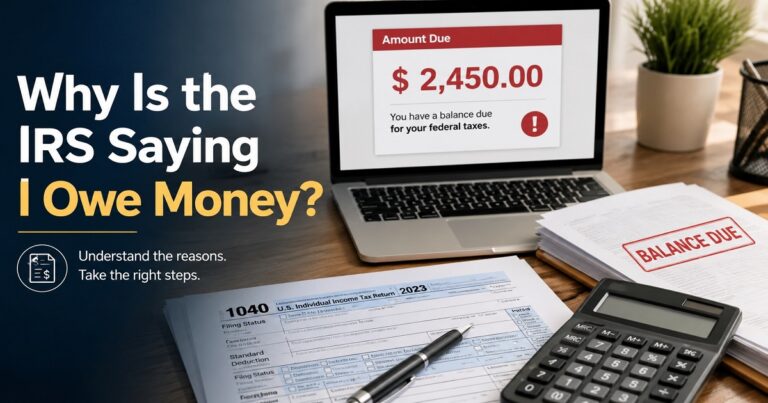
Why Does IRS Say I Owe Money? (IRS Notice Explained)
When the IRS indicates that you owe, it is likely that they’ve done an audit on your return and payment records, but not necessarily an error.
Common Reasons IRS Claims You Owe Taxes
Filing Errors or Missing Income
Mistakes or unreported income (such as a 1099) can add to your taxable income.
IRS Errors in Tax Bill
However, in rare instances, the IRS may make a calculation error or mismatching data may cause the incorrect balance.
Underreported Income
The IRS may revise your return if there are discrepancies between third-party records and your return, and issue you a bill.
Changes After Audit vs Tax Bill Difference
Adjustments can occur as a result of an audit/review—this is why your balance does not match your original return.
Explanation of IRS Notice CP14 Meaning
The first official notice that will appear on your screen that tells you about your balance due, including taxes, penalties and interest is a CP14.
How to Read IRS Notice Correctly
Review the notice number, amount that is required to be paid, the reason for the change and the date of payment.
Understanding IRS Interest and Penalties Explained
Daily interest is charged on unpaid taxes and penalties are levied for late payment or filing, further adding to the total balance.
👉 Takeaway
The majority of the IRS balance due notices are indications of correctable problems; resolve and respond to them in a timely manner to avoid larger issues.
Step 1 – Verify IRS Tax Bill (Avoid Costly IRS Mistakes)
Don’t pay anything to the Internal Revenue Service without first checking the accuracy of the tax bills. Checking is one of the major and expensive IRS errors.
How to Verify IRS Tax Bill
1. Use IRS Account Transcript Check
Log in to your IRS account, and check your transcript. It displays the income, payments, adjustments and the precise cause of the balance.
2. Check for IRS Errors in Tax Bill
Match up your tax return with a record from the IRS. Check for missing payments, incorrect income or calculation differences.
3. What to Do If IRS Says I Owe Money but I Already Paid
Verify your payment record (bank statements, receipts). Sometimes there is a delay in payment, or payment is misapplied – this can be rectified.
4. How to Dispute IRS Balance
If you discover an error, reply to the notice with proof or ask to have it corrected. If necessary, you can file an amended return.
👉 Critical Tip
Always verify before you pay. If a quick review is done, one can avoid over-payment and rectify mistakes before they turn into larger financial issues.
Step 2 – How to Respond to IRS Debt Notice
Don’t ignore a letter from the Internal Revenue Service stating that you are in debt to the IRS. Penalties and stress can be avoided by knowing what to do when you receive IRS notice I owe taxes.
Steps to Take If IRS Says You Owe Money
1. Read Notice Carefully
Look at the notice number, reason for the balance and due date. This gives you a heads up at what the problem is.
2. Confirm the Amount
Check with your tax return and tax payment records to make sure you have the correct number from the IRS.
3. Respond Before Deadline
To prevent extra penalties or automatic adjustments, always respond within the time period specified (typically within 20-30 days).
4. Keep Documentation
Keep a copy of your notice, responses and any supporting documents for future reference.
👉 Tips to Handle IRS Notice Effectively
Be calm, take steps at a time, and answer clearly, providing full information. The secret of solving IRS problems quickly is swift and correct reaction.
Step 3 – IRS Payment Options Explained
You may not be required to pay all money you owe to the Internal Revenue Service. There are ways to get your debt under control.
IRS Payment Plans
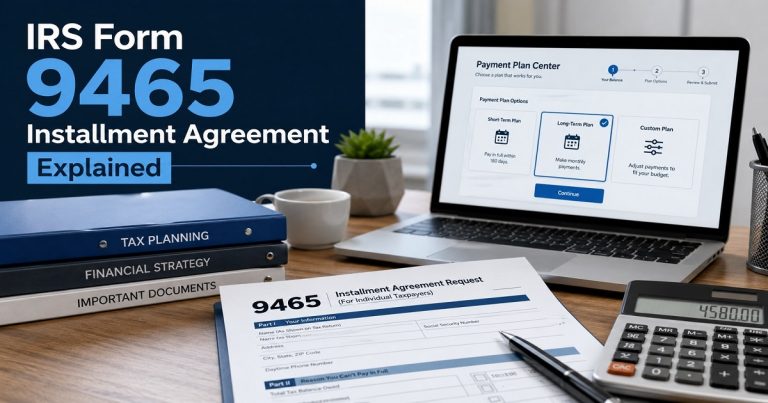
IRS Installment Agreement Plan
Gives you the option to pay your debt in installments rather than in a single payment.
- IRS Month-to-Month Installment Payment Plan
- Make fixed monthly payments that are affordable.
IRS Online Payment Agreement
The application process is quick and easy online and is approved in many instances.
Pay IRS in Installments
Ideal for taxpayers who are unable to pay in full up front, but do not want to face enforcement action.
Plan Types
IRS Short-Term Payment Plan
- Pay within 180 days
- No set up fee; however, the interest will be applied.
IRS Long-Term Payment Plan
To calculate the monthly payments for a long period of time.
May charge set up fees
Best IRS Payment Plan for Small Income
Reduced fees and/or more flexible terms may be available for low-income taxpayers.
Costs
- The IRS charges an interest rate of 25% which is the maximum interest rate.
- Taxes not paid will accumulate interest, daily until balance is paid.
- The IRS will impose penalties if you do not pay your taxes.
- Late payment charges are calculated monthly and will add up to your debt.
Good to know: By setting up a payment plan early you are less likely to experience an aggressive collection approach, have financial stress, or fall out of compliance while managing your finances.
Step 4 – IRS Tax Debt Relief Programs
The Internal Revenue Service (IRS) provides a number of relief measures if you are unable to pay your full balance. These are the legal tax resolution solutions that IRS will decrease or hold your debt back.
✔️ IRS Offer in Compromise (OIC)
IRS offer in compromise eligibility lets you pay less than the amount of tax you owe if you have financial hardship and are unable to pay your tax debt.
✔️ IRS Tax Forgiveness Program
Uses words such as ‘OIC’ or ‘penalty relief’ in reference to a programme that lowers what you owe depending on your situation.
✔️ IRS Penalty Abatement Request
It is possible to have penalties removed for good reasons (illness, financial hardship or first penalty relief), which will reduce the total balance.
✔️ IRS Hardship Program
You might be eligible for temporary relief if you don’t pay taxes before you can pay for essential living needs.
✔️ Currently Not Collectible (CNC) Status
This status is put in place by the IRS so that they halt the collection because you can’t afford to pay them at the moment.
Key Insight
They are not automatic; there is a financial requirement to secure these programs.
What Happens If You Ignore IRS Notice?
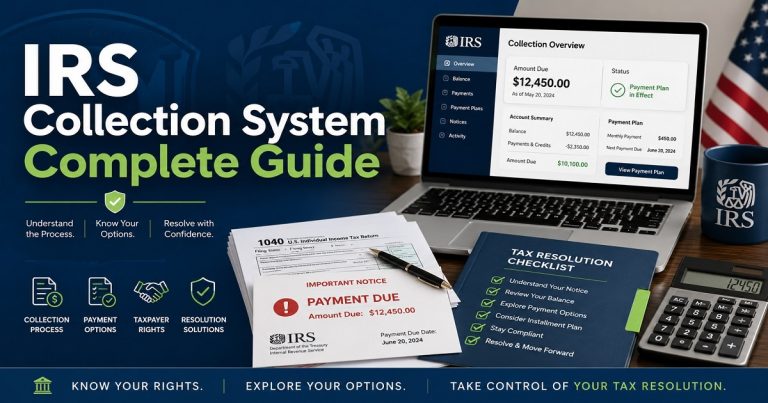
One notice from the Internal Revenue Service can go a long way to creating a major financial problem. The IRS has a very specific collection process timeline and is more aggressive with each step if it doesn’t act.
Consequences of Owing IRS Money
IRS Threatening Collections
The IRS follows up on initial letters (such as CP14) with letters alerting taxpayers to unpaid taxes and potential enforcement action.
IRS Collection Process Timeline
- Bill (balance due notice) that will be issued initially.
- Reminder notices
- Final notice to make the collection
- Enforcement actions begin
IRS Wage Garnishment Rules
If the debt has not been paid, the IRS may legally withhold some of your paycheck from your employer.
IRS Bank Levy Notice
Your bank account can be frozen and your funds may be placed in the IRS’ custody to pay your tax debt following proper notice.
What Happens If You Ignore IRS Debt Notice?
Penalties and interest keep compounding, your financial accounts could be impacted and collection efforts can quickly accelerate.
Warning
If there’s a reason to suspect IRS notices are wrong, the agency typically gives several opportunities to respond before it acts, but that protection is removed if you ignore IRS notices. It’s always the best – and safest – time to act is now.
Step-by-Step IRS Debt Solution (Action Plan)
If you have debt with the IRS, there is a plan you can follow that will ease your financial burden and resolve the situation in a timely fashion.
Step-by-Step IRS Debt Solution
1. Verify IRS Notice
First, carefully read your notice. Double check and verify the balance reason and look for any discrepancies before action.
2. Calculate Real Balance
To check how your tax return, payments and records match IRS records to see how much more you may owe.
3. Choose Best Way to Pay IRS Debt
The third option is for you to pay your IRS debts the best way you can.
Whether to pay in full or make payments over a period of time as you can afford.
4. Negotiate with IRS Payment
If you are unable to pay in full, you may want to make a plan to pay or make a settlement offer.
5. Apply for Relief Programs
See and discuss other possibilities such as Offer in Compromise, penalty abatement or hardship status to decrease your debt in a legal way.
6. Stop Penalties and Interest
Do it promptly – You don’t want to pay or make a plan too late, as this can lead to extra fees.
👉 Key Insight
IRS debt resolution is best achieved by taking action quickly and the correct approach.
Real-Life Example (Personal Experience)
Case Example
The Internal Revenue Service sent a $8,500 payment due notice to Ahmed. He was, like many taxpayers, initially in panic and even thought about ignoring the notice.
👉 What he did
- Obtained an IRS Account Transcript
- He checked his transcript to find out why the balance is given.
- Found Reporting Error
- He found some discrepancy in the reported income that led to an increase in his taxable income.
- Fill out Dispute IRS Balance.
- Ahmed submitted all the supporting documents to correct the error.
- Create a monthly payment plan with IRS.
- The rest he paid in a very reasonable installment plan.
👉 Result
- Ahmed acted promptly and appropriately to mitigate his liability by 30% and any further penalties.
- The message for this lesson is that you should never panic or ignore IRS notices, but instead verify, correct and take action.
Real Case Study (Legal Insight)
Case Study: Offer in Compromise Success
The taxpayer had $25,000 owed to the Internal Revenue Service, and didn’t have the money to pay because of hardship. They assessed their income, expenses and assets, and determined they met the IRS hardship requirements.
👉 What they did:
- Financial statements (income and expenses, assets, etc.)
- Filed a tax offer with the IRS (Offer in Compromise or OIC)
- A proven record of failure to pay all amounts due on the loan.
👉 Result
The IRS took the deal and the taxpayer paid the $25,000 IRC debt for $6,500.
👉 Insight
This case illustrates how IRS debt relief really works. If you’re facing hardship and the IRS sets the eligibility criteria, you might be able to submit an appeal for a smaller amount.
Common Mistakes to Avoid
With the Internal Revenue Service and its tax debt, small errors can result in significant financial troubles. Don’t make these mistakes:
Ignoring IRS Notice
Inaction may result in penalties, interest and collection activities. Demonstrate promptness in response.
Not Verifying IRS Tax Bill
Always check your transcript and records.
Missing Deadlines
- Late submissions may be adjusted or subject to extra fees.
- When you pick the wrong IRS payment plan, it can lead to additional problems.
- You may end up defaulting on your plan and incur additional penalties if you choose a plan you cannot afford. Select an option that you believe you can achieve.
Not Applying for IRS Debt Settlement Options
There are certain programs available that can lower your burden and they are called an Offer in Compromise or hardship status, but there is a problem, you have to apply for it.
Failing to Request Penalty Abatement
You may be able to do more than just remove penalties, if you meet the requirements you also can reduce the total balance.
👉 Pro Tip
Smart tax payers check, act in time and avail all options to the best to reduce debt to the IRS and avoid costly errors.
Pro Tips (Expert IRS Advice)
If you are involved in a transaction with the Internal Revenue Service regarding a tax problem, you should take the time to make the smart choice to save time, money, and stress.
Always Respond Early
Minimize penalties, interest and escalation by acting quickly. The faster you respond, the more choices you have!
Keep Written Records
Keep records of notices, payments and letters, etc. If problems do occur, documentation will be your best defence.
Use Smart IRS Payment Tips
Make sure to pick a payment option that suits your budget either as a lump sum or with installments so that you don’t default.
Seek Professional Help If Needed
A tax professional can help you and maximize your benefit when the issues are complex (audit, hefty debt, dispute).
Focus on Resolving IRS Tax Balance Quickly
Time delays only add to costs. By making an informed decision on how to respond immediately, you will get back on track closer to the quickest.
👉 Expert Insight
Early response, accurate records and the correct strategy is the quickest road to IRS tax debt resolution success.
FAQs
1. Why does IRS say I owe money?
Typically because of filing mistakes, underreporting or because of changes that happen after the IRS has reviewed your return.
2. What should I do if I owe IRS money?
Check the bill, look at the records, answer the notice and select the most effective method for paying/relief.
3. Can I negotiate with IRS?
Yes, you can pay it off in installment plans or programs such as Offer in Compromise.
4. What happens if I don’t pay IRS?
Penalties, higher interest, wage garnishment or bank levies may be imposed.
5. Does IRS offer payment plans?
Yes, just like it is possible to have a short-term or long-term IRS installment agreement, it is possible to have one depending on your financial condition.
6. Can IRS reduce my tax debt?
Yes, by tax relief programs like penalty abatement or settlement programs.
7. How long do I have to pay IRS debt?
It can be as early as possible or as late as the notice, generally the sooner the better to prevent any additional charges.
8. How to check IRS balance?
You can do this by looking it up in your IRS online account or by looking on your IRS account transcript.
Conclusion
Receiving a notification from the Internal Revenue Service for a balance due is daunting, but it’s certainly doable with the right steps. Most problems are verifications, options and action in time.
When you take a thorough look at your tax bill, select the appropriate IRS payment method, and explore IRS debt solutions such as installment plans or relief, you can lessen the stress and take full control over your finances.
👉 Take Action Today
Don’t ignore the notice, respond in a timely manner and take steps to fix the problem, all while taking smart steps to safeguard your financial future.