Tax Basics & Filing in USA: Complete IRS Guide For Beginners
ThFrom the standpoint of Advocate Shahid (Tax Strategy and Advisory Specialist) describes the Tax Basics & Filing in USA. When filing U.S. taxes, you will have to inform the government about your annual income using the 1040 form. April 15th is the Federal tax deadline. Majority of income, such as wages, investments, and tips, are subject to taxes. When you are employed, your employer will automatically deduct taxes from your salary.
Knowing the Basics of a Few Initial Steps
1. Key Documents
- Form W-2
- Form 1099
- Form 1040
2. Tax Deadlines
- Filing Deadline
- Extensions
3. How to File
- Free Online Filing
- Paid Software
- By Mail
4. Important Concepts to Know
- Filing Status
- Standard vs. Itemized Deductions
- Tax Brackets
Tax Basics & Filing in USA
That’s actually the search term: Tax Basics & Filling in USA, but Tax Basics & Filling in USA is a popular search term. Most Americans fill out IRS Form 1040 to report income, claim deductions, claim tax credits, calculate their taxable income and to get money back from taxes withheld from their paycheck, or to pay their taxes.
In an announcement, the IRS announced that it would extend the tax filing deadline for 2025 individuals federal tax returns to April 15, 2026 for most taxpayers. If you can’t pay all at one time, filing is still important as the penalties for filing late may be greater than for payment delays.
What Is a Tax Return in the USA?
Simple Definition of a Tax Return
A tax return is a form that is submitted to the IRS that details one’s earnings. It includes information on wages, income from a freelance (business income), deductions, credits, withholding and payments. After IRS processing of the return, it will be one of 2 items: refund or balance due.
What Is Form 1040?
IRS form 1040 is the primary tax form that is utilized by the majority of U.S. taxpayers. It might include other schedules such as Schedule A (Itemized deductions), Schedule C (Self-employment income), Schedule D (Capital gains) or Schedule SE
Federal vs State Taxes
Special taxes imposed by the federal government go to the Internal Revenue Service (IRS). State income taxes (if applicable) goes to a State tax agency. For instance, a Texas taxpayer may prepare a federal return, but generally they don’t have a state income tax return to prepare, while a California taxpayer may be required to prepare both federal and state income tax returns.
Who Needs to File Taxes in the USA?
IRS Filing Requirements Explained
The people who must file taxes in USA depend on their income, marital status, age, dependency and income type. It may also be a good idea to file, even if the individual does not have to file, because federal withholding was deducted from their paychecks or because they may be eligible for a “refundable tax credit.
Tax Year vs Filing Year
A tax year is the tax year in which the income is earned. A filing year is the year in which you file the return. The bulk of federal income tax returns are filed in 2026 for 2025 tax year.
Documents Needed to File Taxes in the USA
Basic Tax Filing Checklist
Your name, Social Security number or ITIN, date of birth, filing status, details of dependents, previous year’s AGI, bank routing and account number and your IRS Online Account (if applicable) are all part of a good tax preparation checklist.
Income Documents: W-2, 1099, Schedule C
This is a W-2 tax form, which will report employee wages. Tax form 1099: a simple tax explanation of the 1099 tax form, which reports income from sources other than traditional employment, including income earned from platforms or freelance income, which is being reported on 1099-NEC tax forms. Schedule C is typically the form that self-employed taxpayers will use to report their business income and expenses.
Deduction and Credit Documents
Save mortgage interest, student loan interest, charitable contributions, medical expenses, education expenses, child and dependent care, retirement contributions and energy credit (if applicable). These records can be used to answer these questions: What deductions can I take and what tax credits am I eligible for?
How Taxes Work in the USA
Gross Income vs Taxable Income
Gross income is the amount of income prior to making adjustments. The key word is “adjusted” and “adjustments” is a word description of adjusted gross income. Some tax credits or deductions are available based on modified adjusted gross income. Taxable income is the amount of income after deductions, which is the income that is subject to the federal tax.
Tax Brackets and Tax Rates
The U.S. income tax is progressive in nature. There will not be one single tax rate for any income in a tax bracket. Marginal tax rates are used to determine your next dollar of tax, effective tax rates apply to your actual tax.
Withholding and Estimated Taxes
Typically employees are paid via federal withholding. Freelancer, the self-employed and investors may have to pay taxes on a quarterly basis. The Internal Revenue Service (IRS) has a Tax Withholding Estimator and online tools to help taxpayers adjust withholding and/or make estimated payments.
Choosing the Right Filing Status
Filing Status Explained
There are five types of statuses: single, married filing jointly, married filing separately, head of household and qualifying surviving spouse. The filing status impacts on tax rates, standard deduction, tax credits and the amount of tax refunds.
Common Filing Status Mistakes
Common errors are when a person claims head of household when they have not satisfied one or more of the requirements, when they file separately without understanding the tax consequences, and when a person claims a dependent who was already claimed by another person. To avoid e-file rejection help situations, duplicate dependent claim IRS occurs often.
Standard Deduction, Itemized Deductions, and Tax Credits
Standard Deduction Explained
The standard deduction is taken by many taxpayers because they find it easier and don’t have to itemize expenses.
Itemized Deductions Explained
If the standard deduction is less than the itemized deductions, they could be beneficial. Some examples of these are mortgage interest, qualifying taxes, charitable giving, and some medical expenses.
Tax Credits vs Tax Deductions
The Tax deductions lower taxpayers’ income subject to tax. Tax credits are an exemption from taxes. While a $1,000 deduction will decrease taxable income, a $1,000 credit can decrease taxable income by $1,000. Refunds can be issued based on refundable credits if there is no tax liability.
How to File Taxes Step-by-Step in the USA
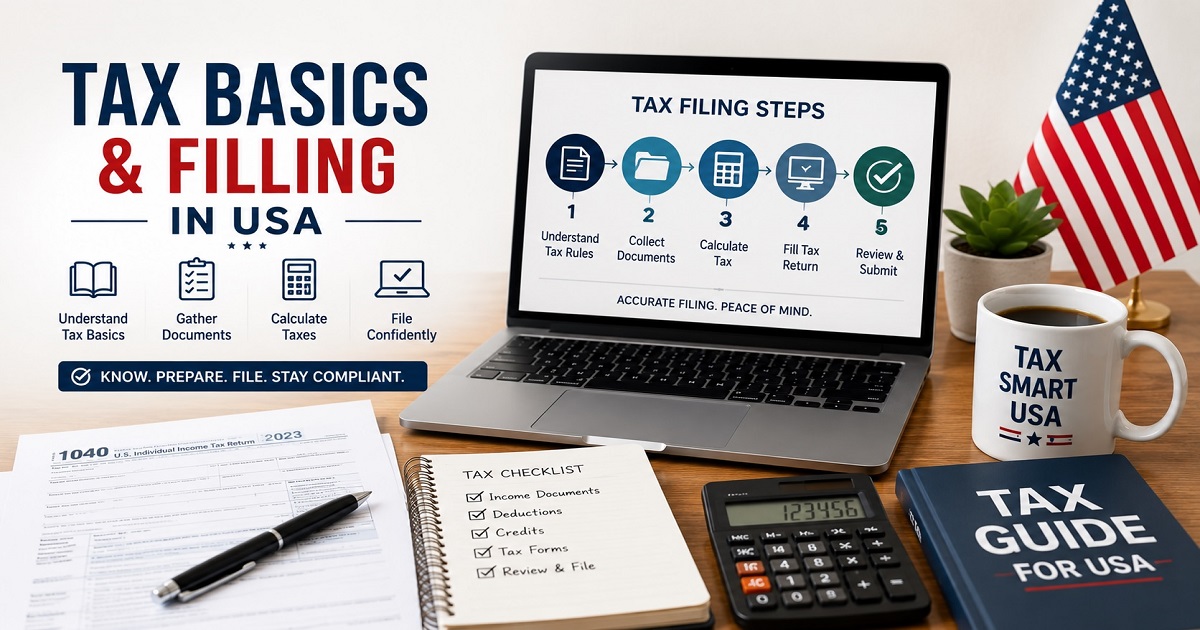
1. Check If You Need to File
Talk about IRS filing requirements, income, filing status, age, and being claimed as a dependent.
2. Gather Your Documents
Obtain W-2s, 1099s, previous year’s AGI, dependent information, deduction records, credit records and bank information.
3. Choose a Filing Method
This can be IRS Free File, tax software, electronic filing, paper filing, tax preparation services USA or professional tax preparer. IRS Free File or IRS e-file taxes USA options can be beneficial in the case of simple returns.
4. Complete Form 1040 and Schedules
Read the instructions for and complete Form 1040, making sure to provide all necessary IRS tax forms or schedules.
5. Review Before Filing
Look for the name, SSN, bank account details, income information, filing status, dependents, signature and previous year AGI. These tax return accuracy rules aid to ensure that tax returns do not get rejected or that there are no issues with the AGI on tax returns.
6. Submit and Save Records
Keep a copy of the return, e-file confirmation, payment confirmation, tax transcript, return transcript, wage and income transcript and IRS account transcript.
First-Time Filers, Freelancers, and Self-Employed Taxpayers
First-Time Filing Taxes in the USA
New filers should obtain income tax documents and determine their filing status, confirm dependents, file electronically if possible, and retain copies of all documents filed. This is an approach to tax filing for beginners, students, new workers and immigrants who may have tax filings in the United States.
Filing Taxes Without a W-2
If a W-2 is not received or incorrect, contact the employer (not IRS). An amended tax return might be required if you didn’t receive W-2 on your tax return or forgot 1099 on tax return, or you may be required to respond to a CP2000 notice later.
Self-Employment and Freelancer Taxes
Freelancer Taxes are different as clients are not necessarily withholding tax. A 1099-NEC income freelance designer can be required to file income on Schedule C, claim qualifying business expenses, pay self-employment tax and pay estimated tax payments. This is particularly important when it comes to 1099 compliance support as well as self employment tax compliance.
Refunds, IRS Refund Status, and Refund Delays
How Tax Refunds Work
Typically a tax refund involves withholding or estimated tax overpayment or the benefit of eligible refundable tax credits.
How to Check Refund Status
Where’s My Refund, IRS2Go and IRS Online Account are tools taxpayers can use to find out the status of their IRS refund. According to the IRS, the tools to determine refund status will need information like the SSN or ITIN, filing status and refund amount. (IRS)
Why Refunds Get Delayed
IRS refund delayed problems can consist of mis-entered SSNs, lack of income forms, identity verification, paper filing, refund offset, kid tax credit audit, amended return delay, or tax return processing delay.
What If You Owe the IRS Money?
File Even If You Cannot Pay
Do not ignore IRS’s return if it indicates that I owe money. Failure-to-file exposure can be minimised even if payment options for taxes are required, if they are filed on time.
IRS Payment Options
The IRS has tax payment plan options for taxpayers, including Direct Pay, IRS Online Account, a short-term payment plan, long-term installment agreement, debit or credit card payments (with processing fees), and more. You can pay your taxes to the IRS Direct Pay at no cost with your bank account.
IRS Payment Plan Costs
If there’s a significant IRS payment plan deficit, some IRS payment plan assistance may be required. The IRS website payment plan setup fees are $0 for some short-term payment plans, $22 for some long-term payment plans that require direct debit, and $69 for some long-term plans online (non-direct-debit plans). Penalties and interest are still applied until the payment plans are paid in full.
IRS Notices, Letters, and Common Tax Problems
Why Did I Get an IRS Notice?
IRS notice/letter can be a balance due notice/letter, missing income notice/letter, refund adjustment notice/letter, identity verification, dependent issue, audit notice, or collection notice.
Common IRS Notices to Know
Some of the common notices include CP14 notice help for balance due, CP2000 notice help for underreported income IRS issues, CP12 refund adjustment, CP504 levy warning, IRS letter 5071C help for identity verification and IRS audit notice concerns.
How to Respond to an IRS Letter
Read the notice and ensure that the tax year is correct, take it apart, keep an eye on the deadline, send documents to dispute, pay or seek relief if you agree. Professional Irs Notices & Problems support may be suitable for audits, large balances, liens, levies or if there is a fraud issue.
IRS Penalties, Interest, and Penalty Relief
Failure to file, failure to pay, underpayment of estimated tax, accuracy-related penalty and civil tax penalty are common types of penalties that the IRS will apply. Common IRS penalties include failure to file, failure to pay, underpayment of estimated tax, accuracy-related penalty and civil tax penalties in serious cases. The IRS says the failure-to-pay penalty is normally 0.5% of the taxes that are not paid for each month or portion of a month, but not to surpass a quarter of the unpaid taxes.
There are two types of penalty abatement: first time penalty abatement and reasonable cause relief. United States v. Boyle is often cited, however, for the proposition that no reliance on another can be a basis for excuse of improper filing timeliness.
How to Fix Common Tax Filing Errors
The most common reasons for e-file rejection by IRS are: Wrong prior year AGI, Wrong Social Security number tax return, Name mismatch IRS return, Dependant claimed by another or Incorrect PIN. A tax return may need to be amended or IRS correspondence may be responded to if one has not filed 1099 income or reported incorrect income, missed tax deductions or missed tax credits.
Back Taxes, Prior-Year Returns, and Tax Debt Relief
Back taxes can help USA usually is unpaid or unfiled prior year’s taxes. To file back taxes, obtain wage and income transcripts, gather missing records, file taxes year by year, follow IRS guidelines for filing and keep copies.
An installment agreement, offer in compromise, Innocent spouse relief and currently not collectible status are some of the tax debt relief programs. The Tax Relief & IRS Solutions can be beneficial in the event of IRS wage garnishment help, IRS bank levy help, IRS tax lien help or IRS tax debt settlement.
Tax Compliance and Legal Risk
The Tax mistakes and not tax fraud. It’s possible to correct errors that are done honestly. It is a risky situation if they deliberately conceal, make false documents, or evade. The failure to file or pay additions to tax, failure to furnish information, and tax evasion problems generally are thought of in conjunction with IRC § 6651, IRC § 7200, and IRC § 7203.
The Supreme Court in Cheek v. United States, explained that willfulness in tax crimes is a “deliberate failure to adhere to a clear obligation of the law. The Court drew this distinction between evasion and passive nonfiling in Spies v. United States.
Official IRS Portals and Tools
The IRS Online Account, IRS Free File, Where’s My Refund, Where’s My Amended Return, IRS Direct Pay, IRS Online Payment Agreement, IRS OIC pre qualifier and the Tax Withholding Estimator are useful IRS tools that you can use. Avoid calling the IRS to resolve any of their issues; if you have an audit risk, a missing income, a tax lien, a tax levy, a tax fraud risk or a big balance, seek professional tax filing help, tax consultant USA or a tax lawyer.
Common Mistakes to Avoid
NEVER: File early, ignore IRS notices, assume extension is extension of time to pay, claim incorrect dependents, not report freelance/gig income, not report using correct filing status, not pay estimated taxes, under-pay estimated taxes or not keep records. Topics of particular interest to owners, contractors and those who are working on a side business are Small Business Taxes, Tax Planning & Deductions.
Real-Life Tax Filing Situations
A person who previously only worked on a W-2 basis can file electronically, and get a refund because he or she had overpaid taxes. A 1099 form may be issued to a freelancer more than once, he/she can report their income on Schedule C and be liable for self-employment tax. If a taxpayer receives a CP2000, his/her job is to compare the CP2000 with records and respond prior to the deadline. The tax payer who should be in debt yet unable to pay should file on time, pay as much as they are able and also request an IRS installment contract.
Need Help Filing Taxes or Solving an IRS Problem?
When you are not sure how to fill out Form 1040, if you don’t have all the tax paperwork, or if you have received a letter from the IRS concerning an issue, taxes, penalties or back taxes or a tax payment plan, professional help is available. You can categorize resources that are related in the following sections: Smart Tax Guides, Tax Basics & Filling, Freelancer Taxes, Small Business Taxes, Tax Planning & Deductions, Irs Notices & Problems, and Tax Relief & IRS Solutions
FAQs About Tax Basics & Filing in USA
1. What are the basics of filing taxes in the USA?
The majority of taxpayers report their income, claim their deductions and/or credits, figure out what tax is due, whether it’s due or due back, and file Form 1040 with the IRS.
2. How do I file taxes in the USA for the first time?
Collect W2s and/or 1099s, determine filing status, claim deductions/credits, submit electronically if available, and keep copies.
3. Who has to file a tax return in the USA?
Filing is dependent on income, filing status, age, dependency status and income type.
4. What documents do I need to file taxes?
These documents are typically W-2s, 1099s, Social Security numbers, dependent information, deduction records, previous year AGI and bank information.
5. What happens if I file taxes late?
Failure to file penalties, failure to pay penalties and interest may be imposed. The sooner the filing will help to minimize cost.
6. What if I cannot pay the IRS in full?
Deal with your return and consider paying the whole amount, arrange to pay in installments, pay over a period of time, and/or pursue tax debt reduction.
7. When should I hire a tax lawyer?
If you have an IRS audit, tax debt, unfiled tax returns, liens, levies, disputes with CP2000s, issues with the Tax Court, or you have any other tax fraud issues, you should have a tax attorney represent you.
Conclusion
Tax Basics & Filing in USA is about determining if you have to submit, collecting the necessary documentation, reporting all income, claiming the proper deductions and credits, submitting timely and promptly addressing IRS problems. Proper records, due diligence and action can avoid many costly tax issues.