Freelancer Taxes in USA: Complete IRS Guide For 1099 Workers
In the perspective of Advocate Shahid (Tax Compliance and Advisory Specialist). Freelance Workers in the U.S. are people who are self-employed in the trade of a business. Income Tax (10% – 37% depending on tax bracket) is due, as is the Self-Employment Tax (15.3% to include Social Security and Medicare). Those who earn over $400 a year are required to file.
Freelancer Taxes in USA (Key Taxes to Pay)
- Income Tax
- Self-Employment (SE) Tax
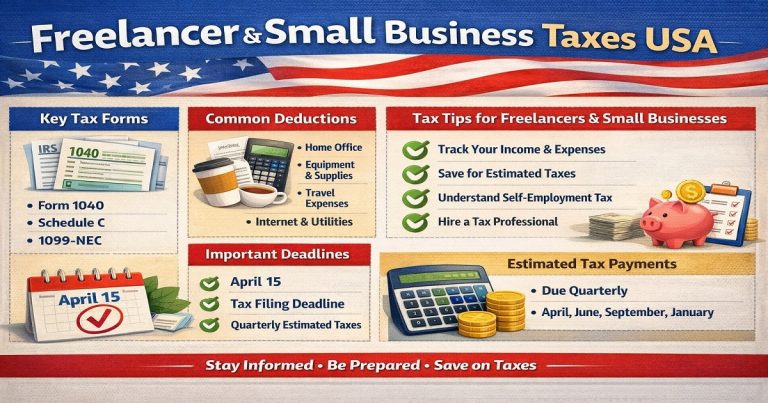
Quarterly Estimated Taxes
- April 15
- June 15
- September 15
- January 15 (of the following year)
Essential Tax Forms
- Form 1099-NEC / 1099-K
- Schedule C
- Schedule SE
Common Tax Deductions
- Home Office
- Equipment & Software
- Marketing & Education
- Health Insurance
How Freelancer Taxes Work in the USA
The tax-friendly procedure of freelancer taxes is quite distinct from the one used by employees. The federal income tax, Social Security tax, Medicare tax, and possibly state tax typically are withheld from your paycheck when you work as a employee. You will be issued a W-2 at the end of the year.
Do Freelancers Pay Taxes in the USA?
Yes. In the USA freelancers have to report their freelance income as taxable. This includes income from clients, online platforms, payment apps, cash payments, side hustle income, consulting projects, writing, design, development, marketing, coaching and delivery income and other income earned through gig economy.
Freelancer vs Employee Tax Difference
There are few differences between freelancers and employees other than responsibility.
- Tracking freelance income reporting
- Keeping freelance income documentation
- Paying quarterly estimated taxes when required
- Claiming deductions on Schedule C
- Calculating self-employment tax on Schedule SE
- Filing a federal income tax return
- Paying state taxes where applicable
Income Tax vs Self-Employment Tax
First of all, income tax. This is based on adjusted gross taxable income, after deductions, credits and other tax rules, are applied.
The other is self-employment tax. Self employment tax for freelancers includes the taxes for Social Security and Medicare. These taxes are paid in addition to various other taxes, and are paid by the employee, but for freelance workers the taxes are usually paid by the self-employed version, since they are self-employed.
Why Freelancers Pay Social Security and Medicare Taxes
Self-employment tax is used to pay Freelancers Social Security and Medicare taxes. This will help to pay for future Social Security and Medicare benefits. In a nutshell, Schedule SE self-employment tax is applied to the net earnings from self-employment in order to determine this amount.
To freelance, “net income” typically refers to freelance income in excess of deductible business expenses. That’s why, in bookkeeping for freelancer, it’s important to have proper bookkeeping. Without accurate bookkeeping, it’s possible that you could be underreporting your profits, and overreporting your taxes.
What Income Freelancers Must Report
There are numerous sources of income that freelancers have to report. Taxable income is determined based on income, not just those forms received, IRS views it that way.
This includes direct payments, platform payments, digital wallet payments, cash payments, side jobs and independent contractor income. It also may include receipt of payments by the freelancer from foreign clients where the freelancer is also a U.S. taxpayer.
1099-NEC Income From Clients
Form 1099-NEC is the standard form that is used to report nonemployee compensation. A freelancer that was paid for services by a client during the tax year, may be given Form 1099-NEC by that client.
An example is that a marketing consultant can work for three clients in the United States and each client could get the consultant’s 1099-NEC reporting the amount paid. The freelancer should check the forms to see if there are any discrepancies. In the event the 1099 amount incorrectly, the freelancer needs to call the payer and ask to submit a corrected 1099.
1099-K Freelance Income from PayPal, Stripe, Venmo, Upwork, and Fiverr
Form 1099-K can include payments made via third party payment networks, or platforms. Depending on reporting rules and thresholds, freelancers who are paid via Paypal, Stripe, Venmo business payments, Upwork or other platforms may be paid this way.
Cash, Digital Payments, Foreign Clients, and Side Hustle Income
There are no restrictions on the kinds of forms that need to be used when earning a living as a freelancer. The freelancer can be required to report on:
- Cash payments
- Bank transfers
- Checks
- PayPal payments
- Stripe payments
- You can make Venmo or Cash App Business payments.
- Upwork income
- Fiverr income
- Foreign client payments
- Referral fees
- Consulting payments
- Side hustle income
For example, a freelance writer who is hired by U.S. clients for $3,000, a foreign client for $2,000 and a site for $1,500 would have a total of $6,500. If the freelancer receives just one form, he must still report the income earned properly as freelance income.
What if a freelancer did not receive a 1099?
In the event that a freelancer doesn’t get a 1099, they ought to at any rate file tax returns and report the pay. The IRS does not consider “no form received” to be a good justification to withhold income from a return.
The answer is to make your own records. These may include:
- Invoices
- Client contracts
- Payment app reports
- Bank statements
- Platform earnings reports
- Bookkeeping software summaries
- Email payment confirmations
IRS Tax Forms Freelancers Usually Need
Once you know the primary tax forms it will be much easier to file taxes as a freelancer. Not all of the forms listed below will be used by every freelancer, but those who are self-employed will likely see some of the following forms.
Form 1040: Federal Income Tax Return
The primary federal income tax form for individuals is form 1040. It is used by freelancers to report the total income, deductions, credits, tax and payments.
For freelance businesses, the income from the business typically is reported on Form 1040, Schedule C and Schedule SE. Other items listed on the return may include your wage income, investment income and other tax items.
Schedule C: Report Freelance Profit or Loss
Many sole traders and freelance self-employed people use Schedule C to record their income and expenditure from their businesses. A freelancer who works as an individual business entity reports gross receipts, deductions related to business expenses and net profit or loss from freelance work on a Schedule C.
Schedule SE: Calculate Self-Employment Tax
Schedule SE is used to calculate self-employment tax. That’s important because freelancers typically aren’t employed by an employer that will withhold Social Security and Medicare tax.
Schedule SE may be used if you have net earnings from self-employment from your freelance work. One of the many mistakes freelance writers make when they file taxes on their own or without the assistance of professionals is forgetting to file Schedule SE.
Form 1099-NEC: Client Payments
The nonemployee compensation is reported on Form 1099-NEC. It is usually forwarded by freelancers to clients from whom they have been paid for their work.
If filled out properly, keep it in your tax records. If you receive an incorrect amount, get in touch with the client immediately and ask them for a new form. Be sure not to disregard a 1099 even if it is incorrect; if it is not, chances are it will cause questions from the IRS at a later time.
Form 1099-K: Payment App or Platform Income
Payment platforms and payment processors can report payments on Form 1099-K.
The freelancer should inform the issuer and ask for a correction, if the Form 1099-K is incorrect. Maintain good books, noting the income which was business and the income which was not.
Form 1040-ES: Estimated Tax Payments
Estimated taxes are figured and paid using Form 1040-ES. It’s used by freelancers who anticipate that they will be liable for tax but don’t have sufficient withholding.
Quarterly estimated taxes are particularly crucial for full-time freelancers and consultants, gig workers, and people with a high level of income from a side hustle.
How to File Freelancer Taxes in USA Step by Step
If pursued via a clean process it does not have to be difficult to file freelancer taxes.
1: Collect Income Records
First of all, gather in all records of the freelance income. This consists of 1099-NEC forms, 1099-K forms, invoices, bank deposits, platform reports, PayPal or Stripe reports and client payment records.
2: Collect Expense Receipts
Then gather receipts of business expenditures. They can be software, internet service, phone, laptop, office supplies, advertising, mileage, travel, bookkeeping or legal fees and fees for freelancer tax preparation services.
3: Separate Personal and Business Expenses
A very common freelancing tax error is meshing personal and business expenditures. Have a different business bank account or system for tracking finances.
For instance, if you use the same computer for your business and personal work, only the business time can be deductible. Claiming 100% business use can be a problem if records are not adequate to substantiate the claim.
4: Calculate Net Profit from Freelance Work
For freelancing, add up all the income from freelancing and then deduct the ordinary and necessary business expenses to get the net profit.
Example:
Gross freelance income: $50,000
Business expenses: $8,000
Net profit: $42,000
5: Claim Deductions on Schedule C
Schedule C is used to claim deductions for freelancers. These deductions can be subtracted from taxable income if they are considered to be ordinary, necessary, documented and related to the freelance business.
Some of the common tax deductions for freelancers include home office deduction, software, Internet, business phone usage, equipment, office supplies, professional services, mileage, advertising and business education.
6: Calculate Self-Employment Tax on Schedule SE
Schedule SE is used to calculate self-employment tax, after determining the freelance net profit. Social Security and Medicare taxes are included in this tax.
It’s important to know this as a new freelancer since you could be impacted significantly by self-employment tax for the final tax bill.
7: File federal and state tax returns
Many freelancers complete a federal income tax return, and could possibly require to complete a state income tax return. However, there are different rules in each state, so freelancers should review tax agency directions in their state.
8: Pay tax or set up an IRS payment plan
If due a tax payment, make the payment on time if possible. Even if you can’t pay the entire amount, it’s important that you file the return. An IRS payment plan or installment agreement might be an option.
People who don’t return are likely to be in further trouble. Failure to file will incur penalties, but filing on time, even if not paid in full, will help minimize failure to file penalties.
Quarterly Estimated Taxes for Freelancers
Freelancers might find themselves in the situation of having to pay taxes in the year rather than in April since they typically are not withholding taxes from freelance payments.
In general, IRS uses estimated tax to pay taxes on income that isn’t subject to withholding, such as self-employment income, explains the IRS. If you’re a freelancer, you may use Form 1040-ES to figure out estimated tax and can pay on-line via IRS payment choices.
Do freelancers need to pay quarterly taxes?
Many freelancers do have to estimate their taxes for the quarter, particularly if they think they are going to be liable for taxes when they file their tax return. This is frequently the case for freelance workers, self-employed individuals, consultants, gig workers and anyone who makes a regular income from their side hustle.
For instance, if a freelance web developer makes only $6,000 a month, then he or she should not wait till the tax season to consider taxes. An alternative method is to make an estimate of income, save for taxes on a monthly basis and pay quarterly estimated taxes.
How to estimate tax payments
To estimate quarterly taxes, freelancers should look at:
- Gross freelance income
- Expected business expense deductions
- Net profit from freelance work
- Self-employment tax
- Federal income tax
- State income tax, if applicable
- Any credits or withholding from other jobs
How to pay IRS estimated taxes online
Estimating taxes is a way for freelancers to pay their taxes online through the IRS using IRS Direct Pay, or an IRS online account. If paying by mail they can also use Form 1040-ES vouchers, but online payments are typically more easy to track.
It’s good practice to save the confirmation numbers each time of payment. These provide useful information for making the tax return and can shield the freelancer in case of misrepresentation of payment.
What happens if you miss estimated tax payments?
As a freelancer, do not put off quarterly taxes, since you’ll have to pay them. Pay as soon as possible, give an up-to-date estimate and keep records.
Freelancer Tax Deductions You May Be Able to Claim
There are certain tax deductions for freelancers that can bring down the amount of taxable income, but it must be a legit one. The concept is straightforward: freelancers can reduce their ordinary and necessary expenses associated with their freelance business.
An expense that you might expect to see in your line of work. A needful expense is beneficial and suitable to your labors. This does not mean that the expense has to be an actual requirement of the business, but that it does serve a real business purpose.
Home office deduction
If a freelancer has a portion of their home that they use it regularly and exclusively for business, then they may be allowed to use that as the home office deduction. For instance, a freelance copy writer whose room is only used by him to write for clients may be eligible.
Internet, phone, and software expenses
Internet, phone service, software subscription, website hosting, cloud storage, design tools, accounting services and communication platforms are some of the tools freelancers use for their work. The portion of the business use may be deductible.
For instance, if an independent contractor uses the Internet 70% for business and 30% for personal purposes, the business use will be the prime factor when determining the amount of deduction. If you state that you were 100% without any substantiation, it may cause issues during an audit.
Laptop, equipment, and office supplies
Equipment or desk items may be deductible when utilized for freelance business, such as a laptop, monitor, camera, printer, chair, desk or other equipment, plus a notebook.
Professional services, tax preparation, and bookkeeping
Any payment of fees to a CPA, tax consultant, bookkeeper or lawyer for business taxes is deductible. A freelancer tax preparation service can be particularly helpful when a freelancer has a number of clients, 1099s, platforms of payment and deductions.
Travel, mileage, advertising, and business tools
Some of these are business-related travel and mileage, advertising expenses, website expenses, business insurance, online courses and professional memberships, as well as tools used to serve clients.
For instance, if a freelance photographer is properly linked to the business, he/she can be allowed to deduct the cost of camera equipment, editing software, travel to the client, website hosting and advertising the portfolio.
What “ordinary and necessary expenses” means
The “ordinary and necessary” part of the definition is significant because not all expenses a freelancer wants is tax deductible. Having freelance income does not make a personal vacation, luxury buy or family meal a business expense.
Real-Life Example: How Freelancer Taxes Are Calculated
Let’s make an example of that.
Example: freelance designer earning $60,000
If a freelance graphic designer makes $60,000 in a year from clients and platforms, what is the average amount each month? What is the average amount of money that the freelance graphic designer receives each month? She gets 2 Form 1099-NEC forms, 1 Form 1099-K and multiple direct deposits to her bank account.
Her income records show:
- Client 1099-NEC income: $32,000
- Platform 1099-K income: $18,000
- Direct client payments: $10,000
- Total gross freelance income: $60,000
Minus business expenses
During the year, she also spends money on tools and services needed for work:
- Design software: $1,200
- Internet business portion: $900
- Laptop and equipment: $2,000
- Website and hosting: $500
- Advertising: $1,000
- Bookkeeping and tax help: $700
- Office supplies: $300
- Total business expenses: $6,600
Net profit calculation
Her estimated net profit is:
- $60,000 gross income
- minus $6,600 business expenses
- equals $53,400 net profit
Self-employment tax and income tax estimate
The freelancer may be liable to self-employment tax on net earnings and regular income taxes based on total taxable income, filing status, tax deductions and credits, and state tax laws.
For most people that percentage is not foolproof, but helps to avoid an unexpected tax bill.
Why saving 25–30% may help many freelancers
If the freelancer is earning $5000 in one month, he might think that he has all that money to spend.
A system that is useful is:
- Use tax funds to pay for all payments
- Keep monthly track of income and expenses
- Make estimated tax payments – quarterly.
- Audits the income again prior to the end of the year
- If income increases, work with a CPA.
Common Freelancer Tax Problems and How to Fix Them
One of the most common problems that freelancers have with tax is due to poor records, missed deadlines, incorrect forms, not paying taxes, or not knowing what 1099 income is.
Freelancer forgot to report income
In the event that a freelancer missed reporting income, it’s the solution is dependent on whether or not the return has been filed. If not filed, be sure to put in the missed income before it is submitted. If the return has already been filed, then the freelancer may have to make amendments to the return.
Freelancer did not receive 1099
A freelancer should still report the income on his or her records if he/she did not get a 1099. You can provide the amount with invoice, payment screen shots, payments into the bank, and platform reports.
Don’t hesitate to file if you are missing a form. The IRS is concerned about proper reporting of income.
Wrong 1099 amount
If the amount on the Form 1099-NEC or 1099-K is incorrect, the freelancer should contact the entity that is issuing the form and ask for a new one. In the case of the Form 1099-K, the IRS indicates that taxpayers should ask a tax issuer to correct the form, and retain records of their communication; but if they cannot obtain a corrected form, they shouldn’t delay filing.
Freelancer missed tax deadline
It’s best to file a tax return with the IRS as soon as possible after the deadline if a freelancer has overlooked the filing deadline. The late filing and late payment penalties can be two separate penalties. The faster you file, the less the damage done will be.
Freelancer paid no estimated taxes
If a freelancer fails to pay any estimated taxes, he or she could be liable for tax along with an underpayment penalty. The solution is to determine the debt, pay it off and begin a quarterly payment plan in the future.
Having a CPA help you pay taxes quarterly can be helpful for those freelancers who have a high income.
Freelancer mixed personal and business expenses
The use of personal and business funds results in a messy record keeping and audit risk. Separating accounts and tidying up records and sorting out expenses are the solutions.
Do not guess. If an expense is business – use a reasonable business – and personal use percentage, and make notes.
Freelancer overclaimed deductions
If the return is audited by the IRS and it is over claimed, then there will be issues. This can be done through a full car allowance for a private car, deducting personal meals etc. or claiming a home office even though not used exclusively for business.
Freelancer forgot Schedule C or Schedule SE
A freelancer that reports the income improperly may forget to include the Schedule C or Schedule SE. This can lead to filing tax return mistakes. If the return has already been filed, the taxpayer may have to make changes to the return.
IRS Notices Freelancers May Receive
The IRS notices can be issued for freelancers if there are mismatches, or if there are missing records, unpaid taxes, or if estimated payments are insufficient. While an IRS notice doesn’t necessarily mean they are auditing, it is not something that can be ignored.
CP2000 notice for 1099 income mismatch
A CP2000 notice typically is associated with income mismatch problems. This can occur for freelancers when they get a 1099-NEC or 1099-K that doesn’t match the income information on the tax return.
If a freelancer’s self-employment income is $40,000 and the form they submits to the IRS is $52,000, the IRS may want to know about this discrepancy.
IRS notice for underreported income
The answer is to go over all the information, check with IRS records if necessary and communicate clearly. IRS has made Wage and Income Transcripts available for online access to review reported forms.
Notice for unpaid tax balance
The IRS could issue a balance due notice if a freelancer files a return, but does not pay the entire amount.
Penalty notice for missed estimated tax payments
If the freelancer didn’t pay enough taxes for the year, he or she might be charged with a penalty. This is frequently the scenario if the freelancer gets paid more and it’s not reflected in his estimated payments.
What to do if a freelancer got IRS notice
The most appropriate response to IRS notice to a freelancer is:
- Please read the notice carefully
- Review tax year and issue
- Check against records
- Please don’t miss the deadline
- Answer with documents, if necessary
- Pay only after checking the amount!
- If the notice has significant tax or audit risk or legal concerns, seek assistance
What If a Freelancer Cannot Pay Taxes?
Far from paying taxes, many freelancers are more concerned with filing taxes. A tax bill can be tough to handle if there is an unexpected drop in income, late payments from clients or failure to pay quarterly taxes.
File the return even if you cannot pay
Often failure to file penalties are harsher than failure to pay penalties. Filing on time demonstrates compliance and can help to avoid further issues.
IRS payment plan for freelancers
The IRS provides payment plan choices for taxpayers that can’t pay the tax bill the same day it’s due.
The IRS payment plan for freelancers can include a plan that you can pay monthly rather than paying a one-time payment. The specifics will vary depending on the amount of debt and the taxpayer’s financial circumstances.
Common Benefits include:
- Steer clear of any more serious collection activities.
- Making payments manageable
- Staying in compliance with the IRS
- Reducing financial stress
IRS installment agreement
It usually entails:
- How to calculate the amount of debt
- Applying for an installment agreement
- Paying monthly payments in accordance with the contract.
For freelancers, the amount of installment payments they may be able to afford can bring about new challenges if they miss out on them.
Penalty abatement options
In certain cases, the IRS might be able to waive penalties.
Examples may include:
- Serious illness
- Natural disasters
- Records destroyed unexpectedly
- Other reasonable cause circumstances:
- Some compliance circumstances which are first-time.
When to contact a freelancer tax lawyer or CPA
Typical situations where a CPA is sufficient are:
- Tax return preparation
- Estimated tax planning every 3 months.
- Bookkeeping review
- Deduction strategies
A freelancer tax lawyer USA may be more suitable in such instances as:
- Large tax debt
- IRS audits
- Collection actions
- Tax liens
- Appeals
- High conflict issues with IRS
That’s where services around Tax Relief & IRS Solutions can be beneficial for freelance that have actually complex tax concerns.
Documents Freelancers Should Keep
Effective recordkeeping is one of the best practices to minimize tax issues.
Throughout, the IRS places a strong focus on the importance of keeping records in support of income and deductions.
1099-NEC and 1099-K forms
Keep copies of:
- Form 1099-NEC
- Form 1099-K
- Corrected forms
- Platform earnings reports
Invoices and client contracts
Freelancers should maintain:
- Client contracts
- Signed agreements
- Invoices
- Payment schedules
- Project summaries
Bank and payment app records
Keep:
- Business bank statements
- PayPal reports
- Stripe reports
- Venmo business transactions
- Upwork earnings reports
- Fiverr payment reports
These records often become the best evidence of actual freelance income.
Expense receipts
- Software subscriptions
- Internet services
- Business equipment
- Office supplies
- Professional services
- Advertising costs
- Business travel
Without supporting records, otherwise legitimate deductions may become difficult to defend.
Mileage and travel logs
Freelancers claiming mileage should keep:
- Trip dates
- Purpose of travel
- Starting location
- Destination
- Miles driven
Detailed logs are usually stronger than estimates made months later.
Tax returns and IRS notices
Keep copies of:
- Filed tax returns
- Supporting schedules
- Payment confirmations
- IRS notices
- IRS correspondence
Many tax professionals recommend retaining records for several years after filing.
Freelancer Tax Compliance and Audit Risk
Most freelancers will never experience a major IRS audit. However, understanding audit risk helps reduce problems before they occur.
Why freelancer audit risk can increase
Certain situations may attract additional attention:
- Large income changes
- Missing 1099 income
- Unusually high deductions
- Poor recordkeeping
- Repeated losses year after year
- Mathematical errors
This does not mean an audit will happen. It simply means records become more important.
Red flags: unreported income, inflated deductions, poor records
Some of the most common freelancer audit red flags include:
- 1099 income not reported
- Freelancer underreported income
- Large home office deductions without support
- Personal expenses classified as business expenses
- No bookkeeping system
- Missing receipts
How to support deductions with documentation
Every deduction should have support.
- Receipts
- Invoices
- Bank records
- Contracts
- Mileage logs
- Software records
- Business calendars
When tax audit defense may be needed
- The IRS requests extensive records
- Large amounts are disputed
- Multiple years are involved
- Significant penalties are assessed
Should Freelancers Hire a CPA, Tax Consultant, or Tax Lawyer?
Not every freelancer needs professional representation. However, professional help often saves time and reduces mistakes.
When a CPA is enough
A CPA for freelancers is usually appropriate for:
- Annual tax filing
- Quarterly tax planning
- Deduction reviews
- Tax projections
- Bookkeeping support
Many freelancers benefit from a CPA long before they need legal representation.
When a tax consultant can help
A tax consultant for freelancers may assist with:
- Tax planning
- Estimated payments
- Business structure questions
- Deduction strategies
- Compliance reviews
This is especially useful when freelance income begins growing rapidly.
When a freelancer tax lawyer is better
A freelancer tax lawyer USA may be appropriate when dealing with:
- IRS disputes
- Tax debt problems
- Appeals
- Collection actions
- Audit representation
- Legal tax controversy matters
Lawyers are particularly valuable when legal rights and procedural issues become important.
Tax preparation vs tax resolution
Many freelancers confuse tax preparation with tax resolution.
- Filing returns
- Calculating tax
- Claiming deductions
Tax resolution focuses on:
- IRS debt issues
- Notices
- Installment agreements
- Penalty relief
- Settlement discussions
Understanding the difference helps freelancers choose the right professional.
Common Mistakes to Avoid
Not reporting income without a 1099
April is the tax filing season and it is too late to think about them!
Even though filing time would be when freelancers would focus on taxes, they should be concerned about them all year long.
Waiting until April to think about taxes
- Not paying quarterly estimated taxes
- Failure to pay quarterly estimated taxes could result in penalties and a big tax bill.
Not paying quarterly estimated taxes
Ignoring quarterly estimated taxes can create penalties and a large tax bill.
Mixing business and personal expenses
Separate accounts create cleaner records and fewer compliance problems.
Claiming deductions without proof
Every deduction should have documentation.
Ignoring IRS notices
- Responding early often creates better outcomes.
Not tracking platform income from PayPal, Upwork, or Fiverr
Set up good records to prevent mistakes in reporting.
Official IRS Portals and Contact Guidance
Freelancers need to use the official media as sources of information as far as possible.
IRS Online Account
Using IRS Online Account, taxpayers can:
- View balances
- Review payments
- Access tax information
- Manage certain account details
IRS Direct Pay
- Direct Pay by the IRS lets taxpayers pay from their bank account.
- This is one of the choices that many freelancers choose to make for their estimated taxes for the quarter.
Form 1040-ES page
Estimated tax payers, such as freelancers, should check out the instructions and worksheets on Form 1040-ES.
Gig Economy Tax Center
The IRS Gig Economy Tax Center offers details on:
- Freelancers
- Independent contractors
- Gig workers
- Platform workers
When to call the IRS or get professional help
- There is significant sizeable tax debt.
- An audit begins
- Collection notices arrive
- You don’t comprehend the notice received
FAQs About Freelancer Taxes in USA
Do freelancers pay taxes in the USA?
Yes. Freelancers typically have to pay income tax and possibly self-employment tax on their net earnings.
How do freelancers file taxes?
The vast majority of freelancers complete Form 1040 and Schedule C and Schedule SE.
Do freelancers need a 1099 to file taxes?
No. Even though no 1099 is received, income must be reported, generally.
What tax forms do freelancers use?
Commonly used forms include 1040, Schedule C, Schedule SE, Form 1099-NEC, Form 1099-K and Form 1040-ES.
How much should freelancers save for taxes?
The amount that freelancers can save depends on tax liabilities, but the average is around 25% to 30% of income.
Can freelancers deduct home office expenses?
Yes, if IRS requirements are met and the space is used regularly and exclusively for business.
What happens if I miss quarterly estimated taxes?
Depending on circumstanced and payment history, you might be due for an underpayment penalty.
Should freelancers hire a CPA or tax lawyer?
For filing and planning a CPA can often be appropriate. If you are in dispute, undergoing an audit, dealing with a tax debt, or seeing a significant amount of tax debt, a tax lawyer may be a good choice for you.
Conclusion
Freelancer Taxes in USA is more than just tax returns. It’s a matter of establishing a system for keeping track of income, logging expenses, making estimated tax payments, and remaining within IRS guidelines with the year.
The easy way to do this is to keep proper records, regularly check the taxes, make payments as necessary quarterly, and consult with a professional when the situation becomes unclear.