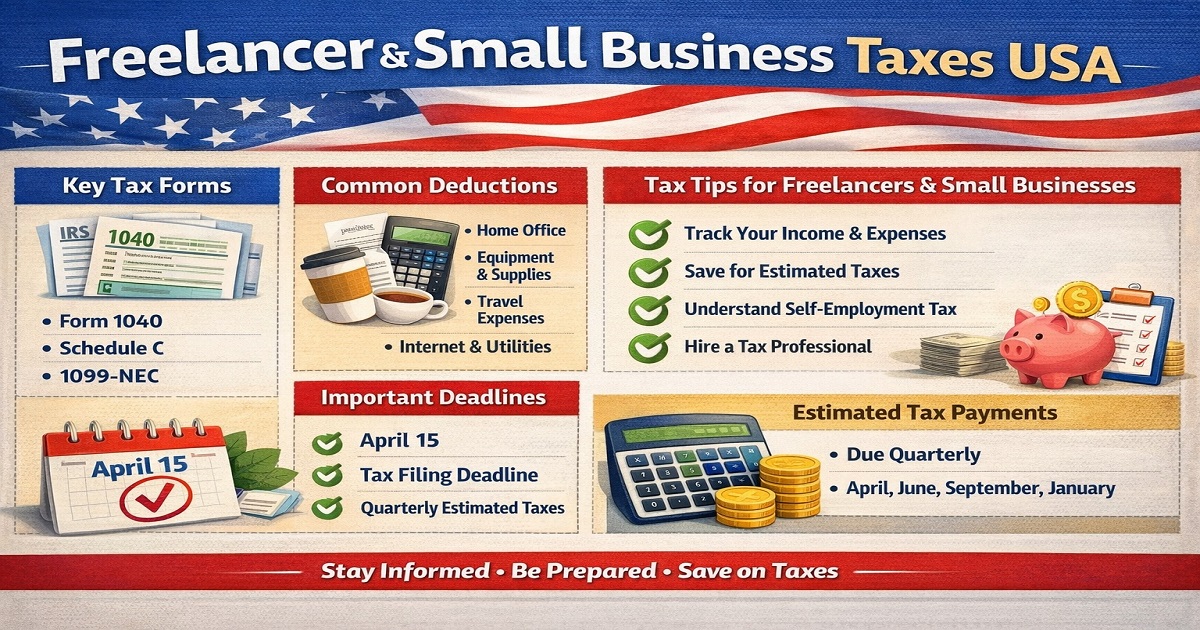
Freelancer & Small Business Taxes USA: Complete Guide to Filing, Deductions, and Tax Savings
In the perspective of Advocate Shahid (Tax Compliance and Advisory Specialist). The Freelancers and Small Business Owners in the USA are generally considered self-employed, responsible for paying 15.3% in self-employment taxes (Social Security and Medicare) plus income tax. They must file Schedule C for earnings, often make quarterly estimated payments, and can deduct legitimate business
Freelancer Taxes USA vs Small Business Taxes USA: What Is the Difference?
The contrasts between the freelancer taxes USA and the small business taxes USA normally depends on the business structure, reporting forms, and how IRS classifies the business in terms of federal taxation. A freelancer would also report it as a sole proprietor or independent contractor, whereas a small business might be a sole proprietorship, single-member LLC, multi-member LLC, partnership, or corporation.
This is the reason why freelancer vs small business tax differences, sole proprietor taxes USA, LLC vs sole proprietor taxes, and the general tax of business structure are significant to such an extent in planning and filing. According to the IRS, self-employed individuals typically are required to file an annual income tax return and often pay estimated tax every quarter, and sole proprietors often use Schedule C to figure the business income or loss.
Who Counts as a Freelancer or Self-Employed Worker?
According to IRS, most freelancers, gig workers and independent contractors are under self-employed taxes USA. According to IRS, in case you are self-employed, then, as a rule, you must file an annual income tax return and make quarterly estimated payments since no employer is withholding income tax, social security or Medicare tax on your behalf. This is one of the essential components of the tax requirements of self-employed USA and freelance income tax USA. When you have net income of self-employment of $400 or more, you are usually required to compute self-employment tax on that income on Schedule SE.
Sole Proprietor vs LLC Taxes in the USA
In the case of sole proprietor taxes USA, the IRS indicates that a sole proprietor reports business income and expenses on Schedule C, and the net earnings will be reported to the personal return of the owner. The difference between an LLC and other structures is that its tax treatment by the federal government hinges upon the number of owners and any tax elections made.
A single-member domestic LLC is typically afforded the same treatment as a disregarded entity under federal income tax (unless it opts to be taxed as a corporation) and a domestic LLC with two or more members is typically treated as a partnership (unless it opts to be taxed as a corporation). Here the tax of business structure matters a great deal.
Why Business Structure Affects Tax Filing and Tax Liability
Your structure influences the type of forms that you will be filing, reporting of profits, and calculation of tax liability on federal income tax. A single-member LLC or sole proprietorship often reports business income on the personal income tax return of the owner and partnerships are required to file an information return and allocate profits or losses to the owners.
According to IRS, partnerships are not required to pay income tax directly; the partners are required to show their partners share in their personal returns. Since the filing rules, estimated taxes and self-employment tax treatment can be different based on the structure used, this proves to be a fundamental aspect of small business tax planning USA.
How Freelancers Pay Taxes USA: Step-by-Step
It is important to learn how freelancers pay tax in USA to avoid punishment and remain in IRS regulations. Freelancers are also required to compute and remit their income, expenses and taxes unlike employees. In this freelancer tax filing USA, the person must monitor the income, report and file a self employed tax return USA with the right forms. The step by step guide on how to file taxes as a freelancer in the USA is clearly broken down below.
Step 1: Track Gross Income and Net Profit and Loss
Begin by listing the gross income gained in the course of freelance work. Then deducted expenditure on the business to determine net profit and loss. This is the last figure and it is your taxable business income, which is the basis of business income reporting USA. Proper reporting requires proper record keeping throughout the year.
Step 2: Report Freelance Income Correctly
The second step is learning to write off freelance revenue. The clients can also send you IRS Form 1099-NEC in the event that you received more than the reporting required, however, even when you do not receive a form, you need to report all the income that you earned. The IRS must have full disclosure of freelance income irrespective of the documentation obtained.
Step 3: File Your Tax Return Using the Right Forms
To fill in how to file taxes as a freelancer, you will make use of Form 1040 as self-employed and the Schedule C form (IRS Form 1040 Schedule C). Reporting your income and expenses can be done on Schedule C, and as a result, you will know your net profit, which will be included in your primary tax filing.
Step 4: Review Your Tax Bracket and Final Tax Liability
Lastly, use your taxable income and find your location within the tax bracket system. This assists you to know how much total tax you will be paying before you file your tax returns. This step should be reviewed carefully to ascertain accuracy and also plan on how to pay taxes in the future.
Self-Employment Tax Explained With a Simple Example
It is worth knowing how to calculate self-employment tax in case of earning income as a freelancer or business owner. In the USA, self-employment tax is distinct to the income tax and is imposed on your business income. The knowledge of the way it works will assist you in estimating payments and you will not face a shock on the submission.
What Is Self-Employment Tax?
Self-employment tax USA is the tax that pays the social security and Medicare taxes to self-employed people. Freelancers pay taxes in full as compared to employees who share them with an employer. The present self-employment tax rate is 15.3, including 12.4% in Social Security and 2.9% in Medicare.
How Self-Employment Tax Is Different From Federal Income Tax
Self-employment tax does not apply to federal income tax. The income tax varies depending on what you earn and your tax bracket, whereas the self-employment tax is taken as a set percentage of your business earnings. The combination of both taxes is that they will come up with your total tax liability and that is why in most cases freelancers pay more when they are not planning.
Example of How to Calculate Self-Employment Tax
In case your net profit amounts to $50,000 you do not tax the entire amount. To begin with, the IRS gives you the option of taking taxable self-employment income as 92.35 0f your net income.
$50,000 × 92.35 % = $46,175
Thereafter, use self-employment tax rate of 15.3%.
$46,175 × 15.3 % = $7,064 (approx.)
Your self-employment tax would come to approximately 7,064.
Quarterly Estimated Taxes USA: What Freelancers and Small Businesses Need to Know
In case you do not have tax withheld on your income, you must know about quarterly estimated taxes USA. The IRS expects a lot of freelancers and small business owners to pay estimated tax payments all through the year rather than once at a time. Being aware of how to pay quarterly taxes USA, quarterly tax due dates and calculation of estimated tax will keep you out of trouble and comply.
Who Has to Pay Quarterly Estimated Taxes?
You are typically required to pay quarterly estimated tax in cases where you are likely to have a balance of taxes due of at least 1,000 and receive credits and withholding. This is the case with small business owners, freelancers, and sole proprietors with income that is not subject to withholding. These advance payments are used by the IRS to pay the income tax and the self-employment tax.
Due Dates for Quarterly Taxes
The IRS has default due dates of quarterly taxes:
- April 15 (Q1)
- June 15 (Q2)
- September 15 (Q3)
- 15th of the next year (Q4)
When a due date occurs during a weekend or on a holiday it is usually rescheduled to the next working day.
How to Estimate What You Owe
Begin with the amount of money you think you will earn annually, subtract deductions and credits and make an approximation of your annual tax bill. And then put that in four equal payments. A lot of taxpayers are using the previous year return as a reference point and making adjustments to it, according to the present income, to come up with more accurate IRS estimated tax payments.
What Happens if You Miss a Payment?
Failure to file or mispaying quarterly estimated taxes may lead to late tax penalties that may be imposed by the IRS. The IRS can impose interest and penalty depending on the amount that was not paid and the duration of time. In more severe conditions, the continued problems may result in further IRS fines on the late filing or the notifications. Paying on time and maintaining records will make sure that you do not run into these issues and keep your filing current on taxes.
IRS Forms for Freelancers and Small Businesses
Knowing the predominant IRS forms is a huge fraction of filing 1099 forms, fulfilling the IRS reporting obligations, and simplifying the tax season of self-employed employees. Forms including IRS Form 1099-NEC, IRS Form 1040 Schedule C, and Schedule SE (self-employment tax) when required are the most important to most freelancers and sole proprietors. Good bookkeeping of freelancers also helps them in being more accurate, having cleaner records, and having more tax compliance.
What Is IRS Form 1099-NEC?
Non-employee compensation is reported on IRS Form 1099-NEC. According to the IRS, this form is used by businesses to declare the payment given to independent contractors and other non-employees of the trade or business to provide services. In case you are freelance, then clients can give you this form but you still have to report all income that is subject to tax even in a case when a client does not provide one.
What Is Schedule C Form?
Scheduling C form can be utilized to declare the profit or loss of a business that you conducted as a sole proprietor. The IRS describes Schedule C to be the one in which you list your business income, deductible expenses, and net profit or loss. This is why Internal Revenue Service (IRS) Form 1040 Schedule C can be considered as one of the most significant forms of freelancers and independent entrepreneurs.
Form 1040 for Self-Employed Taxpayers
Form 1040 is your primary personal filing when you are a self-employed taxpayer and Schedule C serves as its subsidiary. The IRS recommends that you use ScheduleSE, in general, to compute self-employment tax, provided that your net income from self-employment is at least 400.
Why Good Bookkeeping Makes Tax Filing Easier
Good bookkeeping of freelancers will assist in keeping track of gross revenue, deductions, and credits, prepare annual tax statements, and assist in what you report to the IRS. According to the IRS, your records must indicate the income and expenses clearly and the good records will be of help in tracking down the progress of the business, as well as, in preparing the right returns. This puts record keeping on a year-round basis as a foundation of tax compliance.
Business Tax Deductions USA: Top Write-Offs to Know
Understanding the correct business tax deductions USA will assist freelancers and owners to reduce taxable billions and retain more of the incomes they make. To a great number of self-employed workers, the optimal savings are achieved by tracking various common and needy business expenses and recording them appropriately on Schedule 0. This is why freelancer tax deductions USA, an effective list of small business tax deductions, and the self-employed tax write-offs which are carefully documented are so essential. The IRS lists common expense deductions used by businesses, which are advertising, car/truck expenses, insurance, rent, utilities, supplies and home-office expenses.
Home Office Deduction
The home office deduction is offered to qualified self-employed taxpayers who use a portion of the home in business. The space will usually have to meet IRS business-use conditions under Home office deduction rules, and taxpayers have the option of using either a simplified method or an actual-expense method. The simplified alternative employs up to 300 square feet at $5 per square foot.
Internet and Phone Expenses Deduction
Phone bills and internet deduction is possible where such costs are used in the business. In the case of freelancers, internet, phone, software costs are commonly included in the regular operating expenses although their portion of business usage must be deducted in the event of mixed personal usage. Schedule C is used to cover in particular utilities and other operating expenses that could have qualifying business-use costs.
Software and Tools Expenses
Online subscriptions, billing software, design solutions, accounting applications, and other online services may be a deductible business expense under the ordinary business expense exception and the necessity to operate the business. These expenses are usually considered as operating expenses of the day-to-day operations in Schedule C.
Equipment and Supplies Deduction
Other items like equipment, office supplies and work materials can also be deductible according to the nature of the item being used, and how it is utilized in the business. The supplies are also included in the list of common deductible expenses in Schedule C and there are further IRS business-expense regulations governing some larger purchase and depreciation-related supplies.
Mileage and Travel Deductions
Another significant deduction of self-employed taxpayers is mileage and travels. Reimbursable vehicle and travel costs Qualifying business-related vehicle and travel expenses are permitted by IRS, and the 2025 ScheduleC instructions include business standard mileage rate of 70 cents per mile. Expenses on business travel of self-employed persons are typically deductible on Schedule C, but personal commuting is not. These expenses in travelling and covering of miles need good documentation like logs and receipts.
Marketing and Advertising Expenses
One of the most evident write-offs on Schedule C is advertising. It may involve paid ads, promotion, branded materials and numerous marketing expenses that are directly related to the business. This is among the best tax deductions to freelancers and other small businesses since it has a direct relationship with acquiring clients and increasing revenues.
Rent and Utilities Deduction
These (rent and utilities) can be deductible, provided they involve business property, or the business-use portion of a qualified home office. According to the IRS, the home-office expenses (covers utilities, rent, insurance, maintenance, etc.) that qualify on the IRS are limited as not every expense can be listed on the IRS as a home-office expense.
Insurance and Health Premiums Deduction
Business insurance is widely deductible, and a few self-employed taxpayers can also receive a self-employed health insurance deduction. To calculate the deduction of self-employed health insurance which can be made under the IRS, the Form 7206 is provided.
Retirement Contributions Deduction and HSA Tax Deduction
The savings deduction tax on retirement and HSA tax deduction can be strong tax savings. HSAs, self-employed SEP, SIMPLE and qualified plans are deducted in IRS Schedule 1. According to IRS Publication 969, you are allowed to deduct HSA contributions even though you do not itemize. Retirement tax plans (IRA, SEP -IRA) and wider planning using tax-deferred plans frequently focus on these benefits.
Business Deductions and Credits That Can Lower Your Tax Bill
One of the best options to reduce the tax bills on the legal basis is to use the appropriate combination of business deductions and credits. To a freelancer and small business owner, the first step to reducing taxes as a freelancer is to know the expenses and credits available to you that determine how to legally decrease taxes as a self-employed USA. These strategies are useful in maximizing tax deductions to freelancer and avoiding IRS regulations when used appropriately.
The Difference Between a Deduction and a Credit
Deduction decreases your taxable income and this decreases the amount of income that is liable to tax. A credit on the other hand literally decreases your tax payment. This distinction is important as credits tend to have more effect on the final tax liability than the same amount of deductions.
Common Business Deductions That Reduce Taxable Income
There are various business expenses that are considered deductions. These are home office expenses, internet and phone usage, software subscriptions, marketing expenses, travel, supplies and professional services. Such deductions decrease your net profit which consequently decreases taxable income and general tax exposure.
Credits and Tax Benefits Small Businesses Should Review
There are also some credits that are offered in addition to deduction based on your circumstance. These may consist of energy credits, employment rewards, and other benefits that are allowed by the IRS. Although not all freelancers are eligible to all credits, examining the eligibility may open access to precious savings and other tax advantages.
How Deductions and Credits Support Better Tax Planning
The most important aspect in tax planning entails combining deductions and credits. Monitoring costs on an annual basis, examining eligibility at the beginning of the year, and planning financial records would enhance precision and minimize missed chances. An aggressive strategy will allow you to reduce your tax bill, facilitate its compliance, and make sure you are utilizing tax-saving opportunities to their fullest.
Tax Saving Tips for Small Business Owners and Freelancers
The tips that can helpowner of a small business save taxes tend to be in the form of good habit, rather than last-minute guessing. Good tax planning by freelancers begins with good books, regular reviews, and utilization of tax benefits already available to freelancers by the IRS regulations. When it comes to tax planning of small business USA, tax planning of small business, and how to save money on taxes USA, all one should do is to reduce taxable income, legally, avoid missing out on the deductions, and be organized all the year round. Income, deductions and credits are to be prominent in your records, according to the IRS, and it also accepts tax-favored taxpayers like retirement plans and HSA.
Track Business Expenses All Year
Regular tracking of business expenses is one of the best tax saving habits. Maintaining a record-keeping system that effectively demonstrates your gross income, deductions, and credits is why many freelancers have created spreadsheets or expense-tracking software to sort through receipts, subscriptions, traveling, and other write-offs in advance before the filing season is a nightmare.
Use Retirement and Health Savings Options
Current taxable income can be reduced using retirement tax strategies (IRA, SEP-IRA) and other tax-deferred accounts, which will assist you in saving towards the future. According to IRS guidance, retirement plans and HSAs are two of the most viable planning tools that self-employed taxpayers can use to gain tax benefits as a result of qualified contributions to HSA.
Separate Personal and Business Finances
This helps in keeping records clean in case the IRS ever needs to inquire since it is easier to trace deductions and keep business and personal spending apart. It also minimizes the chances of not recording write offs or incurring personal expenses on behalf of your business. This is an easy practice that freelancers and small-business owners can use.
Plan Ahead Before Tax Deadlines
It is best to do tax planning before it is too late to do so. By looking at your income, deductions, and projected tax beforehand, you have a better control over the cash flow, estimated payments, and decisions at the end of the year. Premature preparation helps in making the filing more precise and decreases the possibility of preventable errors.
Common Tax Mistakes Freelancers and Small Businesses Should Avoid
The prevention of tax errors is the major factor to decrease the stress, fines, and avoidable expenses. Causes of many of small-business tax issues include failure to meet deadlines, incomplete filing or failure to understand rules to follow in the IRS. Such inaccuracies may lead to missing in business deductions, excessive payment of taxes, or IRS notices. Early problem detection assists you in correcting filing errors before they develop into a big problem.
Forgetting Quarterly Estimated Taxes
One of the most frequent mistakes is to skip or pay less than the quarterly estimated taxes. These payments will need to be paid by freelancers, failure to which will activate penalties and interest. Calculate and estimate how you should pay so as not to be caught unawares.
Missing Business Deductions
Freelancers lose money because they do not claim the full deductible expenses. Ignoring deductions like home-office, softwares, travel, or marketing raises the taxable income and results in excess payments of taxes. Checklist Use a transparent checklist to miss no opportunity.
Poor Recordkeeping and Bookkeeping Errors
One of the biggest causes of tax problems is weak recordkeeping. Expenses are difficult to justify and no real income can be computed without documentation. Computer-assisted bookkeeping maintains proper reporting and adherence to IRS.
Reporting Income Incorrectly
Failure to document all the income particularly among various clients could create audit risks. You are required to report every earning although there is no 1099-NEC. Proper reporting will minimize the possibility of corrections or penalties.
Filing Late and Facing IRS Penalties
Failure to file within the stipulated time or payment can attract fines and charges. The IRS can also impose charges depending on the late filing of the return or the size of the tax due. To prevent loss of money, file on time and revise your return.
Beginner Guide to Small Business Taxes and Tax Compliance
A good beginner guide begins by ensuring one understands that, self-employed workers and small-business owners have to remember to keep track of income, write offs properly and file when due. To any person studying the US business taxes, the most important concepts are simple to report your business income, maintain your records and support your deductions and credits, and comply with the rules of filing which is relevant to your business type. Forms 1040 Schedule C and other related schedules Taxpayers filing these forms can use IRS resources.
Basic Tax Rules for Freelancers
Freelancers are required to submit a yearly income tax filing and tend to remit estimated taxes throughout the year as no employer withholds their taxes on their behalf. You are required to pay self-employment tax and use Schedule SE in case your net earnings in self-employment are at least 400 dollars. These are the main IRS regulations of freelancers and gig workers.
Tax Requirements for Self-Employed USA
Self-employed individuals are required to report the right type of business income and expense, prepare the right return, and pay quarterly estimated tax when necessary. According to the IRS, the majority of self-employed people can submit an annual filing and calculate the estimated taxes every quarter based on the income and expenses of a sole-proprietorship on Schedule C.
How to Stay Compliant With IRS Rules
Good records form the basis of good tax compliance. The gross income, deductions, credits should be clearly recorded in your record keeping system and you should maintain records such that have a long life time to verify what you have reported in your return. Systematic bookkeeping, receipts, and summaries of transactions are the keys to remaining within the tax regulations of the IRS and other tax obligations of a small business.
Freelancer Tax Checklist USA Before You File
A clear freelancer tax checklist will ensure that you have not overlooked important information before filing your return. It is also easier to file your tax returns correctly with proper preparation and to have your tax return that is self-employed is correct and complete.
✔️ Essential Items to Review Before Filing
Total Gross Income – Sum total of income to all clients, whether a form was received or not.
Net Profit and Loss – Taxable income = business expenses minus.
IRS Form 1099-NEC -Compare every form you get with the income you recorded.
Schedule C- Any income or deductions should be properly reported.
✔️ Payments and Tax Obligations
Quarterly Estimated Taxes Paid- verify all the payments made within the year.
Check balances- Escape penalties by paying due.
✔️ Key Deductions to Include
Home Office -Claim -if you qualify by IRS rules.
Mileage and Travel – Expenses related to business-related travel should be deductible.
Software and Tools- Include subscriptions and work-related equipment.
Marketing and Advertising- Deduct promotions, marketing and branding expenses.
Retirement Contributions- Subtract IRA or other eligible retirement plans.
HSA Deduction – Claims when you have deposited to an account called Health Savings.
✔️ Final Records Check
Business Expense Records – Store receipts, invoices and journals.
Check calculations and totals twice.
By simply going through this checklist, you will minimize errors, increase accuracy and you will also be able to claim all the deductions you are entitled to before filing.
Final Thoughts on Freelancer and Small Business Taxes USA
Freelance and small business taxes are not that hard to understand. Divide the process into easy steps. Be organized, stick to the fundamental tax guidelines and document income, spending and payments in an understandable way throughout the year. Understanding the process of tax payment simplifies the process of deadlines, estimating payments, and prevents the frequent errors.
Proper tax behavior is a big impact. Be great at record keeping, get ahead of schedule, complete the appropriate forms and check your figures prior to state submission to minimize stress and enhance accuracy. Learn, too, how to calculate self-employment tax, quarterly estimated taxes and what deductions are available to you.
Stay proactive rather than waiting until tax time, to reduce taxes as a freelancer. Good bookkeeping, payments made at the right time, and proper deductions tracking minimises errors, reduce liability where necessary, and promotes improved management of taxes in the long term.
FAQs About Freelancer & Small Business Taxes USA
1: How do freelancers pay taxes in the USA?
Freelancers declare business income and expenses in 1040-T10 with Schedule C. Their self-employment tax is also paid through ScheduleSE. Due to the fact that clients typically do not withhold taxation, freelancers tend to make quarterly estimated payments.
2: What taxes do small business owners pay in USA?
Freelancers and sole proprietors pay business profit and self-employment tax to Social Security and Medicare on their income. State and local taxes can also be used depending on the business and location.
3: What is self-employment tax and why do freelancers pay more taxes?
Self-employment tax provides employer and employee contributions to both Social Security and Medicare. This tax is computed by Schedule SE, which is why freelancers tend to pay more in comparison with the employees whose payroll tax is divided.
4: Do freelancers have to pay quarterly estimated taxes?
Yes, in the case they anticipate a sufficient tax payable and no withholding coverage. IRS instructs persons who are self-employed to submit an annual filing and pay estimated taxes quarterly via Form 1040ES.
5: What forms do freelancers need to file taxes?
The most important ones are the 1099-NEC used to report client payments, Schedule C used to report a profit or loss, and general Form 1040, the main return, and in many cases Schedule SE, used to indicate self-employment tax.
6: What are the best tax deductions for freelancers and small businesses?
Ordinary and necessary business expenses are represented by common write-offs such as home-office expenses, advertising, supplies, insurance, rent, utility, vehicle expenses and other miscellaneous items. Deductions and credits could reduce tax and they should be considered.
7: How can I reduce self-employment tax legally?
Sound all deductions allowable to the business, utilize deductions based on retirement or health, and make estimated payments. The deductions decrease the taxable profit and assist in reducing total tax.
8: What are the most common tax mistakes freelancers make?
Absent quarterly payments, bad bookkeeping practices, inaccurate reporting of income and neglecting deductions are common issues. Income, deductions, credit recordkeeping can help avoid common errors and before one files most problems are usually rectified.