IRS Notice Lookup System Explained: How to Read, Verify, and Respond to IRS Notices
As stated by Advocate Shahid (Tax Law and Advisory Specialist). IRS Notice Lookup System is an online system from the Internal Revenue Service (IRS) and the Taxpayer Advocate Service (TAS) for taxpayers to better understand IRS notices. When taxpayers receive the specific code included in their letter, they will know the reason for the IRS contact and what steps they should take.
How the Lookup System Works
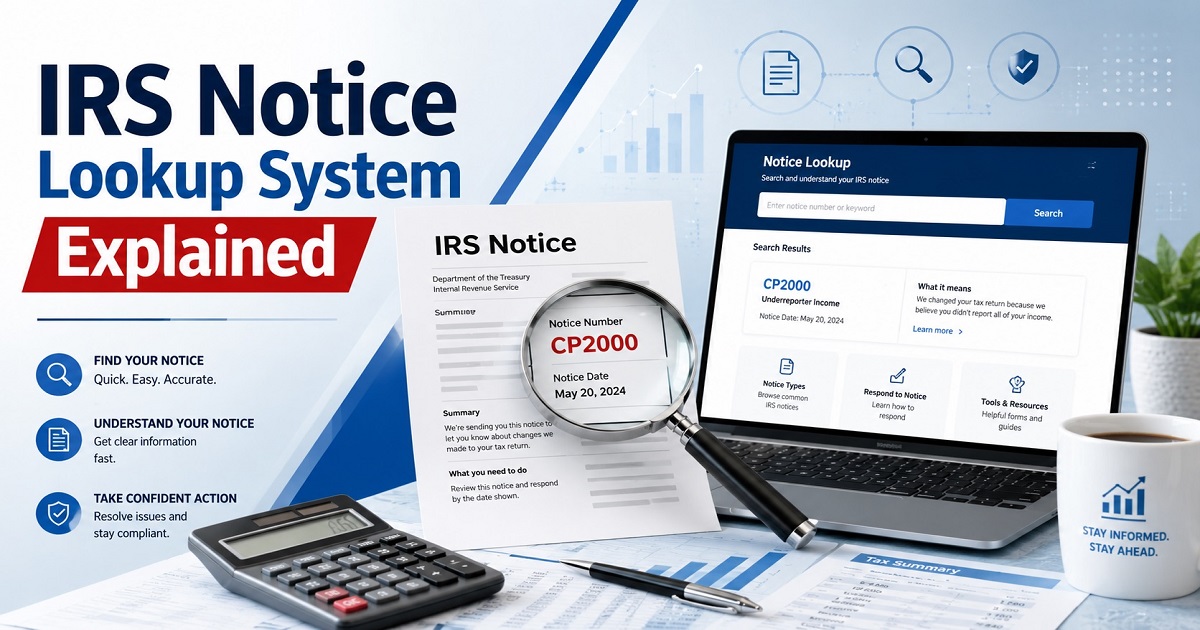
- Read your IRS document to find your Notice/Letter Code: This is located in the top or bottom right-hand corner of your IRS document, such as CP501 or LTR 915.
- Use the Lookup Tools: Type in this code on the official IRS Notices & Letters Search or the Taxpayer Advocate Service Notices Directory.
- Understand the Results: The tool will give you a plain-English explanation of your notice, which includes a detailed breakdown of the issue, what documents or payments you need to send and important deadlines.
What Is the IRS Notice Lookup System?
The IRS notice lookup system is a taxpayer-friendly tool to determine what an IRS notice or IRS letter means by using the IRS notice/letter number that is written on the IRS letter. It is possible to look up the IRS notice number meaning, and learn what the IRS was communicating to them through a notice search tool, IRS notice code lookup, IRS letter lookup by code or IRS CP notice lookup online.
How does the IRS Notice Lookup System work?
Typically, a correspondence from the IRS will begin with the CP number or the IRS letter number located at the top or corner. A search for IRS notice or IRS notice lookup by its number online will provide you with an explanation as to whether you must pay an IRS notice, respond to an IRS notice, dispute an IRS notice, verify your identity, provide missing information to IRS, or contact the IRS for further assistance.
What the IRS Notice Lookup System Can Help You Find
Taxpayers may use IRS CP notice lookup online to help them interpret the CP number/letter number on their IRS notice, the reason for receiving an IRS notice on their tax returns, and if the notice is related to additional tax owed. It might also indicate if the letter is a penalty notice, interest charges are accelerating, IRS has made proposed tax changes and a response or payment deadline.
Why Did I Get an IRS Notice in the Mail?
When you receive an IRS e-notice, many taxpayers wonder, “why did the IRS send me a notice in the mail?” Notices/letters are issued by the IRS when there is a tax account issue that requires attention. A mailed IRS notice could be a balance due, notice of a changed refund, a question regarding your return, verification of your return, corrected return information, or delayed processing. Taxpayers also have online account tools at their disposal through the IRS to view balances, payments and tax records.
Typically, this is an IRS “balance due notice” that you have a balance due for a tax year, or a “refund adjustment” that the IRS adjusted your refund amount. An IRS notice can also be received for tax return corrections, which may occur due to a mathematical error or problems entering the return. An issue that has occurred with IRS notice accounts can be due to missed payment, account mismatch or un-resolved item that has to do with tax compliance.
How to Read an IRS Notice or Letter
- If you ever find yourself asking how to read an IRS notice, take it slow and read through the letter, line-by-line. The vast majority of IRS letters are standardized and provide details about the changes, the IRS’s reasons for contacting you, and what you might need to do.
- To find the notice number or notice letter number, first look for the “Notice No:” or “Notice Letter No:”. Check for a CP number, notice number or a letter number near the top or right side. This will assist in determining what kind of IRS correspondence it is.
- After that, look for the tax year. Typically, IRS notices are sent to the recipient for a single tax year, not necessarily the year that one is currently in.
- Next, read aloud the statement in the notice. Be alert for terms that include balance due, refund changed, proposed changes, additional information needed or verify your identity.
- Then, look for the deadline for the answer(s). Depending on the type of notice, some must be acted on within 21, 30, 60 or 90 days.
- In addition, check the due date for payments. If you agree and are responsible for paying the tax, look for IRS notice payment options.
- Lastly, verify your taxpayer ID information—such as your name, address, partial SSN or ITIN and account information. Check the notice against the notice from your paid tax return, W-2 or 1099, payment records and the IRS account transcript.
- The IRS usually recommends that taxpayers pay attention to notices so that they can act in time to minimize the extra penalties and interest charges.
How to Look Up an IRS Notice Step by Step
The first law of How to Look Up an IRS Notice is don’t panic, or pay them right away. Not all IRS letters are in error. Some notices are of a proposal, reminder, identity check, change of refunds or request for missing information.
Step 1: Do Not Panic or Pay Immediately
Read carefully the notice before taking action. Verify information provided by the IRS, tax year, and if payment, response, or verification is required.
Step 2: Use the IRS Notice Lookup by Notice Number
On the notice, look at the CP number or letter number and use the Internet to search using terms such as IRS notice code lookup, IRS letter codes explained, IRS CP notices explained, IRS notice code list, and IRS notice meanings. This will help you to understand before responding to the notice.
Step 3: Log In to Your IRS Online Account
In case you are pondering about “where can I check my IRS notice status?” or “can I look up an IRS notice online?” then IRS online account is a great place to start with. Taxpayers can access tax records, payments, some notices and letters, balances, and account activity.
Step 4: Review Your IRS Account Transcript
An IRS account transcript can be particularly helpful in the event that the notice states that you owe money but you think that you’ve already paid. Activity, payment posting, penalties, interest, adjustments and balances for each account can be displayed on the Transcripts.
Step 5: Compare IRS Information With Your Records
Check the IRS notice against your filed tax return, W-2s, 1099s, payment confirmations, bank records, previous IRS letters and tax software documents. Many people see that they have some problems resulting from a mismatching of income, non-payment of taxes, or a wrong tax year posting.
Step 6: Decide Whether You Agree or Disagree
Please contact the notice according to instructions if you consented to the notice. If you disagree, follow the instructions to respond to the IRS notice that are attached to the letter, and include any supporting documents.
Step 7: Respond Before the Deadline
Always reply in the official way indicated in the notice. Never send documents to an unknown address on the Internet. Failure to pay by the due date could restrict your choice and could result in greater penalties and/or interest.
Common IRS Notice Codes Explained
Below are IRS notice codes explained in layman’s terms. As a starting point, use IRS CP notices explained and IRS letter codes explained, but always follow the instructions, address, deadline and method of response of a specific IRS notice you receive.
| Notice / Letter | Meaning | What the Taxpayer Should Do |
|---|---|---|
| CP14 notice | First common IRS balance due notice saying tax is owed. The IRS says CP14 explains how much you owe and how to pay. | Pay, set up an IRS payment plan, or contact the IRS if you disagree. This is often searched as IRS notice CP14 explained. |
| CP2000 notice | Third-party income or payment records do not match your return. The IRS says CP2000 is not a bill; it is a proposed adjustment. | Compare IRS data with W-2s, 1099s, and your return. For an IRS CP2000 notice response, agree, disagree, or partially agree with documentation. |
| CP11 notice | The IRS corrected one or more mistakes, and the amount owed changed. | Review the correction and respond if you disagree. |
| CP12 notice | The IRS corrected mistakes, and your refund amount changed or you are now due a refund. | Review the refund adjustment and compare it with your return. |
| CP22A notice | The IRS made changes, often after taxpayer-requested changes, and a balance is due. | Review the account and set up payment if needed. |
| CP49 notice | The IRS applied all or part of your refund to another federal tax debt. | Check whether the offset is correct. |
| CP501 notice | Reminder that you still owe a balance. | Pay, respond, or arrange payment. |
| CP503 notice | Follow-up balance-due notice showing the IRS still has not received payment or a response. | Act before collection becomes more serious. |
| CP504 notice | Serious collection notice; the IRS states it intends to levy because of an unpaid balance. | Do not ignore it; review appeal, payment, or resolution options. |
| Letter 5071C | Identity verification notice with an online option. | Verify your identity and return if you filed. |
| Letter 4883C | Identity verification notice by phone. | Call the official number on the letter. |
| Letter 525 | General 30-day letter related to proposed examination adjustments. | Agree, submit documents, or request an appeal/protest. |
| Letter 1058 | Final Notice of Intent to Levy and notice of hearing rights. | Act quickly; this usually involves Collection Due Process rights and strict deadlines. |
Real-Life Examples: How to Respond to Common IRS Notices
Example 1: IRS Notice Says I Owe Money — What Should I Do?
The issue is that a CP14 notice is received by a taxpayer indicating the amount of their tax due, but they have already paid their tax for that year.
Explanation: IRS balance due notices don’t necessarily mean that the IRS is right. Payment may be late, and may be applied to the wrong tax year. The IRS has admitted that there are cases in which taxpayers had received wrongful CP14 balance-due notices even though they had paid their taxes. (IRS)
Step-by-Step Solution
- Look in your IRS account online.
- Create or download your IRS account transcript.
- Match up the payment date, amount and tax year.
- Have receipts (bank statements, confirmation numbers etc.).
- If you don’t have the number listed on the official notice, you can call the number.
- Review IRS notice payment options, but do not make payments unless a tax professional confirms it is necessary to make a second payment.
- For example, if you don’t receive a 1099 income, you should file a CP2000 Notice and proceed with your usual tax filing process.
Example 2: CP2000 Notice for Missing 1099 Income
Explanation: A CP2000 typically is a CP based on third-party information matching by the IRS. The IRS matches Forms W-2, 1099, 1098, etc., with the income, credits, payments and deductions that you report on the return. A CP2000 is not a bill, it’s a proposal to adjust your return, the IRS says.
Step-by-step solution
- Carefully read through the CP2000.
- The IRS proposed reduces the taxes on your return.
- Review all 1099s, W-2s, bank statements and business income statements.
- If you agree with the IRS, sign and send the response form.
- Explain and provide documents if the IRS is incorrect.
- Make copies of all documents sent.
This is the best and safest method for responding to an IRS CP2000 notice, particularly if you must reply to an IRS notice, resolve an IRS notice problem, challenge an IRS notice, or reply to proposed IRS tax changes.
Example 3: Letter 5071C or Letter 4883C Identity Verification
The issue is that once a return is filed, a taxpayer will get a letter 5071C or Letter 4883C.
Explanation: IRS issues identity verification letters when it’s trying to verify if a return was submitted by the taxpayer. The IRS is asking the taxpayer to verify his or her identity and tax return before the tax return is processed for a Letter 4883C. In the case of CP5071/5071C notices, the IRS recommends a taxpayer check to see if they filed the return or if they are being scammed.
Step-by-step Solution:
- Don’t disregard the letter.
- Do not use any other method of verification than the one provided on the IRS notice.
- Be prepared with your notice and return of tax and identity information.
- Report potential ID theft if you did not file the return.
- Follow up on refunds and/or account changes later.
This type of IRS notice verification typically requires taxpayer identity, verification of tax documents and the knowledge of how to verify if an IRS notice is legitimate before providing personal information.
Real Case Laws and Legal Lessons for IRS Notices
Deadlines for IRS notices are not mere administrative deadlines but instead, they may impact a taxpayer’s rights.
Case Law 1: Boechler, P.C. v. Commissioner
In Boechler, the U.S. Supreme Court found the thirty-day time limit for filing a petition to the Tax Court after a Collection Due Process ruling is nonjurisdictional and may be tolled under the doctrine of equitable tolling in the appropriate circumstances.
Lesson: Do not take “exceptions” for granted when there is relief possible. Keep a record of all IRS deadlines.
Case Law 2: Culp v. Commissioner
In Culp, the Third Circuit ruled that IRC § 6213(a)’s 90-day deficiency notice period was nonjurisdictional and could be tolled, likely as a result of the unique facts of that case, and possibly in other circumstances; however, the ruling may be different in other jurisdictions and may be subject to later developments.
Lesson: If a notice provides you Tax Court rights, consult a qualified tax pro right away!
Case Law 3: Dodson v. Commissioner
In the Dodson case, the Tax Court considered the issue of whether taxpayers may take advantage of the last petition date in a notice of deficiency.
Lesson: Envelopes, notices, and mailing records are important to keep as IRS notice dates can be significant.
IRS Notice Response Guide: What to Do After Receiving an IRS Notice
Read the full notice carefully
Before paying, calling, or mailing the documents, thoroughly read the IRS notice to know what the IRS wants.
Identify the notice number, CP number, or letter number
Typically, this figure is found in the upper position of the notice or on the right hand side, it is used to locate an IRS notice.
Check the tax year and taxpayer identification details
Verify the tax year, name, partial social security number or individual taxpayer identification number (ITIN), account information.
Find the main issue
Pay attention to any terms like the following: balance due, refund adjustment, proposed changes, missing information, or identity verification.
Look up IRS notices using IR notice number
This will help clarify the type of notice you received from the IRS, and how to properly respond to a tax notice.
Look in your IRS account online
Check balances, payments, tax records and notices/letters available.
Create or download your IRS account transcript
This can display the following information about the account: activity, posting payments, penalties, interest, and account balance.
Check against the notice and check your records
Check tax return, W-2s, 1099s, payment receipts, bank statements and IRS letters.
Select the appropriate response
Choose to agree, disagree, pay, appeal, verify identity, fill out IRS notice response form or ask for additional time.
If you are owed a payment, discuss payment options with them
If you agree to the balance, you can pay the balance on the IRS notice or check out the options for IRS notice payment plan.
Only use the IRS phone number provided by IRS
On your official IRS notice, use the IRS contact number. Don’t use phone numbers that you see in ads, forums or from websites not authorized.
Make copies of all items
Keep the notice, envelope, response form and documents sent, fax confirmations, certified mail receipts and payment proof.
IRS Notice Payment Options
If the notice is accurate and you are owed money, take in account your IRS notice payment choices prior to the due date. It will depend on your balance, income, expenses and if you can pay it right away.
Pay in full online
The quickest method of paying IRS notice balance is to use an IRS-approved electronic payment method, if you have the funds. Online payments can help provide confirmation and may help lower the additional penalties and interest, the IRS says.
Short-term payment plan
If a taxpayer has an immediate financial need, but is able to pay off the entire amount in the near future, a short time plan might be beneficial.
Long-term installment agreement
A long-term IRS payment plan is one that provides eligible taxpayers the ability to pay their taxes over the term of a long pay plan. Taxpayer Advocate Service also mentions taxpayers can apply for payment plans online via an IRS Online Account.
Offer in compromise
If the taxpayer is eligible, an offer in compromise can help to resolve tax debt for less than what the tax debt is. The IRS states that financial ability, filing compliance and other factors are the general criteria for eligibility.
The current status of this species is not-collectible
The IRS may temporarily hold back on collecting money if you would not be able to afford the payments if you made them. This does not get wiped away and penalties and interest can still accrue.
Penalty relief request
If applicable, taxpayers can seek relief from the penalties, including reasonable cause relief and first time penalty abatement. Generally interest is not waivable without the removal of the related penalty.
Each of the IRS notice payment plan options needs to be studied thoroughly prior to making an IRS notice payment.
How to Verify an IRS Notice Is Legitimate
It’s critical to know that an IRS notice is genuine before paying, calling or providing personal information. According to IRS, taxpayers receive a letter or notice as the first method of IRS contact and can go to the IRS notices and letters page to search by a CP or LTR number to learn about the issue.
Check for a real notice number or letter number
Find a CP number, LTR number or a letter number – typically in the upper left or right corner.
Confirm the tax year
A valid Federal tax notice will typically be for a particular tax period or tax year.
Review the official IRS contact instructions
Only use the phone number, mailing address or verification on the notice.
Check the payment method
Any IRS payment instructions you receive should include instructions on how to make that payment using IRS official channels. The IRS cautions against the following signs of a scam: the scammer asks to receive gift cards, wire transfers or cryptocurrency.
Verify IRS notice online
Verify the IRS notice by using IRS notice search tools found on IRS.gov by searching the notice number or letter.
Check your IRS online account
Balances, payments, tax information and some notices and letters may be listed in your online account.
Match the notice to your IRS account transcript
When responding, check the issue, balance, payment history, penalties, and/or refund changes against your transcript.
Is an IRS Notice the Same as an Audit?
No. An IRS notice doesn’t necessarily represent an audit. Numerous notices are informational letters relating to a balance, refund adjustment, correction of a tax return, missing information or identity verification. The IRS states that notices can be issued for a taxpayer who has a balance due, a change in the amount of their refund, an unclear return, needs identity verification or if their returns are delayed.
A CP2000 notice is a typical example of a notice that is frequently misinterpreted. So, the IRS clarifies, it’s not a bill, it’s a proposal stemming from a mismatch in information by the third-party and with the tax return. The IRS has also indicated that it is not a formal audit notification.
IRS notice: Typically covers one account, payment, refund, correction or verification.
Audit letter: Request documents, review items to return and make tax adjustment recommendations.
Letter 525: Frequently associated with proposed exam changes following an audit/examination review.
When IRS issues a letter with an IRS audit notice, IRS examination or audit, IRS proposed adjustments, or IRS notice about changes to the tax return, use an IRS audit notice lookup tool.
Common Mistakes to Avoid When Responding
Ignoring an IRS notice
A common question many taxpayers have is “what happens if I ignore the IRS notice?A frequent question is “What happens if I ignore an IRS notice?” The answer will depend on the notice received, but failing to respond to the notice may result in further penalties and interest, collection notices or the loss of your right to appeal.
Missing the response deadline
Prompt response can minimize any further penalties and interest charges, while responding by the deadline can be required to preserve the right to appeal, the IRS states.
Paying without checking whether the notice is correct
Before paying, be sure to check the notice against your tax return, IRS transcript of your tax records, and the proof of payment.
Sending documents without a copy of the notice
Attach a copy of the notice to help the IRS match up with the one you sent with your response and the proper tax year.
Calling a phone number from Google instead of the notice
Use the IRS contact number on the official IRS notice.
Forgetting to check the tax year
A notice can be from a previous tax year (not the current year).
Confusing a CP2000 proposal with a final bill
CP2000 is typically a proposed change, as it is not necessarily a bill that is passed.
Not saving proof of mailing or fax confirmation
Maintain receipts for certified mail, fax confirmations and copies of all documents.
Failing to check penalty notice and interest charges
Check to see if penalties and Interest are building up prior to IRS notice issue or dispute IRS notice.
Not requesting help for serious notices
If the notice includes any mention of levy, lien, audit or Tax Court rights, consult an experienced tax specialist. Fundamental rights of taxpayers when dealing with the IRS.
When to Contact the IRS About a Notice
If the notice is for a serious IRS notice account problem, is for a deadline or is reminding you that you may lose rights you should contact IRS or a qualified tax expert.
- You disagree with the amount
- If the balance, penalty, income adjustment or refund change looks incorrect, call the IRS.
- You already paid
- Review payment history and IRS account transcript and call if payment is not on there or listed in the wrong tax year.
- The notice shows the wrong tax year
- Notice may be for a past year so check the year in advance before paying and responding.
- You suspect identity theft
- If the IRS notice refers to a return that you did not file, you should get IRS notice assistance ASAP.
- You received Letter 1058
- An IRS letter numbered 1058 is one that indicates that the IRS will take any property or rights to property and you must contact the IRS ASAP.
- You received Letter 525
- This is usually a 30-day letter (letter 525) dealing with proposed audit adjustments.
- You received a notice of deficiency
- This could include the rights to file claims with the Tax Court and how and when it is done.
- You cannot pay before the deadline
- Inquire about payment plans or other solutions.
- The notice mentions levy, lien, or appeal rights
- These issues can impact on rights of taxpayers that are important such as rights to appeal.
Utilize IRS notice number from official notice. If you must call the IRS, they recommend you use the number provided on the notice.
Final Checklist: How to Use the IRS Notice Lookup System Correctly
This IRS notice guide makes tax notices easier to understand for taxpayers and helps them know what to do if they receive one. If you’ve received an IRS notice, and are wondering how to use the IRS notice looking system or what an IRS notice means, follow this checklist before taking action:
- Identify a notice number, CP number or letter number.
Check in the upper or right margin of the IRS letter. - Look on the IRS notice search site.
Use notice number or letter code to determine the type of notice. - Read the explanation of the IRS notice.
Know the purpose of the IRS letter and what to do. - Look into your IRS website online account.
Check out balances, payments, tax records, and notices available. - Check your IRS account transcript.
Verify the status of an account, payments, penalties, interest, and adjustments. - Check with the notice against records.
Utilize filed return, W-2s, 1099s, bank statements and payment verifications. - Verify tax year.
Be sure that the notice is for the proper tax period. - Be aware of the time limit for the answer.
Failure to meet a deadline may lead to higher penalties and/or interest and/or collection risk. - Fill out the appropriate IRS notice response form.
Please follow the form or instructions provided with your official notice. - Dispute, verify or appeal before the deadline for payment.
This is what IRS notice lookup system is all about to the taxpayers: You have to determine the identity of the notice, verify that the notice has been issued, uphold your rights, and respond in time.
FAQs Section
1. What is the IRS Notice Lookup System?
IRS tools that search and explain notices by notice number, CP number, LTR number, letter number or topic are frequently referred to by taxpayers as the IRS Notice Lookup System. It can help answer questions about why the IRS reached out to you, and what you may need to do. The IRS indicates that taxpayers can use the notice or letter number or the topic to locate the notice or letter, and the number is typically in the right upper corner of the letter.
2. Can I look up an IRS notice online?
Yes, but be careful and always consult a professional if you have any questions.
3. How do I find my IRS notice number?
Check near the top or upper-right hand corner for a CP number, LTR number or letter code. The IRS says the CP or LTR number is usually found on the right corner of the letter.
4. What does an IRS CP notice mean?
An IRS CP notice typically is a computer-generated notice regarding a problem with a tax account, including a balance due, change in a refund, missing information, reminder of a payment, new return completed or a proposed adjustment. The IRS will use notices to inform taxpayers of a balance due, that changed refunds, questions about their return, verification of identity, a corrected return, or a delayed return.
5. How do I respond to an IRS notice?
Carefully read the notice, determine the problem, review response due date, review records and comply with instructions for the response. If you don’t agree, send documentation by the method that was provided on the notice. Call the phone number listed on the notice if you need to call
6. What happens if I ignore an IRS notice?
Failure to respond to the IRS notice may result in further penalties, interest, IRS notices of collection, offsetting of your refunds, tax liens, IRS levies and/or the loss of your appeal rights depending on the nature of the notice of concern. Taxpayers should be sure to read IRS notices and when they are asking for action, do so by the designated deadline.
7. How can I tell if an IRS notice is fake?
Look at the notice number, tax year, IRS contact instructions and your IRS online account. The IRS cautions scammers can pretend to be the IRS in emails, texts, social network messages, phone calls, letters and websites.
8. Is an IRS notice the same as an audit?
No. There are a lot of IRS notices that aren’t audits. Note that a CP2000 notice is typically a proposed adjustment, rather than a final bill, for example, in the event that there is an information mismatch by third parties.