IRS Form 4868 Extension Filing Guide: How to File a Tax Extension Correctly
Advocate Shahid, Tax Technical Advisory Specialist, said that as mentioned earlier by Advocate Governor. IRS Form 4868 is a 6-month extension that you can use to submit your federal individual income tax return (from April 15 to October 15). This will lengthen your filing period but not extend the time for any taxes due to be paid, which will still be due by the original payment deadline of April.
Top Ways to File Form 4868
- Pay Electronically (No Form Needed)
- E-file via Tax Software
- Mail a Paper Form
Step-by-Step Instructions
- Identification
- Line 4 (Estimate of Total Tax Liability)
- Line 5 (Total Payments)
- Line 6 (Balance Due)
- Line 7 (Amount You Are Paying)
Important Rules to Remember
- No Explanation Needed
- Good-Faith Estimate
- Out of the Country
What Does IRS Form 4868 Do?
IRS Form 4868 is an automatic extension for eligible individual taxpayers to file their federal income tax return. It’s basically simply an extended period of time to get your tax documents ready and in.
If you need to wait for certain investment documents to come in, such as a corrected Form 1099, business income records, or a Schedule K-1, for instance, filing Form 4868 can help you prevent a late filing issue until you receive the necessary documents.
However, taxpayers may be confused by the extension, because the extension isn’t about extending payments. You still have to make an estimate of your tax liability and pay the amount you estimate you owe by the regular payroll tax filing deadline. While filing for an extension, you may incur penalty and interest charges if you don’t pay enough.
For example, if a person does not have his or her brokerage statements until April and cannot fill out Form 1040 by then, he or she is in a difficult situation. Filing Form 4868 may help prevent a late filing penalty, although the taxpayer should make an estimated tax payment and make an educated guess on the amount of tax that should be paid.
What Is IRS Form 4868?
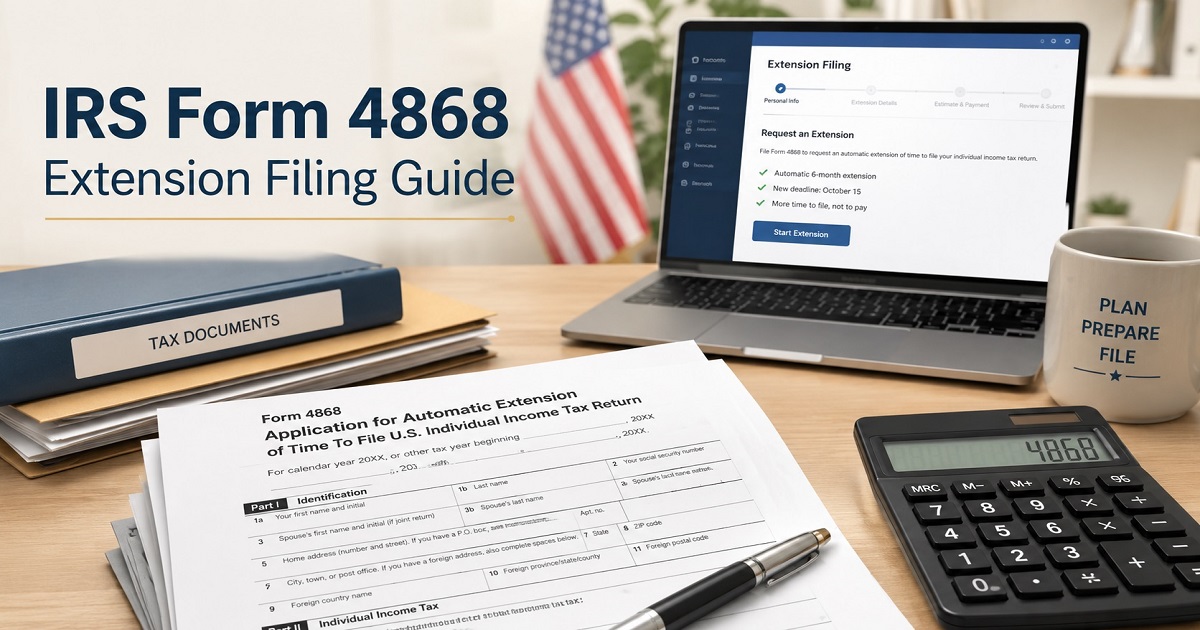
IRS Form 4868 is the application for automatic extension of time to file U.S. Individual Income Tax Return which is used by individual taxpayers who require more time to file their federal income tax return.
Form 4868 Meaning in Simple Words
The simplest interpretation of Form 4868 is that it’s a request for additional time to submit your tax return. It’s not a plea of a temporary postponement of tax payments. It’s not a tax debt settlement form, penalty removal request or IRS payment plan application.
If approved, usually taxpayers have up to six months to file after receiving Form 4868. That’s why it is sometimes referred to as a Form 4868 tax extension or IRS tax extension form.
Which Tax Returns Can Be Extended?
Individual income tax returns, such as:
- Form 1040
- Form 1040-SR
- Form 1040-NR
- On Form 1040-SS (if applicable),
This could impact U.S. citizens, residents, seniors who use the Form 1040-SR, some of the self-employed, and non-resident taxpayers who fill out Form 1040-NR.
Who Commonly Uses Form 4868?
There are several reasons why individual FILING OF FORM 4868. Others are waiting to receive missing tax documents. Others may require more time due to having complex business income, freelance records, investment transactions, rental property income, and/or K-1 forms.
What Form 4868 Does Not Do
Form 4868 comes in handy, but it’s not all-powerful. There are a number of IRS pitfalls that can be avoided by understanding these limits.
It Does Not Give More Time to Pay
The tax extension is not an extension of time for the IRS to be paid, but rather it is an extension of time to file paperwork. If you have tax to pay, it’s best to pay the balance before the April tax deadline. That’s regardless of an extended filing deadline of October 15.
The question that many taxpayers ask is, “Does Form 4868 extend the time to pay taxes?” The answer is no. The IRS may impose a failure to pay penalty and interest on any remaining tax liability if you file an extension and don’t pay the taxes.
It Does Not Remove Interest Automatically
Just because you file the extension properly doesn’t mean there won’t be penalty and interest charges for unpaid tax. The filing of Form 4868 may be helpful to minimize or eliminate a failure to file penalty, but will not prevent interest from accruing on unpaid tax.
It Does Not Fix Prior-Year Tax Problems
Form 4868 is only applicable to filing for the current tax year. Does not address old IRS notices, tax debt, old IRS audits, wage garnishments or unfiled tax returns. For individuals with IRS collection issues, tax compliance assistance or IRS notice assistance as well as professional tax resolution help might be required.
IRS Form 4868 Deadline: When Should You File?
Form 4868 is a form that must be filled in before the regular federal tax return deadline (usually April). Due dates may be adjusted to the next business day on weekends and/or legal holidays.
Regular Deadline for Most Individual Taxpayers
Normally, taxpayers will have to file Form 4868 by the April regular tax filing deadline. If you owe any taxes, a late-filed return might not be the remedy you’re looking for when it comes to hiding from late filing penalties.
October 15 Extended Filing Deadline
If you need more time to file your federal income tax return, you will have until Oct. 15. It’s the usual tax deadline that taxpayers think of when it comes to extensions, which is October 15.
The October 15th is NOT a new payment date, it is an extended filing date. The original April due date for any tax remains as they are due.
Special Situations: Taxpayers Abroad and Disaster Relief
Some international taxpayers, military or disaster hit taxpayers have special deadlines. There may be other extension rules for taxpayers overseas, and other concerns arise, such as payment and interest.
The following rules apply to the U.S. and disaster relief situations only, and taxpayer facts will dictate the rules applied to any other situation, so it is advisable to check the official IRS guidance or consult a tax expert.
How to File IRS Form 4868 (Step-by-Step Guide)
If you are looking to learn how to file Form 4868 step by step, it’s not too difficult to do, but it’s important to get it right.
Step 1: Estimate Your Total Tax Liability
Prior to filing Form 4868, calculate the total amount of tax you’re liable for in a year. Include any income records, deductions, credits, withholding and estimated tax payments that were made. This is not to be an exact number, but more of an estimate that is reasonable.
For instance, a freelancer can check the bank deposits, invoices, business expenses and previous year’s tax files to get an idea of the income that is taxable.
Step 2: Calculate Taxes Already Paid
Then, determine the taxes that have been paid. This can include estimated payments, payments of federal income taxes withheld from wages, refundable credits and other payments made throughout the year in the form of income taxes.
Step 3: Calculate Your Estimated Balance Due
Calculate taxes that have been paid and subtract from the total estimated taxes. The difference will be the amount of the balance you estimate you will have. If you have to pay back money, do so as much as possible in the extension.
Step 4: Choose a Filing Method
There are a number of methods to file Form 4868. The forms that may be filed electronically include tax software, IRS Free File, a tax professional, Form 4868 (paper or electronic), and an electronic payment that is paid as an extension payment.
Electronic tax extension filing is typically more rapid and much more beneficial confirmation records.
Step 5: Keep Confirmation Records
Keep an IRS payment confirmation, extension confirmation number, e-file acknowledgement, or a certified mail receipt, after filing. If the IRS tells you that it has no extension on file, these records will be necessary.
Ways to Submit Form 4868
There are multiple methods to fill out an application for federal tax extension.
Option 1: File Form 4868 Online
Form 4868 can be e-filed online using IRS Free File online filing service, tax software filing extension or a tax professional. This is typically the simplest alternative for taxpayers who wish to have speedy confirmation.
Option 2: Pay Online and Mark the Payment as an Extension
In certain instances, an electronic tax payment, coupled with appropriate marking as an extension payment may be considered an extension request. You can use approved payment methods such as IRS Direct Pay extension payments, debit card tax payment, credit card tax payment or digital wallet tax payment.
Option 3: Mail Paper Form 4868
Another option for filing Form 4868 with the IRS is by mailing it to their address. If you submit a paper Form 4868, be sure to use the right IRS mailing address and that it’s postmarked before the tax deadline. If the form is sent to the wrong address and/or late, then it can cause complications.
Option 4: Use a Tax Professional
If you have self-employment income, several income sources, IRS notices, previous year tax problems or have a large tax balance to pay, tax professional assistance is helpful. A professional can assist you to determine the amount of taxes due, to correctly file the extension, and to tell you about a payment plan.
When considering tax topics and tax filing options, a source such as a Smart Tax Guide can help readers in a practical manner to understand the next steps.
Required Documents and Details for Form 4868
You don’t have to fill out your entire tax return before you file Form 4868; but you need enough information to make a reasonable estimate.
Personal Information
If you are filing a joint return, you will need your name, address, Social Security Number and spouse’s Social Security number.
Tax Estimate Information
You’ll have to include your estimated total tax liability, the total amount you’ve already paid and the amount that you expect to pay, and the amount you’re paying with the extension.
Supporting Records to Review Before Filing
Some useful records are W-2 forms, 1099 forms, K-1 forms (if applicable), records of business income & expenses, estimated tax payment records, records of prior year’s tax returns, IRS Online Account payment history, and the records of tax software.
This Form 4868 checklist will assist you avoid wrong amount errors and delay problems in getting the tax returns prepared.
How to Pay Taxes With a Form 4868 Extension
One of the most crucial steps in tax payment is to pay taxes with an extension.
IRS Online Payment Options
There are options available to taxpayers to pay their taxes using the IRS Direct Pay, IRS Online Account, EFTPS, debit card, credit card, or any digital wallet accepted by the IRS. Taxpayer may pay via tax software or by an authorized tax professional.
How Much Should You Pay?
Pay as much as possible of the estimated amount of the tax due. If you can’t afford the entire payment, then any payment will help lower the penalties and interest.
In the case of a debt of $4,000, if the payoff is $2,500, then it’s better to pay $2,500 than $0.
What If You Cannot Pay the Full Tax by the Deadline?
Don’t put off paying your taxes, if it’s not possible to do so on time. Submit the extension on time, make payment that you can make and make an IRS payment plan after extension. Depending on the amount of tax owed, and the taxpayer’s compliance history, the IRS may be willing to set up an installment agreement after extension.
Fees, Charges, Penalties, and Expected Costs
Is There an IRS Fee to File Form 4868?
There is no fee requested by the IRS to get a federal tax extension. You could incur fees, however, if you utilize a tax software, a tax expert, or some payment processors.
Possible Payment Processing Fees
Tax payments made using a debit card, credit card and digital wallet may have third party processing fees. Other forms of direct bank payment might be more cost-effective.
Failure-to-Pay Penalty
Failure to pay penalty could result in penalties if the tax hasn’t been paid on time. Typically it is lesser than failure to file penalty but can still accumulate over time.
Failure-to-File Penalty
Failure to file penalty may be imposed should you not file your return on time or a valid extension. This is why it’s important to fill out Form 4868 if you require more time.
Interest Charges
The Interest may accrue until the unpaid balance of tax is paid. Interest will not be waived if an extension is filed.
Common IRS Form 4868 Mistakes to Avoid
Mistake 1: Thinking the Extension Also Extends Payment
This is the worst mistake that could possibly be made. This extension is to extend the time for filing, not paying.
Mistake 2: Estimating Tax Due Too Low
Your estimated tax due could be inadequate and you may be liable for penalties and interest. Be careful in using the records and make a reasonable estimate.
Mistake 3: Filing After the Deadline
Deadline extensions may not be of benefit if you are a taxpayer with tax debt. Do file ahead of time, if possible.
Mistake 4: Mailing Form 4868 to the Wrong Address
IRS mailing address may be different depending on the state and situation. Please always use the current Form 4868 instructions.
Mistake 5: Losing Proof of Filing or Payment
Keep every confirmation. Proof can be useful to iron out the issue if the IRS denies that your tax extension was received.
Mistake 6: Using the Wrong Tax Year
It’s possible you could still get a tax bill even if you paid if the IRS took your payment to the wrong year. Specify tax year and type of payment.
Common Form 4868 Errors and How to Fix Them
Form 4868 Rejected by IRS
Rejected notice of a Form 4868 may occur due to a mismatch in Social Security numbers, incorrect prior year AGI, duplicate filing, name mismatch, wrong tax year or a tax software error.
If you were denied the extension, fix the problems and resubmit the extension as soon as you can.
IRS Says No Extension Is on File
If the Internal Revenue Service (IRS) doesn’t report that an extension has been filed, review your e-file acknowledgement, IRS payment confirmation, IRS mailing proof, IRS Online Account and tax software records.
Extension Filed but IRS Sent a Notice
Don’t panic if an extension was filed but a notice of IRS received. The items in the notice can be late payment, missing return, payment mismatch, tax year mismatch or IRS processing delay.
Payment Made but Not Applied Correctly
Verify the payment year, payment type, confirmation number and IRS account transcript. If necessary, call the IRS with the information on the notice.
What Happens If You Miss the Form 4868 Deadline?
If you did not file for tax extension, the next step on your part will be determined by whether or not you are indebted to the IRS.
If You Owe Tax
You have made an error by not filing an extension on your tax return and you owe tax, you should file the tax return as soon as possible and pay the taxes you owe. Penalties for late filing and/or non-payment may apply.
If You Are Due a Refund
When it comes to refunds, penalties are generally not as significant as they are when you pay the tax that you owe, since being due a refund is generally less the reason for penalties. However, it’s best to file your return as early as possible to receive your refund and maintain up-to-date records.
What to Do Immediately
Fill out tax return as early as possible. Pay what you can. Carefully read IRS notices. Take a look at a plan of payment. If applicable, seek Penalty Relief. If the balance, notice or compliance issue is significant seek professional tax assistance.
IRS Notices After Filing an Extension
An IRS notice after tax extension may be confusing if you think that you’ve done everything right.
Why You May Receive an IRS Notice
These are usually due to unpaid balances, late payments, failure to return the form by the deadline, incorrect year of the payment, declining to pay if the payment was not accepted, or math or income reporting errors.
What to Do Before Responding
Before you reply, make sure to review your tax files, payment confirmation, extension filing proof and filed tax return with the IRS taxpayer notice.
When to Contact a Tax Professional
If the notice contains penalties, IRS has indicated there was no extension, you can’t pay the tax, the IRS is enforcing on multiple tax years or the notice references wage garnishment, levy, or lien risk, consider seeking professional IRS assistance.
Legal and Tax Compliance References
Internal Revenue Code Section 6081
A checklist of legal and tax compliance references. Legal and tax compliance references checklist.
The Internal Revenue Code contains Section 6081.Section 6081 of the Internal Revenue Code exists.
There are extensions of time to file certain returns provided by Internal Revenue Code Section 6081.
Treasury Regulation Section 1.6081-4
The regulations in Treasury Regulation Section 1.6081-4 address automatic extension of time for filing of an individual income tax return.
Internal Revenue Code Section 6651
Mostly associated with failure-to-file and failure-to-pay penalty provisions is Internal Revenue Code Section 6651.
Important Compliance Note
Form 4868 is not a tax debt settlement tool, it’s a tax filing compliance solution. You might require help with professional tax resolution, IRS penalty relief request, IRS payment plan or IRS reasonable cause penalty abatement, if you’re unable to pay.
Real-Life Examples and Practical Situations
Example 1: Self-Employed Freelancer Who Owes Tax
A freelancer is aware that he or she is required to pay tax, but has not completed bookkeeping. They file Form 4868 prior to the deadline, make an estimate of income, pay as much as they can and file ahead of October 15th.
Example 2: Employee Waiting for Corrected Tax Forms
An individual working as a W-2 employee is awaiting a corrected brokerage statement. The filing of Form 4868 provides additional time to accurately file and to avoid an amendment at a later time.
Example 3: Taxpayer Abroad
Individuals who are U.S. citizens outside of the U.S. may have special extension rules, and should be aware of payment and interest considerations.
Example 4: Taxpayer Receives IRS Notice After Extension
A taxpayer files an extension, but incorrectly pays the extension for the wrong year. Before they respond they will need to review the payment records, IRS account transcript and the notice.
Should You File Form 4868 Yourself or Hire a Tax Professional?
When DIY Filing May Be Enough
If you have basic W-2 income, no tax burden, no IRS correspondence and no problems with self-employment or problems with filing the previous year, DIY filing might suffice.
When Professional Help Is Recommended
Professional tax extension assistance is beneficial for anyone who has self, business or a large unpaid tax balance, IRS penalties, an extension being rejected, IRS notice after extension, unfiled prior tax returns or a need for a payment plan.
When a Tax Lawyer May Be Needed
If you are under a threat of IRS collection, facing a tax penalty or a dispute with the IRS regarding the abatement of that tax penalty, have a large balance due, an IRS audit, a tax dispute, wage garnishment, a concern about an IRS levy, a complicated tax compliance issue, or other factor, a tax lawyer may be needed.
Smart Tax Guides will be helpful to readers needing to prepare clear explanations before consulting a tax professional, for more practical filing and IRS problem solving.
Official IRS Portal and Contact Guidance
Where to File or Pay Online
IRS Free File, IRS Direct Pay, IRS Online Account, EFTPS, IRS-approved payment processors, tax software, or an IRS-authorized tax professional can be used by taxpayers to access their IRS tax accounts.
Where to Mail Form 4868
The instructions on the current IRS Form 4868 will provide the correct address to mail to. Mailing addresses may differ depending on tax payers’ status, payment, and state.
If You Received an IRS Notice
Call the phone number or address listed on the IRS notice. Avoid using random phone numbers that you may find online as IRS notices will contain instructions on how to respond.
IRS Form 4868 Checklist Before You File
When preparing to submit check: make sure to verify tax year, taxpayer name, SSN, estimated total tax liability, taxes already paid, how much you can pay, how to pay, payment confirmation, extension confirmation, and the October 15 filing deadline.
This final review can avoid issues with filing extensions, problems with the tax year or confirming issues.
Conclusion
Form 4868 is a helpful form to use if you cannot get your federal income tax return completed and filed by its due date. It’s not an excuse to postpone payment, however. The best way to do this is to file the extension on time, accurately estimate your tax liability, pay as much as you can by April’s deadline, ensure you have a copy of the tax extension and all payments and have a copy of any IRS notices.
When tax advice is needed, having a professional help you out will minimize errors and safeguard your tax compliance role if you’re not sure what you owe, received a tax notice, forgot time to pay, or are unable to pay the entire tax amount.
FAQs
What is IRS Form 4868?
IRS Form 4868 is the name given to IRS Form 1040 Extra that individual taxpayers use to ask for an automatic extension of time to file their federal income tax return.
Does Form 4868 give me more time to pay taxes?
Taxes are generally due by the regular April filing deadline, but there is an extension of time to file in No. Form 4868.
How long is the IRS Form 4868 extension?
A valid extension for individual taxpayers is generally until Oct. 15 and provides up to six additional months to file, for most.
Can I file IRS Form 4868 online?
Yes. In general, you can e-file Form 4868 with the IRS via IRS Free File, tax software or a tax professional.
Can I file Form 4868 if I owe taxes?
Yes. If you are liable to pay taxes, you can file Form 4868 but you should try to estimate and pay as much as you can by the deadline.
What happens if my Form 4868 is rejected?
Review the “Rejection reason” and correct any names, Social Security number, AGI or tax year discrepancy and resubmit before the deadline.
What if I missed the IRS tax extension deadline?
File your tax return as quickly as possible, pay as much as you can, and read any IRS notice that you receive; and consider penalty relief or professional tax help.
Should I hire a tax professional for Form 4868?
While you don’t necessarily have to get help for an extension, professional help is beneficial when you owe tax, have self-employment income, an IRS notice or face IRS penalties.