IRS Enforcement Process Explained: Step-by-Step Guide to Notices, Liens, Levies and Tax Debt Relief
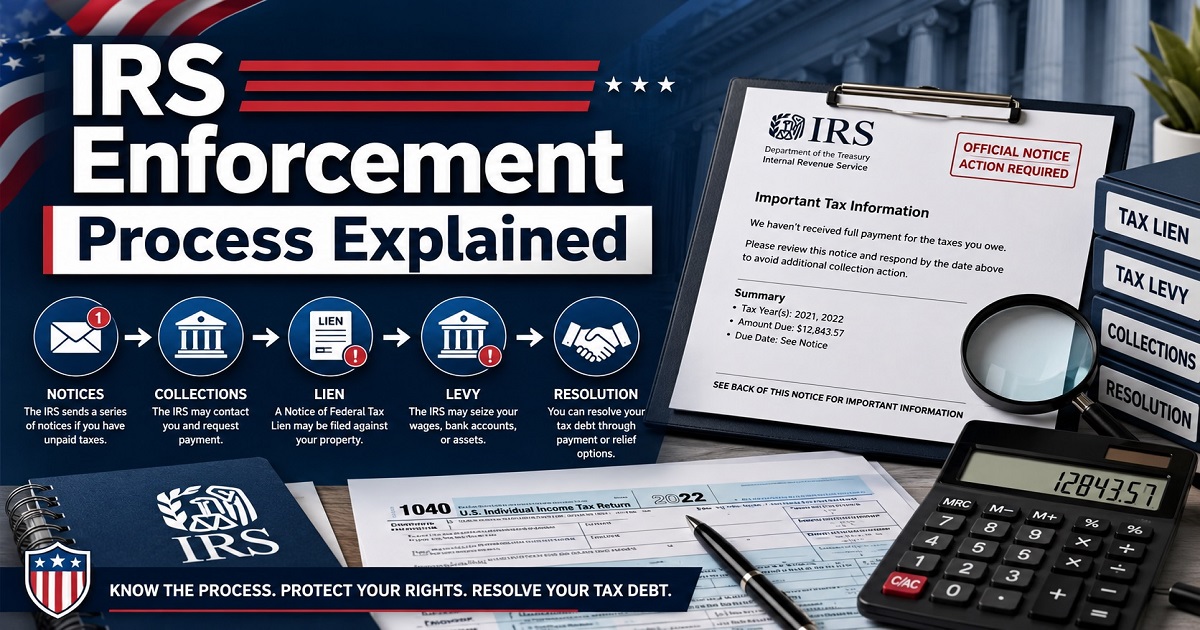
From the standpoint of Advocate Shahid (Tax Strategy and Advisory Specialist). The IRS Enforcement Process will usually start with a letter indicating that the tax is owed, and then take escalating steps if the tax is not paid. Steps include audit, filing federal tax liens, and forced collection such as wage garnishments, bank levies. Whenever extreme asset seizures happen they are preceded by a series of warnings and opportunities for taxpayers to respond.
An awareness of the continuum of enforcement can assist in determining where you and/or your client are at, and what you need to do as a result:
IRS Enforcement Process at a Glance
| Stage | What Happens | Main Risk | Best Response |
|---|---|---|---|
| Tax assessment | IRS records your tax liability | Balance due begins | Check your IRS account balance |
| IRS tax bill | CP14 notice or balance due notice arrives | Penalties and interest grow | Respond early |
| Collection notices | CP501, CP503, CP504, LT11 or Letter 1058 | Final warning before enforcement | Contact IRS or request payment options |
| Federal tax lien | Notice of Federal Tax Lien may be filed | Credit, property and business impact | Pay, appeal or request lien relief |
| IRS levy | IRS may take wages, bank funds or property | Wage levy, bank levy, seizure | Request CDP hearing or collection alternative |
| Resolution | Payment plan, OIC, CNC or penalty abatement | Wrong response can cost more | Choose based on financial condition |
How IRS Tax Enforcement Begins After Unpaid Taxes
Typically, the IRS tax-enforcement initiative begins following a tax assessment. Tax Assessment is when the IRS has officially recorded the amount of the taxes on the taxpayer account. This may occur in the event that there is tax due following a filed tax return, or following an audit, substitute return or other tax compliance problem.
IRS doesn’t typically aggressively collect unpaid taxes. First, it will send an IRS bill or IRS demand for payment. The IRS may proceed with collection notice and ultimately force the money out of the taxpayer’s system if he or she does not respond to the IRS’s correspondence. The IRS Collection Process consists of notices, penalties, taxpayer rights, Appeals and payment/release options.
One actual case in point is an individual who is self-employed and submits a tax return with a $18,000 balance due, but can’t afford to pay. Initially, they will get a CP14 notice. They procrastinate, assuming that they will “catch up later.” After a few months, late payment penalty, interest and possibly the failure to file penalty was added to the amount due IRS. Once a tax bill becomes an IRS debt collection process.
IRS Collection Notices and What Each One Means
For many taxpayers, the notice stage provides time to correct the problem before a levy or lien is an issue. IRS tax debt letters may contain:
CP14 Notice: First IRS Tax Bill
A CP14 is likely to be the first balance due notice that the IRS sends. It informs the taxpayer that there is an amount of taxes that the IRS has recorded. It’s the time to pay IRS tax debt, to setup an IRS payment plan, or to contact the IRS if the tax debt amount is incorrect.
CP501 Notice: Reminder of Unpaid Tax Debt
Typically, a CP501 notice is a notice from the IRS to remind you that your tax bill hasn’t been paid. May refer to balance due, penalties, interest and payment options.
CP503 Notice: More Urgent IRS Warning Letter
A CP503 notice is a more serious notice. When it’s this, the IRS has not received payment or a response from a taxpayer. Now, it’s time for the taxpayer to not ignore the IRS collection notice.
CP504 Notice: Warning Before Stronger Collection Actions
A CP504 notice could notify about the potential levy action and may include a federal tax lien risk. When this letter is received by many taxpayers they begin their search for “what happens after an IRS notice” or “how long before IRS starts collection”.
LT11 or Letter 1058: Final Notice of Intent to Levy
One of the most important IRS enforcement letters that could be sent out is the LT11 notice or other IRS letter 1058. It notifies the taxpayer that the IRS would like to take ownership of the property or the right to the property if the debt is not settled. Taxpayers normally have 30 days from the date on LT11 or Letter 1058 to file a Collection Due Process hearing on Form 12153 with the IRS.
IRS Lien vs Levy: What Is the Difference?
A taxpayer may be mistaken about the difference between IRS lien and IRS levy.
A federal tax lien is a legal claim by the government for the unpaid tax debt on property. The actual tax law seizure of property to collect the tax debt is a tax levy. A lien protects the government’s interest, but a levy comes with the property, the IRS says.
| Topic | IRS Lien | IRS Levy |
|---|---|---|
| Meaning | Legal claim against property | Legal seizure of property |
| Action | Secures government interest | Takes money or assets |
| Examples | Notice of Federal Tax Lien | Bank levy, wage levy, property levy |
| Impact | Can affect property, credit and business assets | Can immediately affect wages or accounts |
| Solution | Lien release, lien withdrawal, lien discharge, lien subordination | Levy release, appeal, payment plan, CNC or OIC |
So, in a sense, the answer is yes, because if authorized by law, the IRS can seize money in a bank account via a bank account levy. When asked to the question, “Can IRS take his or her property for tax debt?” in some instances, yes, because if the notices are not received and the tax debt is not addressed.
How the IRS Tax Lien Process Works
Federal tax lien can be created at the time the IRS will demand that the tax debt be paid, if the taxpayer does not pay it. When the IRS files a Notice of Federal Tax Lien, it is a form of public notification of the IRS claim. This can have an impact on real estate, personal property, business asset rights, accounts receivable and future assets acquired while the lien is in place. When the federal government doesn’t collect taxes, it has an interest in the property through a federal tax lien, the IRS states.
There are several ways to handle an IRS lien:
- IRS lien release after the debt is paid or legally satisfied.
- IRS lien withdrawal in qualifying cases, which removes the public Notice of Federal Tax Lien.
- IRS lien discharge, which removes the lien from specific property.
- IRS lien subordination, which does not remove the lien but may allow another creditor to move ahead of the IRS.
- Installment agreement, especially a qualifying direct debit installment agreement in some situations.
That’s why you can’t have a single answer to the question of how to remove IRS lien. The best choice depends on the amount of money that is due, a taxpayer’s compliance record, the type of property that is owed, and if the taxpayer can pay, settle, or prove hardship.
How the IRS Levy Process Works
A levy by the IRS is more pressing than a lien since it is removing property or cash. A levy can be placed on wages, a bank or financial account or vehicles, real estate or other personal property, according to the IRS.
The IRS will typically proceed with the levy in this manner:
- IRS is the one that is responsible for assessing the tax.
- A notice and demand for payment is sent by IRS.
- Taxpayer’s repayment is not made or settled.
- IRS sends a Final Notice of Intent to Levy and notice of appeal rights.
- Without action, the IRS will send a wage levy, bank levy, social security levy, business asset levy or property levy.
A wage garnishment will remain in effect until the tax debt is paid, released or settled via a collection option. A bank levy is unique in that it seizes and holds the money that’s in the bank. It may be possible to release a levy if a taxpayer is experiencing financial hardship, the IRS may ask for financial details.
IRS Enforcement Process Explained Step by Step
Step 1: IRS Assesses the Tax
The IRS has the tax liability on the taxpayer account. This can be due to a filed return, audit, correction or other IRS activity.
Step 2: IRS Sends a Tax Bill
The IRS sends a notice to the taxpayer indicating how much is owed to the IRS in the form of a tax bill, IRS notice letter or payment demand notice.
Step 3: Penalties and Interest Continue
Tax fines and interest could continue to increase. The failure-to-pay penalty is normally a one per cent a month, or part of a month, of the unpaid taxes, up to a maximum of 25 per cent.
Step 4: IRS Sends Collection Notices
The taxpayer could be sent a certified letter from the IRS, CP14, CP501, CP503, CP504, LT11 or a Letter 1058.
Step 5: Taxpayer Has Appeal Rights
The taxpayer has the rights to appeal, challenge IRS action and to have a representative present. You may have Collection appeal rights, such as a Collection Due Process hearing, and/or IRS appeals process.
Step 6: IRS May File a Federal Tax Lien
The IRS may even issue a Notice of Federal Tax Lien if the tax debt is not fulfilled.
Step 7: IRS May Levy Wages, Bank Accounts or Property
When the taxpayer still doesn’t react, the IRS can take tax levy steps to forcibly collect.
Step 8: Taxpayer Resolves the Debt
Some resolution options are full payment, IRS payment plan, offer in compromise, currently not collectible status, partial payment installment agreement, penalty abatement or appeal.
Smart Tax Guides also can be a useful tool when structuring IRS notices, forms and the next steps in the tax process.
Taxpayer Rights During IRS Collections
There are steps that taxpayers can take to fight IRS collections. The Taxpayer Bill of Rights lists the rights that include the right to be informed, the right to pay no more than the proper, the right to challenge the position of the IRS, the right to appeal, the right to representation and the right to finality.
This is because the taxpaying public is able to contest its IRS account balance, petition the IRS Independent Office of Appeals to review, request IRS collection alternatives, and if it is a serious hardship, can seek assistance from the Taxpayer Advocate Service.
What Is a Collection Due Process Hearing?
An IRS Independent Office of Appeals hearing that is also known as a Collection Due Process hearing is a hearing held by the IRS Independent Office of Appeals that may be used by a taxpayer to contest some actions by the IRS in proposing a lien or levy. It is often associated with a Collection Due Process notice, LT11 or Letter 1058 or lien filing notice.
Taxpayers normally file a Form 12153 to request a CDP hearing. The hearing may consider the IRS’s actions, whether they are in compliance with proper procedures, the taxpayer’s eligibility for a collection alternative, and enforcement action.
But a CDP hearing is not for all situations of a second bite at the apple when it comes to tax debt. In Goza v. Commissioner, 114 T.C. 176, the Tax Court detailed that in general the tax liability itself can only be challenged during a CDP proceeding if the taxpayer had not been previously given the opportunity to challenge the tax liability, such as through a notice of deficiency.
IRS Tax Debt Resolution Options
Pay in Full
If it’s possible to pay in full, then this is the cleanest way, as this will prevent any further collection pressure and decrease any further penalties and interest.
Short-Term IRS Payment Plan
It may be possible for a taxpayer to pay in instalments with a short term payment plan. Today, the IRS lists short-term payment plans as being available for 180 days in many situations, and has no fee to set one up; however, penalties and interest will still accrue until the amount is paid in full.
Long-Term Installment Agreement
A long term payment plan (installment agreement) allows taxpayers to pay their tax in installments. As long as $50,000 or less is owed for combined tax, penalties and interest, and if necessary tax returns have been filed, people can sometimes file online.
Online Payment Agreement and Form 9465
The IRS has an online system for taxpayers to use to set up payment agreements. You can also fill out Form 9465 to ask to have an installment agreement set up.
Offer in Compromise
The IRS OIC is an offer in compromise that can help those who qualify to pay less than what they owe the IRS. There are a number of documents required by the IRS, such as Form 656, Form 433-A(OIC) or 433-B(OIC), an application fee of $205 (unless there is an exception) and a payment in full.
Currently Not Collectible Status
If financial hardship would result if the item were to be collected, it may be temporarily placed in the Currently Not Collectible (CNC) status. This is not a cancellation of the Federal tax debt. Penalties and interest may go on, but if the taxpayer continues to be unable to pay, collection of penalties may be suspended.
Penalty Abatement
Penalty abatement could be a way to lower the rate of failure to file penalty, failure to pay penalty, or other penalties. Taxpayers may be eligible for a penalty abatement for the first time, and reasonable cause may be available if, for example, the taxpayer suffers a serious illness, experiences a disaster, has lost its records or suffers for another valid reason.
IRS Enforcement Fees, Penalties and Payment Plan Costs
IRS rates may change, please check the IRS.gov for up-to-date information. According to the most up-to-date information on the IRS online payment agreement, the fees charged for a payment plan are as follows:
| Option | Current IRS Setup Fee |
|---|---|
| Pay now | $0 setup fee |
| Short-term payment plan | $0 setup fee |
| Long-term direct debit installment agreement | $22 setup fee |
| Long-term non-direct debit plan | $69 setup fee |
| Revise or reinstate online payment plan | $10 setup fee |
| Offer in compromise | $205 application fee plus initial payment unless exception applies |
These fees are listed on the IRS online payment agreement page and penalties and interest are added to the balance until it’s repaid in full.
Documents Required to Resolve IRS Enforcement
Taxpayer response is stronger when documents are ready. Common documents include:
- IRS notice or letter
- Social Security number or ITIN
- IRS Online Account access
- Tax return copies
- IRS account balance details
- W-2s, 1099s or business income records
- Bank statements
- Pay stubs
- Rent or mortgage proof
- Utility bills
- Vehicle loan statements
- Medical expense proof
- Business profit and loss statement
- Form 9465 for an installment agreement
- Form 433-F, 433-A or 433-B for financial disclosure
- Form 656 for offer in compromise
- Form 12153 for CDP hearing
- Proof of financial hardship for CNC status or levy release
If a taxpayer organizes his/her tax forms using Smart Tax Guides, he/she should check the IRS form requirements with the IRS or a qualified tax professional.
Real IRS Enforcement Case Laws and Case Studies
United States v. National Bank of Commerce, 472 U.S. 713
This case was about IRS’s ability to levy on joint bank accounts. The Supreme Court considered whether IRS can levy an account where the delinquent taxpayer holds the rights to access the funds. The lesson learned here is that getting a bank levy can be a big deal and particularly when the taxpayer has a property interest in the account.
United States v. Rodgers, 461 U.S. 677
Federal tax lien enforcement and property sales were issues in this case. In select tax lien enforcement cases, the Supreme Court has ruled that federal district courts may order the sale of the house, not just the delinquent taxpayer’s share, under Section 7403, while allowing for the protection of the compensation rights of a nondelinquent spouse.
Practical Case Study: Self-Employed Taxpayer
After a number of years of underpaid estimated tax, a contractor is $32,000 in the hole for unpaid taxes. He is responsive to CP14, CP501 and CP503, but is not responsive to anything else. He finally logs in to his taxpayer account after CP504 and Letter 1058. If accepted, a long-term installment agreement could stop any more IRS enforcement action since he has paid all the returns and has money to pay the monthly installment.
Practical Case Study: Financial Hardship
A person who doesn’t pay a federal tax debt, even when the IRS has sent him a certified letter, is liable to a bank levy. Levy doesn’t permit rent and food payments. In this case, the taxpayer can apply for the release of the levy because of financial hardship, submit bank statements, pay stubs and proof of expenses, and request to see if financial hardship or a partial payment installment agreement is a viable option.
Common IRS Enforcement Problems and Solutions
| Problem | Why It Happens | Practical Solution |
|---|---|---|
| Ignoring IRS notices | Fear or confusion | Open every letter and track deadlines |
| Bank levy | Final notice deadline missed | Contact IRS and request levy release or payment option |
| Wage garnishment | No resolution arranged | Request installment agreement, CNC or appeal |
| Federal tax lien | Balance stayed unpaid | Pay, appeal, request withdrawal, discharge or subordination |
| Cannot pay full balance | Financial hardship | Consider OIC, CNC or partial payment plan |
| Penalties keep growing | Debt remains unpaid | Pay faster or request penalty abatement |
| Wrong IRS response | Wrong form or missing documents | Match solution with correct form |
| Missed appeal deadline | LT11 or Letter 1058 ignored | Ask about equivalent hearing or other appeal route |
Mistakes to Avoid During IRS Collections
Additional common mistakes include failing to include all financial documents with an offer in compromise, requesting CNC status without providing hardship documentation, not providing the IRS with hardship documentation when requesting a CNC status, not keeping copies of IRS correspondence and thinking that penalties and interest are waived during most payment plans.
The basic guideline is that there’s no point in waiting for a wage garnishment or bank levy. Take action on the initial IRS notice!
What to Do If IRS Enforcement Has Started
Follow this step-by-step procedure:
- Read the IRS notice carefully.
- Confirm the tax year, amount owed, deadline and notice type.
- Check your IRS account balance.
- File any missing tax returns.
- Decide whether you agree with the tax debt.
- If you disagree, review appeal or challenge options.
- If you agree but cannot pay, compare payment plan, OIC, CNC and penalty abatement.
- Gather financial documents.
- Submit the correct IRS form.
- Keep proof of mailing, fax confirmation or online submission.
- Follow up with the IRS.
- Stay compliant with future filings and payments.
Final Thoughts
The IRS enforcement process is one that is much more serious than it is unstructured. Taxpayers typically are notified of the collection process with notice, deadlines, and avenues for appealing prior to any aggressive collection action. The most important thing to do is not to panic. The best answer is to grasp and comprehend the IRS collection notice, preserve appeal rights and assemble documentation and select the appropriate tax resolution path.
Tax lien, federal tax levy, IRS wage garnishment, bank account levy, offer in compromise, installment agreement and currently not collectible status are all examples of situations in which the taxpayer will have more control if he or she acts early. While Smart Tax Guides will explain the process, it is important to note that no one should rely on them to understand the current IRS rules, and anyone who has a large amount and/or enforcement action has already begun should seek professional guidance.
FAQ
1. What is the IRS enforcement process?
The IRS enforcement process is the procedure followed by IRS to collect unpaid taxes. Can contain IRS notices, tax bills, penalties, interest, federal tax liens, levies, wage garnishment, bank levies, appeals and tax debt resolution.
2. What triggers IRS enforcement action?
Unpaid taxes, unanswered IRS notices, unpaid tax assessments, IRS notices rejected or failure to answer a Final Notice of Intent to Levy are all potential triggers for IRS enforcement action.
3. How many notices does the IRS send before levy?
The number can vary, but taxpayers may receive CP14, CP501, CP503, CP504, LT11 or Letter 1058. The LT11 or Letter 1058 is particularly significant as it could provide rights of appeal to Collection Due Process.
4. What is the difference between a federal tax lien and an IRS levy?
A federal tax lien is a legal claim that is against the property to recover tax debt. An IRS levy is actually a taking away of the property or funds such as wages or financial savings in the financial savings account, Social Security advantages, or enterprise assets.
5. Can the IRS garnish my wages?
Yes. If a wage levy is warranted under the requirements of the IRS and if the IRS has reason to believe that a taxpayer’s wages will provide it with the funds needed to satisfy its tax debt, it may levy wages. There are ways for taxpayers to either eliminate or minimize the wage garnishment, such as wage garnishment payment plans, hardship status, tax relief options such as appealing the wage garnishment, or other options.
6. How do I appeal an IRS levy?
After receiving a levy notice, you can appeal to the IRS by writing a letter to the IRS for a Collection Due Process hearing or by filing a form 12153 within the time limit indicated on the IRS notice of the levy. If CDP deadline has passed, there may be other appeal options available.
7. What happens if I cannot pay my IRS debt?
You could be eligible for a short-term payment plan, long-term installment agreement, offer in compromise, currently not collectible status, partial payment installment agreement or penalty abatement if you can’t pay.
8. Does the IRS forgive tax debt?
Tax debt cannot be automatically waived by the IRS. There are other options, however, for qualifying taxpayers to settle for less (offer in compromise) or to get a temporary delay (currently not collectible) or to reduce penalties (penalty abatement).