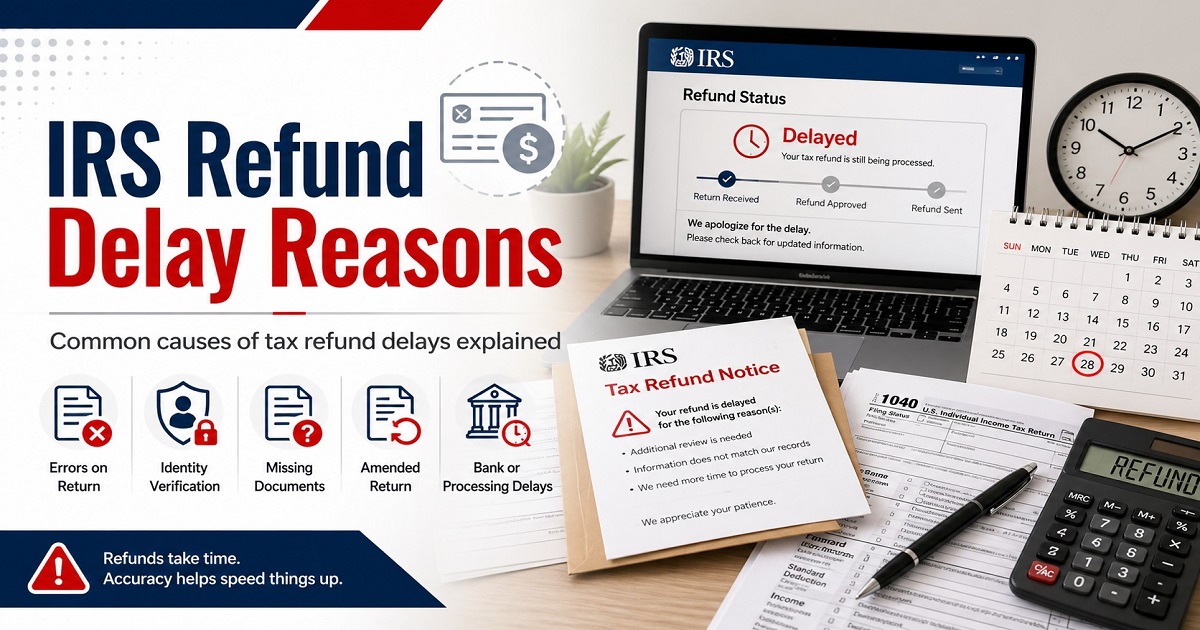
IRS Refund Delay Reasons (2026): Why Is My IRS Refund Delayed & How to Fix It Fast
As stated by Advocate Shahid (Tax Law and Advisory Specialist). IRS Refund Delay Reasons (2026) are mainly caused by attempts to decrease paper checks, identity verification, and errors when claiming new tax credits. The most common include math mistakes, incomplete returns, and claiming the EITC or ACTC which are withheld until mid-February. The IRS is also retaining up to 6 weeks of refunds in case no direct deposit information is given.
Top 2026 IRS Refund Delay Reasons
Paper Check Phase-Out and Direct Deposit Problems
IRS is phasing away paper checks, so that without bank account information, issuing a tax credit could require up to 6 weeks.
Processing slowdowns have been caused by errors in New Tax Breaks
High error rates or over-claiming of the new, complex overtime income deduction.
Identity Checking
Refunds may be withheld by IRS to check identities as a measure to curb fraud.
Credit Holds (EITC/ACTC)
Refunds with the Earned Income Tax Credit (EITC) or Additional Child Tax Credit (ACTC) are held until at least mid-February.
Math Errors or Incomplete Returns
Manual reviews are caused by errors, including missing signatures or incorrect Social Security numbers.
Amended Returns
The processing time of amended returns is much longer than that of standard returns.
Trading Debt
Refunds can be used to settle outstanding federal, state or child support debts.
Status Check
Use IRS Where is my Refund Tool that is updated daily or check your IRS Online Account notifications.
IRS Refund Processing Time & Timeline (2026)
The knowledge of a timeline of a refund by the Internal Revenue Service can help to alleviate stress and reduce unrealistic expectations.
Standard IRS Refund Schedule:
E-file returns: The average length of processing them is 21 days.
Paper returns: Approximately 6-8 weeks, as it is done manually.
Amended returns: Have a maximum of 20 weeks and above.
What “Tax Refund Still Processing” Means
When your status is still processing, it generally means that the IRS is reviewing your return- this may be because of some minor mistakes, checking of identity or other checks such as credits and income matches. It does not necessarily imply a problem, but does increase the IRS wait time to get the refund.
Real Example
One of the freelancers uploaded on-line hoping to get a speedy refund. Their return was however marked as a further verification was to be done due to their claim of the Earned Income Tax Credit (EITC). The refund was received after 5 weeks instead of 21 days, demonstrating that the ability to delay timelines due to the complexity of returns may vary depending on the complexity of the returns.
Top IRS Refund Delay Reasons Explained
Knowing the reason the Internal Revenue Service takes too much time to offer you a refund may help you resolve the problem on a faster time frame and avoid being panic-stricken.
1. Incorrect Tax Return Information
Among the most common ones, there are inaccurate information in the tax returns, error in filing tax returns with the IRS and error in tax returns. Even the slightest error can halt the processing.
Example: The wrong SSN or wrong bank information may cause errors in processing the IRS refunds and slowing down the payment.
2. IRS Identity Verification Delay
Delay in verification of identity by IRS is often caused by the detection of a fraud by IRS refund systems.
Case: A flagged return that is identity theft can take 30+ days before being verified is possible to refund it.
3. Missing Documents IRS Refund
Lack of forms such as W-2 or 1099 may result in a refund under review IRS status, and will hold up your refund until papers are verified.
4. IRS Backlog & Processing Issues
The backlog tax returns of IRS and limitations of the systems tend to cause delayed tax refund IRS cases, particularly during peak filing seasons.
5. Credits Causing Delay
Delay of earned income tax credit and the delay of additional child tax credit are typical.
These refunds are under the law held until mid-February under the Protecting Americans from Tax Hikes Act.
6. Refund Offset or Debt Issues
Refund offset IRS regulations permit deductions in case of a stand-off situation of refunding a tax debt.
Illustration A default of a student loan can lead to a lesser refund by IRS.
7. Amended Return Delays
The delay of amended return refund is greater as the amendments have to be reviewed manually, and processed again.
8. IRS Review Process
Tax return review process IRS can hold up refunds in case of discrepancies are discovered, resulting in IRS refund not approved status until fixed.
Common IRS Refund Problems (Real-Life Case Studies)
Real life experiences demonstrate how Internal Revenue Service (IRS) delays can oftentimes be solved with the appropriate actions.
Case Study 1
One of the examples of incorrect income reporting is the case of a taxpayer who was delayed in getting an IRS refund months after filing his tax returns. The discrepancy between the reported income and the records made by the employers caused a review. With the submission of supporting documents (W-2 corrections), the problem was corrected and the refund was disbursed in a few weeks.
Case Study 2
The refund of another filer was held up due to the identity checks. The IRS has raised a red flag over the return because of security reasons. After the online verification procedure by the taxpayer was done, the refund was approved and delivered within 10 days.
Case Study 3
In another instance, a taxpayer was paid less than he/she expected. This refund was vitiated by a notice issued by IRS which pointed out that there were prior-year taxes that were not paid. The rest was automatically applied and what it shows is the effect that offsets can have on the final amounts of refund.
Real Case Laws & IRS Rules You Should Know
Become aware of the major laws that caused Internal Revenue Service to hold refunds until they became aware of the issue.
1. PATH Act & Refund Delays
The Protecting Americans from Tax Hikes Act would provide that the IRS would delay the issuance of refunds to taxpayers claiming the Earned Income Tax Credit (EITC) or Additional Child Tax Credit.
👉 In a nutshell: Although you will be filing early, the IRS will still have to retain your refund until the middle of February in order to prevent fraud.
2. IRS Authority for Fraud Checks
The IRS has legal powers to suspend or detain the refunds in case it suspects that there is identity theft or suspicious activity.
👉 This is because your money will not be refunded immediately, as they will be more likely to verify your identity or income information, it is a protection measure, not a punishment.
3. IRS Refund Adjustment Notices
In case IRS notices any mistakes (such as wrong income or unpaid taxes), he or she can change the amount of your refund and send you a notice of the change.
👉 To simply put: When numbers do not match the records, they update it and notify you prior to the final refund being released.
Warning Signs – When to Worry About IRS Refund Delay
Although the vast majority of refunds issued by the Internal Revenue Service go off without any problems, there are some indications that you might have to do something about it.
With no refund after 21 days IRS (when filing e-filed returns), it might be worth taking a closer look at your status. Such a message as IRS refund is in processing weeks with no updates may indicate a problem with verifying or may be some kind of error.
More severe cases involve IRS refund that has been delayed several months, which in most cases refers to identity checks, missing documentation or amendment of returns complications. Also, complaints of IRS refund delay are on the increase every year, which points to the current backlog and challenges in processing, particularly during peak tax seasons.
When to Act
- None of the status updates after 21-30 days.
- You get letters of IRS asking information.
- The amount of your refund is suddenly changed.
In such instances, reviewing your return, promptly responding to IRS notices or even calling the IRS can help eliminate delays more quickly.
Step-by-Step Solution – How to Fix IRS Refund Delay
In case of a delayed refund, use this sensible procedure suggested by the Internal Revenue Service to determine and remedy the problem within the least amount of time:
Step 1: Check Status
Begin with Where is my refund status IRS tool also referred to as the IRS refund tracking tool. It features real time updates such as processing, approved or sent.
Step 2: Review Your Tax Return
Attentively examine mistakes that are related to tax filing IRS like wrong income, SSN or bank information. Minor errors may cause delays in the processing.
Step 3: Respond to IRS Notices
Don’t overlook the IRS refund adjustment notice that you received. Give prompt responses with the necessary documents to ensure no additional delays.
Step 4: Verify Identity
To fix the delay in identity verification by IRS, either verify online or through mail. It is also essential in case your returned is considered as a security issue.
Step 5: Contact IRS
In case of the delays, contact IRS to receive the delay support in the form of a refund. IRS customer service refund help is able to provide guidance to you depending on the particular case you have.
Step 6: Track Timeline
Keep track of the delays in IRS processing in regular intervals. Knowing updates will enable you to keep up with the updates and take early action in case of need.
How to Speed Up Your IRS Refund
Looking to find out how to get faster tax refund? Although you can never ensure that you will not have a delay, intelligent filing choices can enable you to receive payment sooner by the Internal Revenue Service.
File Electronically (E-file)
The quickest method is through e-filing. It also saves you time and money as it eliminates manual process and in most cases will have your refund processed within 21 days.
Avoid Errors
Check and recheck all the information– SSN, income and bank details. Delays are caused by simple mistakes to a large extent.
Use Direct Deposit
Use direct deposits, rather than paper checks. It is faster, safer and does not entail the delays of mailing.
Submit Complete Documents
Make sure that all documents (W-2, 1099, credits info, etc.) are correct and are attached. Reviews can be instigated by missing documents.
👉 Pro Tip
The best way to get your tax refund faster, and to avoid the avoidable IRS delays, is to file early, accurately and electronically with direct deposit.
Common Mistakes to Avoid
It can also be beneficial in saving time as a result of making simple mistakes when it comes to dealing with the Internal Revenue Service.
Incorrect Tax Return Information
The biggest reason of delays is entering incorrect information such as the SSN, income or filing status. Never forget to check and recheck prior to submission.
Missing Documents IRS Refund
The necessity to incorporate the necessary forms (W-2, 1099 or credit-related documents) may subject your refund to scrutiny and delay the process.
Ignoring IRS Notices
The non-response to IRS letters delays their own refunds by many taxpayers. Such announcements are commonly urgent to get your refund emancipated.
Filing Incomplete Returns
Posting of incomplete or inaccurate information will result in manual processing which will add a lot of processing time by IRS.
Wrong Bank Details
Wrong account or routing numbers may result in failed deposits and IRS will have to reissue your refund and add additional weeks.
👉 Tip
The keys to eliminating unnecessary IRS refund delays are accuracy, completeness and prompt responding.
Personal Experience Insight
I have observed clients panicking about the cases of the late tax refund USA when it appears that an update on the case is taking a long time or is not clear enough. In practice, the majority of delays occurred due to some minor issues, such as identity verification requests, minor errors when inputting data, or the lack of documents.
One of these, a client was keeping him waiting more than a month thinking that something really serious was wrong but it turned out that it was a minor SSN mismatch. After being rectified, the refund was received in a few days. One other client was not given his refund because of verification checks but once this was done online the refund was released in a short time.
👉 The Most Important Takeaway
Sometimes, IRS delays may seem complex, yet in most situations, they are just temporary and can be easily resolved by responding appropriately and taking the necessary actions.
What to Do If Refund Is Still Processing
When you get the message: why is my refund still processing, it may be frustrating, but it usually does not mean that the Internal Revenue Service has rejected your return, but is simply reviewing your return.
👉 What to do if Refund is Delayed
1. Check Your Status Regularly
Tracking updates Use IRS tracking tool to monitor updates. Status messages can always be updated when the reviews have been made.
2. Wait the Standard Timeframe
In case less than 21 days (e-file) or 6-8 weeks (paper) it is still possible that the delay is normal.
3. Look for IRS Notices
Look into your email and mail to see whether there are IRS letters in your mail requesting that you provide them with documents or verification of identity.
4. Verify Your Information
Make sure that you are using the correct details regarding your returns (income, SSN, bank information).
5. Contact the IRS if Needed
In case your refund is being processed out of the ordinary timeframes, contact to get some clarifications and instructions on what to do next.
👉 Bottom Line
Still processing normally refers to progress being made- it just needs some more time or effort on your part to finish.
FAQs Section
1. Why is my IRS refund delayed this year?
The delays can be typically due to the errors, identity verification checks or due to the IRS backlog tax returns processed by the Internal Revenue Service.
2. How long can IRS hold my refund?
Any refunds that are delayed past 21 days can be withheld by the IRS in case your return is under audit, needs verifying, or contains some credits.
3. Can IRS delay refund without notice?
Yes, particularly where there is a fraud detection or internal review process, where the immediate notice might not be given.
4. What are common IRS refund problems?
Among the common are wrong information and missing documents, identity checks and countering refunds of unpaid debts.
5. When should I worry about refund delay?
You ought to take note when there is no update after 21 days (e-file) or when you are unable to update after several weeks.
6. How do I contact IRS about refund delay?
To get in touch with the IRS customer support or to use formalized online tools, which can be found on the IRS site.
7. Why is my refund still processing?
Generally, it is your money that is under scrutiny or delayed because of checking or slight inconsistencies.
8. What causes IRS refund delays after 21 days?
Common reasons are errors in filing or tax credits such as EITC or identity verification or delays in processing backlog cases by the IRS.
9. Why is my IRS refund delayed in 2026?
The delays in 2026 are generally connected with the tax returns that have been backlogged in 2026, with identity checks, and increased fraud detection by the Internal Revenue Service. Mistakes in filing or claiming of specific credits might as well increase the time of processing.
10. Common IRS refund delay reasons explained
The most common reasons are the wrong information in the tax returns, missing entries (W-2 or 1099), refund under examination IRS status and the refund offset on unpaid debts. Such problems can be very tedious to have to look at manually.
11. What causes IRS refund delays after 21 days?
A delay of your refund past 21 days may be because of identity checks, mistakes in your tax return, or credits such as EITC which may require further verification. Time schedule varies depending on workload because there are instances that the processing of tax returns is delayed by the IRS.
12. How long does IRS take to process delayed refunds?
No definite time frame. Simple delays can be resolved within the forthcoming few additional weeks and complex cases (amended returns or reviews) can take 420 weeks or more, depending on the case.
Conclusion
Knowledge of reasons of delayed IRS refunds can keep you calm, informed and proactive. Majority of delays by the Internal Revenue Service are not permanent but most of the time they are caused by simple errors, verification checks or processing backlogs which can be resolved with appropriate measures.
Don’t worry, but be sure to review your return, reply to IRS notices, and generally monitor your status. Even little things can have a huge impact when it comes to hastening your refund.
👉 Call to Action
No need to wait and be confused–check the status of your IRS refund today, address any problems you have immediately and take a personal lead on the tax refund process to get faster results.