IRS Letter Response Template: How to Reply to an IRS Notice Correctly – Step-by-Step Guide
An IRS sample response letter is a written, formal template to respond to disputes or clarifications with the IRS, such as CP2000 notices or audits. It contains taxpayer and notice information, reasons for disagreement, and attachments. It’s also known as an IRS response letter, tax dispute letter or tax audit response letter.
What Is an IRS Letter Response Template?
According to Advocate Shahid (Tax Research and Advisory Specialist). This is a template that can be used to draft a response to an IRS notice, tax notice, audit notice, penalty notice or balance due. The template helps taxpayers to include the required information, such as the IRS notice number, year, taxpayer name and ID number, issue and supporting documents.
For example, Maria received a CP2000 that she under reported her self-employment income. She explained in an IRS response letter, that her income statement had a duplicate Form 1099. She attached her bank statement, her return (Form 1040) and the corrected income statement. The IRS accepted the response, and reduced the tax.
When Should You Respond to an IRS Letter?
IRS Notice Types
The IRS may send you various notices to be responded to:
- CP2000: Sent if there is a mismatch of income you reported on your tax return and the IRS. You have 30 days to respond.
- CP14: Sent if there are taxes to pay. This needs to be responded to quickly, to avoid interest charges. This should be responded to quickly (within 21 days).
- CP504: Received when there is tax unpaid and the IRS is going to seize your assets. This needs to be responded to within 30 days.
Legal Case
In Miller v. Commissioner, the taxpayer did not respond to the CP14 notice issued and was liable for a penalty of $5,000 for failure to pay and interest. This case shows that it is important to respond to avoid penalties.
Step-by-Step Solution
- Identify the notice: To determine what type of IRS notice you received (e.g., CP2000, CP14, CP504).
- Note the deadline: There is a deadline for responding (21-30 days).
- Gather documents: Gather any necessary documents (e.g., tax returns, pay slips).
- Respond on time: Mail your response or apply for an extension. Be sure to do so in time to avoid fines.
- Make sure you get a confirmation: Certified mail, or an IRS e-filing provider.
Common IRS Notices That Require a Response
Notice Types
IRS CP2000 (Underreporting of Income)
This is issued when the IRS has found an inconsistency between what you have reported on your tax return, and what someone else has reported to the IRS (such as an employer or bank). It’s a sign you may owe more taxes.
For example, Sarah got a CP2000 because she underreported her income from self-employment. Sarah provided the correct Form 1099 and other information, which the IRS corrected her tax return and tax.
IRS CP14 (Balance Due Notice)
If you have unpaid taxes. You will be charged interest and penalties if you don’t pay.
Example: John got a CP14 for not paying his taxes on his self-employment income. He responded by setting up a payment plan, to avoid further penalties and garnishing of his wages.
IRS CP504 (Final Notice of Intent to Levy)
This is the final notice the IRS is going to levy (garnish) property or assets to pay the taxes. It’s the final notice to avoid the IRS taking an action.
Example: Maria received a CP504 but didn’t respond. The IRS then levied her bank account. And now she knows to respond promptly, even if it’s to enter into an installment agreement to pay the debt.
IRS LT11 (Final Notice of Intent to Levy)
This is also a final notice (similar to CP504). If not dealt with, the IRS could take collection actions, including wage garnishing and liens.
Example: Mark was able to immediately enter into a payment plan with the IRS in response to an LT11. He was therefore able to avoid collection actions and having his wages garnished.
Examples of Issues
There are different actions for each notice:
- CP2000: If you believe the underreporting of income is wrong, then you will need to provide appropriate documentation, like amended 1099s or bank statements.
- CP14: If you agree with the balance due, then you should either pay the tax or request an installment agreement. If you don’t respond, you may be subject to additional penalties and/or a wage garnish.
- CP504 and LT11: If you receive these notices it’s important to respond. You’re required to pay the amount you owe, set up a payment plan or dispute the decision to avoid levy or seizure of assets.
These notices can be avoided and penalties such as liens, levies or garnishes can be prevented.
What to Include in Your IRS Response Letter
Required Information
When responding to an IRS notice, be sure to include the following information so that the IRS will take your response into account:
Taxpayer Identification Number (TIN)
This can be used to identify your taxpayer account.
Social Security Number (SSN)
Individuals’ TIN may be their SSN. It’s essential for identification of you.
IRS Notice Number
This is at the top of the IRS notice and enables the IRS to match your response to the problem.
Explanation or Dispute
If you’re responding to an IRS audit notice that you disagree with, include a description of the mistake you think was made. Be sure to explain how and why you disagree.
Supporting Documents
Include any documentation such as tax returns, amended tax returns, income statements, bank statements or other documents to support your explanation.
Real Example
Tom received a CP2000 stating that he reported income. He included his Social Security number (SSN), the IRS notice number and an explanation of the issue. He also attached his Form 1099 and bank statements to prove that he did report the income. This allowed his response to be processed rapidly and the IRS corrected his account to correct the error, which saved him time and energy in having to pursue this issue. This is a case where giving all the necessary information and explanations can help the IRS resolve tax issues faster.
IRS Letter Response Template Sample
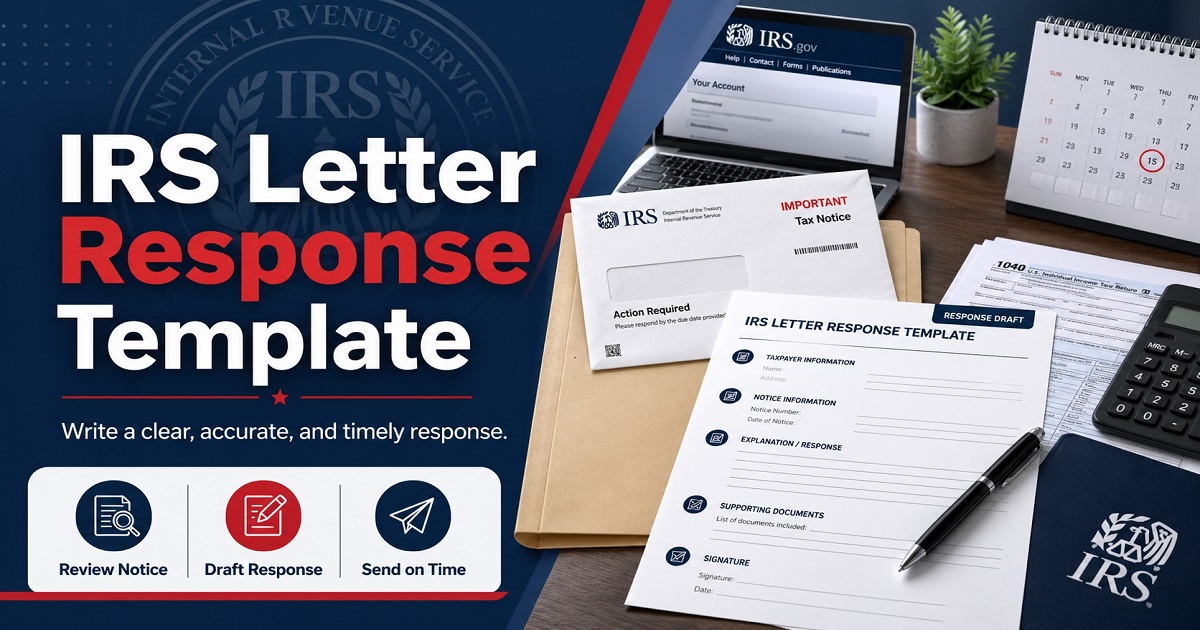
Sample Template: This is a template you can use to respond to the IRS in the form of a letter, which can be amended according to the notice you have received (CP2000, CP14 etc). The layout of the letter will be identical but its content will differ for each notice.
[Your Name]
[Your Address]
[City, State ZIP Code]
[Phone Number]
[Email Address]
Date: [Insert Date]
Internal Revenue Service
[IRS Address (as per Notice)]
[City, State, ZIP Code]
Re: Reply to IRS [Notice Number]
Taxpayer Identification Number: [TIN/SSN]
Tax Year: [The year it is about]
Dear Sir/Madam,
This is in response to your notice [Notice Number] dated [Notice Date] regarding [reason – e.g. “underreported income” or “balance due”]. I’ve reviewed the information in the notice, and would like to offer the following information to resolve the issue.
Explanation of Discrepancy
[Provide a succinct explanation of the issue you are writing about, e.g., if the notice is about underreported income, explain why the IRS’s notice might be wrong, including any facts and documents you have.]
Supporting Documentation
I have attached the following to support my claim:
[List of tax return, Form 1099, bank statements etc.]
I would be grateful if you could please add the above to my account. If you have any questions or need more information please feel free to contact me.
If you require any further information please contact me. Looking forward to hearing from you.
Sincerely,
[Your Signature]
[Your Printed Name]
Step-by-Step Walkthrough
Provide Your Information: Insert your information, such as name, address and phone number. This will help the IRS to reach out to you.
Provide Details about the Notice
Enter the IRS Notice Number and Tax Year. These will help the IRS to locate your account.
Explanation of Issue
Write an explanation of the issue. If you disagree with a CP2000 for underreported income, give the reason for miscommunication of the income reported on the Form 1099.
Include Documents
Include all the documentation to support your explanation. For example, with a CP2000 you would include the forms 1099, tax returns or bank statements of the correct income.
Finish with a Request
Please request the Internal Revenue Service (IRS) to review your documents and make the updates. With a CP14 (Balance Due Notice), you can request an Installment Agreement or Penalty Abatement, if needed.
Example: Filling out a CP2000 Letter Response for Income Discrepancy
Tom received a CP2000 that he underreported income from a Form 1099 of freelancing. He found that he was double billed on the Form 1099.
Tom’s response letter included
- A copy of his Taxpayer Identification Number (TIN).
- Why an error was made (e.g., “The income reported on the 1099 was erroneously reported twice by the issuer.
- Any supporting documents: his original and revised Form 1099 and tax return.
- He requested the IRS to correct his bill and it was amended.
Example: Writing a Penalty Abatement Letter for IRS Penalty Reduction
If you are requesting an adjustment to a penalty (e.g., late payment penalty), your letter will include:
- Explanation of why you incurred the penalty (e.g., “I was not able to make timely payment due to a medical emergency”).
- Evidence supporting the reason (e.g., bills, paystubs).
- The amount of penalty abatement requested, due to reasonable cause (IRS abatement guidelines).
- Using the above template and including all of the information, you can ensure that you have a formal response to the IRS.
Tips Before Sending Your Response to the IRS
Mistakes to Avoid
Providing Incomplete Information: Be sure to include all required information. This may delay the process and make it more challenging.
Failure to Respond
If you’re late responding to IRS deadlines, you may have to pay additional fees or have wages garnished. So, it’s essential to promptly respond.
Wrong Address
Make sure you use the address provided. This could cause your letter to not be read.
Certified Mail
Always send your letter to the IRS via certified mail so you have proof you sent it and that it was received in a timely manner – this will be important if the IRS claims they didn’t receive your letter.
Real-Life Story
One of our clients almost received additional penalties due to not sending in their Form 1040 with their CP2000 response. They hurriedly sent in the response (sent via certified mail) in time, thus avoiding further penalties. It’s important to pay attention to detail and keep records.
How Do I Respond to an IRS Letter?
Here’s what to do:
Read the Notice
Thoroughly read and understand the notice (e.g., tax return amount differ from information, tax owed).
Gather Documents
Gather documentation, like tax returns, forms (1099s, W-2s) and any evidence necessary to support your position on the IRS issue.
Prepare Your Response
Respond to the issue the IRS is concerned about, provide any necessary information and attach documents.
Submit Your Response
Be sure to include your response to the IRS in the correct office and timely.
What Should I Include in an IRS Response Letter?
Your response should include:
- Taxpayer Identification Number (TIN) or Social Security number (SSN).
- IRS Notice Number and Tax Year.
- Description of the issue.
- Attachments (such as tax return, amended forms, other documentation).
Can I Use a Template to Reply to the IRS?
It is OK to use a template to help you format your response and make sure you include all the information. You can use a template – it can help you format your response.
How Do I Dispute an IRS Notice?
To dispute an IRS notice:
- Provide a statement of disagreement: Briefly state your disagreement.
- Attach documents: Attach documents, statements or forms to prove your position.
How Long Do I Have to Respond to an IRS Letter?
How long you have to respond will vary, depending on the type of letter. For example:
- CP2000: 30 days to respond.
- CP14: 21 days to pay balance (or payment plan).
- Failing to do this timely will put you at risk for increased penalties, and/or garnishing.
Should I Send My IRS Response by Certified Mail?
It’s a good idea to send it by certified mail. It provides proof that you sent your response on time – which could be helpful if there are any issues.
What Happens If I Ignore an IRS Notice?
Not responding to an IRS notice can lead to:
- Fines and penalties.
- Fed-up IRS wage garnishing or seizures.
- It’s crucial to take timely steps to avoid these.
How Do I Write a Penalty Abatement Letter to the IRS?
- Explain the Penalty: Give a brief description of the penalty (late filing, illness).
- Request Penalty Abatement: Kindly request the IRS abate the penalty for reasonable cause.
- Attach Documentation: attach documentation, if applicable (e.g. medical documentation, etc.)
Related Blog Subtopics
Types of IRS Letters and Notices
IRS sends taxpayers various letters and notices. Common types include:
- CP2000: Taxpayer’s reported income is lower than the IRS believes it should be or there is an error on the tax return.
- CP14: Taxes due.
- CP504: Last notice before the IRS collects taxes (takes your property) for non-payment.
- CP21A: Your tax return has been amended, for example, your refund.
It’s important to know what they are, and what to do, so you can respond promptly.
How to Read an IRS Notice
Understanding the purpose of an IRS notice is crucial to respond timely. Things to check:
- Notice Number: This tells the kind of notice and problem you have.
- Taxpayer Information: Check your personal information.
- Action Required: Understand what to do, which may be to pay taxes, dispute charges or provide documentation.
- Deadline: Know the deadline to respond to avoid fines.
IRS Certified Mail Instructions
If you are sending your response to the IRS:
- Go to your post office, or mail online.
- Fill out the confirmed service form on the form with the mailing address of the IRS and your mailing address.
- Include receipt with your response.
- Retain the tracking number and receipt to prove the receipt, in order to get a prompt response.
When to Hire a Tax Professional
It’s a good idea to seek the help of a tax expert if:
- Complex Tax Issues: If you have complex tax issues, such as unreported income or large tax balances, or are in dispute over tax deductions, you can get help from a tax professional.
- IRS Settlements: If you have a significant problem with the IRS, or are working on an IRS settlement, you may need the advice of a tax professional.
IRS Payment Plan Request Process
If you can’t afford to pay in full, you can put an IRS payment plan in place, by filing Form 9465:
- You can fill out Form 9465 from the IRS website, or online.
- Complete the form: This will require your outstanding balance, income and monthly payment amount.
- File the form: You can e-file, mail or have your tax professional file the form.
- Be sure to make payments on time to avoid penalties and interest.
Mistakes to Avoid
Rushing to Send
Don’t be in a hurry to answer your IRS question. Be sure to read all the relevant facts, such as the IRS letter, your response and any attachments. You could end up with a delay or mix up if you write an incomplete or poorly worded letter.
Misunderstanding Deadlines
The most important mistake is to misinterpret the deadline to respond to the IRS. Failing to do so may result in increased penalties, interest and even more collection actions. Be sure to review and respond by the due date.
Inconsistent Information
Be consistent with previous years and other information you have given to the IRS. Providing inconsistent information (such as contradicting information or not supporting the information on your return) can result in confusion, errors and a delay in processing your case. Make sure to double-check information, data and documents.
Conclusion: How to Respond Effectively to IRS Letters
Recap of Key Steps
Here are some important things to keep in mind when responding to IRS letters:
Read and understand the reason and action required: Thoroughly understand the reason for the notice and what you need to do.
Collect Relevant Information
Collect any information you may need, such as tax returns, forms or amended returns.
Write the Response Letter
Utilise the IRS response letter template to ensure your response letter is in the correct format and includes all the required information, including your social security number, IRS notice number and documents.
Send the Letter on Time
We recommend sending it by certified mail to ensure it will be received on time.
Follow Up
If you haven’t received a confirmation, contact the IRS to be sure they received your response.
Call to Action
Click on the template of an IRS response letter to download it and follow the instructions to write your response letter. Don’t wait until it’s too late, resolve your tax issues and penalties!
FAQs Section
What happens if I don’t respond to an IRS letter?
If you don’t respond to the letter, you may be charged with penalties, interest and subjected to collection efforts such as garnishing wages and taking property.
How do I dispute a tax notice from the IRS?
If you want to dispute a tax notice you should use the IRS dispute process, which involves a written explanation, evidence and proof to explain and/or amend the error.
Can I get a penalty reduction from the IRS?
You can request an abatement of penalty by filing an IRS Form 843 or in a letter.
What documents should I include with my IRS response?
Include the IRS reference number, tax returns, amended returns and documents requested by the IRS to support your argument.
How can I avoid IRS audit penalties?
Make sure all the tax returns are current, complete and accurate. Respond to all audit correspondence with all of the necessary information to avoid penalties.
How do I write a response to IRS CP2000?
When responding to a CP2000, fix the income error, and attach documents to prove your income (Form 1099, bank statement, etc.).
What is the IRS CP504 notice?
CP504 is the last notice of the intent to levy – that means if you do not pay the tax you owe now, or contact the IRS, your wages and/or property will be taken.
Do I need a tax professional to respond to the IRS?
You can but it may be best to get some assistance if the case is complicated (disputes, audit, etc.) to avoid any errors.