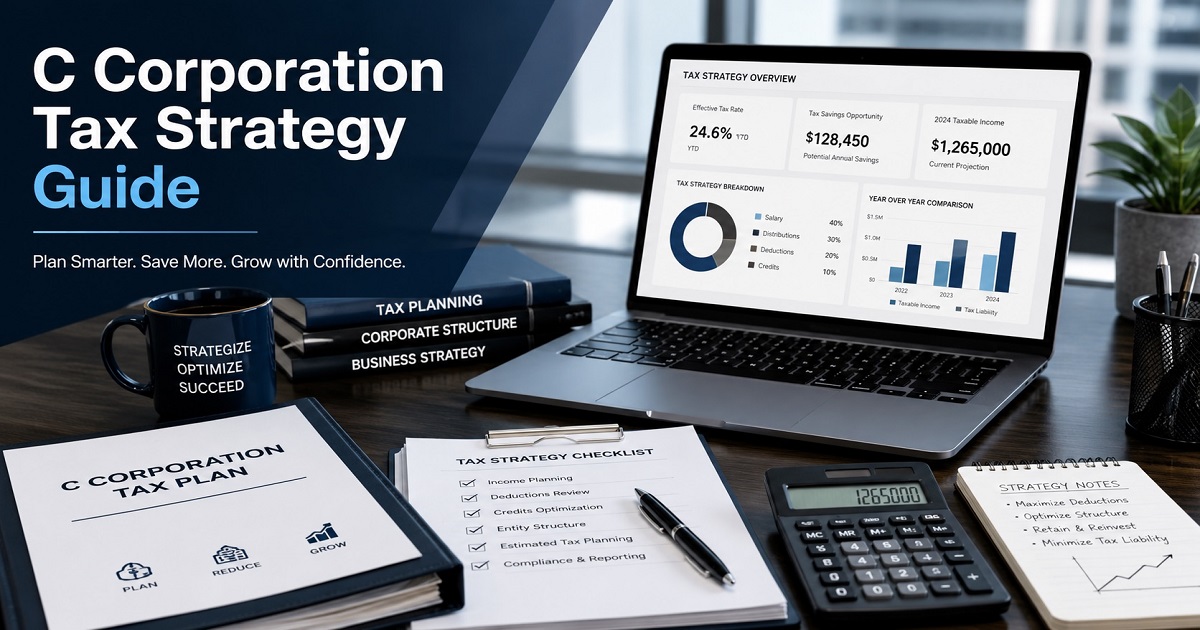
C Corporation Tax Strategy Guide: How to Reduce Taxes, Stay IRS-Compliant, and Avoid Costly Mistakes
In the opinion of Advocate Shahid (Tax Advisory and Research Specialist) describe the C Corporation Tax Strategy. The C Corporations have a flat 21% federal tax rate and are very beneficial for retaining earnings and reinvesting in growth. The key to strategic tax planning is taking full advantage of this flat rate, maximizing deductible expenses, making use of fringe benefits without paying taxes on them, and avoiding double taxation by judiciously distributing profits.
Important C Corporation Tax Strategy
1. Optimize Shareholder Compensation
- Reasonable Salaries
- Bonuses
2. Maximize Fringe Benefits and Deductions
- Healthcare Plans
- Retirement Contributions
- Company Vehicles & Perks
3. Leverage Retained Earnings Strategically
- Accumulated Earnings Tax (AET)
- Documentation
4. Capitalize on Tax Credits and Deductions
- R&D Tax Credit
- Section 179 & Bonus Depreciation
5. Structure Corporate Investments
- Dividends-Received Deduction (DRD)
- Intercompany Lending
6. Time Income and Expenses
- Defer Income
- Accelerate Expenses
What Is a C Corporation Tax Strategy?
Quick Answer for Business Owners
A corporate tax strategy is a viable approach to corporate income, deductions, credits, salaries, dividends, retained earnings, estimated taxes and IRS compliance.
A corporation is a separate, tax-paying entity, known as a C corporation. That is, the corporation pays Federal corporate income tax on taxable income. Another time when shareholders have to pay tax is when corporate profits are distributed as dividends.
That’s why C corporation tax planning is not so much bookkeeping. If you’re thinking of making a plan, you should take into consideration the big picture: your income, your expenses, your payroll, your shareholder payments, your tax filing deadlines, your corporate paperwork and the IRS risk.
Why C Corporation Tax Planning Matters
C corporation tax planning issues are important, because little errors can cost a lot of money. If a company waits until the filing season to file a profitable business, it can find that it has not paid enough estimated taxes, not kept adequate records of business expenses, or not made the payments to owners on time.
For instance, let’s say that a C corporation has solid sales in the second and third quarters. The company incurs expenditures on software, payroll, travel, equipment and professional services, but does not maintain adequate records of the expenses. The corporation can end up owing tax, an estimated tax penalty, and deductions can be forfeited at the end of the year as documents are incomplete.
How Are C Corporations Taxed?
Entity-Level Tax
A C corporation is subject to tax separately as a corporation. Reports income, gains, losses, deductions and credits on IRS Form 1120 (U.S. Corporation Income Tax Return).
The corporation begins with gross receipts and then subtracts returns and allowances, then cost of goods sold (if applicable), and then business expenses that the corporation is allowed to deduct. This is corporate taxable income. The corporation then computes its net tax liability based on the taxable income after taking credits and other tax matters into account.
That’s the simple answer to the question of how c corps are taxed: c corps are taxed separately from their owners at the federal level as corporations.
Shareholder-Level Tax and Double Taxation
Firstly, the company can suffer corporate tax on its profits. Second, the shareholders can be taxed again on the after-tax profits that are paid to them in the form of dividends. Typically, the corporation will not be able to deduct these dividends paid to shareholders.
But a C corporation isn’t necessarily a bad form of business organization. The reason many businesses elect to be a C corporation is to go about business in the manner as they wish: reinvesting, seeking outside investors, planning for growth, equity compensation, legal structure and more. However, matters with respect to the distribution of the dividends is important as it will impact the overall tax burden.
C Corporation vs S Corporation vs LLC Taxation
A c corporation is a corporation that files a separate tax return and pays entity level tax. In general, an S corporation distributes its income, losses, deductions and credits to its shareholders when it is taxed at the federal level. LLCs can be taxed as a business or an election.
That’s why one of the most frequently-searched questions is C corp vs S corp taxes. Profit level, Investor plans, Payroll, State Taxes, Shareholder objectives and Exit strategy are the best options to consider.
The other difference is the qualified business income deduction. The QBI deduction is typically not applicable to the income of a C corporation, but may apply to some pass-through business income when requirements are satisfied.
Core C Corporation Tax Strategies That Can Reduce Tax Legally
1: Maximize Ordinary and Necessary Business Deductions
- The first tax-saving idea is easy: Take every business-deductible expense that you qualify for, and properly track them.
- Some of the typical, common C corporation tax deductions include rent, payroll, professional fees, software, insurance premiums, marketing, office expenses, travel and cost of goods sold. Any expense that is ordinary, necessary, business-related and has been properly documented will lower corporate taxable income.
- The legal warning is that, however, but. Expenses that are paid by corporation are not necessarily deductible. If you have personal expenses, poorly-documented expenses, or the wrong kind of capital expenses, they can lead to IRS issues.
2: Use Accountable Plans Correctly
If the IRS rules are followed, the reimbursement of business expenses by an accountable plan can result in a reimbursement of the expenses without the reimbursement being included as wages in the C corporation’s taxable income.
The following should be included in a “proper accountable plan”:
- Business purpose
- Date
- Amount
- Receipt or invoice
- Timely expense report
- Return of any excess reimbursement
3: Plan Officer Compensation Carefully
- This is one of the most highly sensitive issues in C corporation tax planning. Owner-employees can be paid a salary, but it must be fair.
- If the salary is too high, the IRS may claim that it shouldn’t be considered compensation for services rendered. This may be particularly applicable in situations involving a corporation that reduces the taxes it has to pay by allocating salary to avoid a dividend allocation.
- While the case of Exacto Spring Corp. v. Commissioner may not be the most important case in reasonable compensation analysis, it is one that is often referenced.
- One way to do this is to keep a record of the officer’s job, responsibilities, hours, experience, performance of the company, similar salary, and explanation of the business rationale behind the salary.
4: Manage Dividends and Retained Earnings
- Earnings of a C corporation can be used for future business expenses or paid out to shareholders as dividends. There are a variety of uses for retained earnings including equipment, working capital, hiring, debt repayment, and expansion.
- Retained earnings planning must be for a real business purpose. When there is an excessive accumulation of earnings for no reason for the business, there are concerns for accumulated earnings taxes.
These questions can be answered by using good c corporation retained earnings tax strategy:
- Why is the corporation keeping the money?
- Is there a documented business plan?
- Are funds needed for expansion, payroll, debt, or reserves?
- Should some profits be distributed as dividends?
5: Use Depreciation, Section 179, and Bonus Depreciation
- Depreciation deductions may be useful if a corporation purchases equipment, machinery, computers, business equipment or vehicles.
- Depending on the asset, timing, limits and current law, it may be possible to obtain a faster deduction in certain cases via Section 179 and bonus depreciation. When this is the case, tax planning at the end of the year is important for the Company.
- In this case, if a business requires new equipment, they can consider purchasing the equipment and putting it into use before the end of the year, as this may provide a beneficial deduction. The buy should be business sensible after all. Don’t make bad purchases for tax purposes.
6: Track Net Operating Losses
- Net operating loss rules could also provide that a business can apply the loss to offset income in a later tax year, if such a year is available and within the net operating loss limits.
- For businesses, such as startups or cyclical businesses, a net operating loss (NOL) can be beneficial. However, the corporation needs to accurately account for and keep records of the NOL carryover.
- Losses can have an impact on a company’s future tax planning and this is an important component of corporate loss planning.
7: Review Available Tax Credits
- Tax credits may be more effective than deductions as they cut tax directly. This can be in the form of research and development credits, energy credits, work opportunity credits or industry-specific credits.
- Not all corporations are eligible. Compliance with corporate tax credit involves keeping records, qualifying for tax credits and filing proper forms.
- When considering a tax saving strategy for corporations, it is important to consider both deductions and credits before filing Form 1120.
C Corporation Tax Filing (Step-by-Step Guide)
1: Gather Required Business Records
A clean C corporation tax filing checklist should include:
- EIN confirmation
- Prior-year tax return
- Profit and loss statement
- Balance sheet
- General ledger
- Bank statements
- Payroll reports
- Loan statements
- Fixed asset schedule
- Expense receipts
- Shareholder records
- Dividend records
- Estimated tax payment confirmations
- IRS notices, if any
2: Calculate Corporate Taxable Income
The first step in determining corporate taxable income is to determine gross receipts or sales. Add and subtract returns and allowances (as applicable) and costs of goods sold. Next, deduct from the $ amounts of corporate allowable deductions, credits, and other tax deductions.
This should be carried out carefully as mistakes in this process will impact on the ultimate corporate tax liability.
3: Prepare Form 1120
It should be the same as the corporation’s books, bank activity, payroll activity, transactions with shareholders, and estimated tax payments.
4: Review Estimated Tax Payments
Typically, corporations pay taxes on a quarterly basis when they anticipate that they will have sufficient tax to cover when they file their return. Penalties may apply if you do not pay estimated taxes.
5: File the Return or Extension
However, an extension is NOT an additional time to pay. Even if the corporation missed the original tax deadline, it should make its best guess as to the amount of tax it owes and pay it by the original deadline to minimize penalties and interest.
6: Pay Any Balance Due
The corporation can pay federal taxes on business via the IRS payment means, such as EFTPS. It is important to keep payment records.
The corporation must not neglect the amount if it fails to pay in full. Interest and penalties will add up and unpaid tax problems can rapidly become serious.
C Corporation Estimated Tax Payments and Penalty Risk
When a C Corporation Must Pay Estimated Taxes
Estimated tax payments are likely to be required for a corporation if it anticipates a tax bill of $500 or more when it files its return. Often these are known as quarterly tax payments but they aren’t always due at the same time; this would depend on the tax year of the corporation.
This is an important mechanism of paying federal taxes for C corporations.
What Happens If Estimated Taxes Are Missed?
The corporation could be subject to a penalty for under-payment of estimated taxes, if they are not paid or paid too low. To figure out if the corporation is liable for the penalty and how much, form 2220 is utilized.
This can come as a shock to business owners. A corporation can make its payment late or make insufficient payments throughout the year and still be liable for an estimated tax penalty.
Practical Example
Suppose a C corporation had more income in the second and the third quarter, but had not paid taxes until the end of the year. If the final Form 1120 is correct, but the corporation failed to pay the installment payments timely, then the corporation may still be liable to pay a penalty as a result of underpayment by a C corporation.
IRS Notices, Penalties, and C Corporation Tax Problems
Common IRS Notices for C Corporations
Don’t put off an IRS business tax notice. Generally, the notice contains information regarding the tax year, tax form, issue, amount of the tax, when the tax is due, and instructions on how to respond.
Late Filing and Late Payment Penalties
The Internal Revenue Service (IRS) may impose penalties and interest if a C corporation files late, or late payment. The Form 1120 late filing penalty can be particularly irritating due to the fact that it’s likely an attainable penalty with a timely filing or extension.
IRS Penalty Relief and Reasonable Cause
Any of these serious events, fire, natural disaster, inability to get records, etc., may occur, or any other event that is beyond ordinary negligence.
It should clear up events and how compliance wasn’t possible, documents that substantiate the situation and the steps the corporation took to solve the problem.
What to Do After Receiving an IRS Notice
Use this step-by-step fixing method:
- Read the notice carefully.
- Confirm the tax year and form involved.
- Compare the IRS claim with the filed return.
- Check payment history.
- Gather records.
- Respond before the deadline.
- Submit missing forms or explanations.
- Contact a tax professional if the amount is large or the issue is legal.
Common C Corporation Tax Mistakes to Avoid
1: Mixing Personal and Corporate Expenses
Corporation’s personal expenses can be denied as a deduction or reclassified as a taxable compensation or dividend or loan to the employee.
2: Poor Expense Documentation
If the records are incomplete, the IRS might refuse to allow deductions. Failing to keep up records of business expenses, not knowing what receipts are for, and inadequate corporate tax documentation makes the corporation weaker.
3: Ignoring Estimated Tax Payments
Even if you file your taxes on time, you can still get an underpayment penalty. Even if a C corporation doesn’t make estimated payments until the end of the year, it can still get penalties for under-payment.
4: Misclassifying Salary, Dividends, and Loans
Tax disputes may arise from a shareholder loan tax mistake, incorrect distributions or an incorrect classification of distributions as dividends instead of salary.
5: Forgetting State and Multi-State Tax Obligations
Compliance is just one aspect of federal tax. A corporation can also have state corporate tax compliance, state franchise tax compliance, state sales tax, state payroll tax, and state multi-state nexus.
C Corporation Tax Audit Risks and Legal Compliance
Common Audit Triggers
Some of the most frequently seen C corporation audit red flags are large deductions with no supporting documentation, personal expenses, shareholder loans, excessive compensation, missing payroll, inconsistent revenue reporting, unreported dividends, repeated losses and late or amended returns.
The corporate tax audit doesn’t automatically mean that the company is guilty of any wrongdoing. However, it involves record keeping and thoughtful reactions.
What to Do If Your C Corporation Is Audited
If the corporation receives an IRS audit letter:
- Do not ignore it.
- Identify the tax years and issues under review.
- Preserve records.
- Avoid sending extra information not requested.
- Prepare a clear written response.
- Use tax representation when needed.
Corporate tax audit defense is very crucial in circumstances of substantial deductions, stockholder payments, payroll tax or interpretation.
Useful Legal References
- The principle of the general respect for a corporation as a separate taxable entity is quoted in Moline Properties, Inc. v. Commissioner.
- INDOPCO, Inc. v. Commissioner is helpful in addressing the question of whether certain expenses will be capitalized or deducted immediately.
- In the context of reasonable compensation issues with a C corporation, Exacto Spring Corp. v. Commissioner is relevant in discussions of the owner’s salary.
These cases illustrate why it is important that compliance with corporate taxes is more than just a matter of forms. It’s also related to legal categorization, documentation and business purpose.
When Should a C Corporation Hire a Tax Lawyer or Tax Consultant?
Situations Where Professional Help Is Important
A C corporation should consider professional help when it faces:
- IRS audit
- Large tax debt
- IRS notice with a deadline
- Payroll tax issue
- Corporate tax dispute
- Penalty abatement request
- Multi-state tax exposure
- Shareholder compensation dispute
- IRS collection threat
- Complex restructuring or entity conversion
A C corporation tax lawyer may be in particular demand when the matters involve legal risk, IRS issues of controversy, audit defense, or even the disputed tax liability.
Tax Lawyer vs CPA vs Enrolled Agent
- Typical services that a CPA provides include tax preparation, accounting, planning, preparation of financial statements and corporate tax return preparation.
- An enrolled agent is allowed to represent taxpayers before the IRS, and help with tax compliance and IRS issues.
- A tax lawyer advises clients on legal tax issues, defends against tax audits, resolves tax controversies, resolves litigation risks, and assists with privileged tax controversies.
- A lot of corporations that are C corporations utilize more than one professional.
Service Conversion Section
A professional review may be able to help your C corporation determine the safest next steps if you have an IRS notice, unpaid taxes, a penalty notice, an audit letter or filing issue before the deadline.
Business owners are looking for a practical solution, not just a theory, and that’s what each of the above search intent terms indicates. These search intent terms all refer to the need of business owners for a practical solution, not just a theory.
Official IRS Forms, Portals, and Contact Guidance
Important IRS Forms for C Corporations
Important forms may include:
- Form 1120: U.S. Corporation Income Tax Return
- Form 7004: Extension request
- Form 1120-W: Estimated tax worksheet for corporations
- Form 2220: Underpayment of Estimated Tax by Corporations
- Form 1120-X: Amended corporate return
- Form 1099-DIV: Dividend reporting
- Form 4626: Corporate alternative minimum tax
Official IRS Tools and Portals
Use IRS.gov for official forms and instructions. Use EFTPS for federal tax payments where required or appropriate. Follow the specific instructions listed on any IRS notice.
Expected Fees, Costs, and Penalty Considerations
Tax Preparation and Advisory Costs
The costs of preparing and advising on your C corporation taxes differ. The cost will vary based on the size of the business, the amount of transactions, the condition of the books, the state filings, payroll complexity, number of shareholders and the need for IRS representation.
It will be less expensive to prepare a simple corporation with clean books than a corporation that has shareholder loans, IRS notices, multi-state filings, and poor books.
IRS Penalties and Interest
Late filing penalties, late payment penalties, estimated tax underpayment penalties, interest on unpaid taxes on corporations and professional fees for defense in audit and litigation.
Prevention is the best remedy for cost control: timely filing, paying estimated taxes, maintaining records and promptly answering notices.
Practical C Corporation Tax Strategy Checklist
Monthly Checklist
- Reconcile bank accounts.
- Record income and expenses.
- Save receipts and invoices.
- Review payroll tax deposits.
- Track shareholder payments.
- Update loan records.
- Review sales tax and state tax duties.
Quarterly Checklist
- Estimate taxable income.
- Review estimated tax payments.
- Review payroll compliance.
- Update depreciation records.
- Check cash flow for future tax payments.
Year-End Checklist
- Review deductions.
- Confirm officer compensation.
- Consider needed equipment purchases.
- Review dividends and retained earnings.
- Confirm estimated tax payments.
- Prepare Form 1120 documents.
- Review IRS notices before filing.
Conclusion: Build a Strategy Before There Is an IRS Problem
Having a good C corporation tax strategy isn’t only about minimizing taxes. It’s all about timely and accurate filing, timely payment of taxes, proper documentation of deductions, planning for payments to shareholders, and timely response to IRS correspondence.
Business owners that approach tax planning throughout the year are less likely to encounter any tax surprises, fewer penalties, and more protection when IRS audits them. While it’s important to use practical tools such as Smart Tax Guides, make sure to seek professional information when it comes to tax issues that may involve a lot of tax, IRS deadlines, an audit risk, or uncertainty.
FAQs
What is a C corporation tax strategy?
A C corporation tax strategy is a plan for the management of income, deductions, credits, salaries, dividends, estimated taxes and IRS compliance, in a legal and organized manner.
What tax form does a C corporation file?
The domestic C corporation applies Form 1120, U.S. Corporation Income Tax Return, for reporting income, tax deductions, tax credits and the tax liability of the C corporation.
How can a C corporation reduce taxes legally?
There are several tax-saving strategies that can be used to legally lower taxes: proper business deductions, tax credits, depreciation planning, accountable plans, reasonable compensation planning and year-end tax review.
Does a C corporation pay estimated taxes?
Yes.
What happens if a C corporation files taxes late?
Penalties for late filing, for late payment and interest may apply to filing with the IRS.
Can a C corporation request penalty relief?
Yes. Under specific circumstances, such as where there is reasonable cause and supporting documentation, a corporation can ask for penalty relief.
How does double taxation affect a C corporation?
Double taxation may result when the corporation is taxed on profits and then the shareholders are taxed on the dividends they receive from the profits.
When should a C corporation hire a tax lawyer?
Any C corporation that receives an IRS notice, is subject to an audit, owes taxes, has payroll tax issues or requires legal tax dispute resolution should discuss the matter with a tax lawyer.