0% Capital Gains Tax Rate means that under certain conditions, qualified investors will not have to pay federal taxes on their long-term capital gains from stocks, bonds, or real estate. This benefit is not offered to everyone, however. Eligibility will be based on your taxable income, filing status, investment type and IRS tax-year rules.
The income requirement is that you must be in the 0% long-term capital gains tax rate according to the IRS. Other income sources may factor into whether or not you’re eligible for the zero-tax benefit, even if your investment profit is qualified.
0% Capital Gains Tax Rate (Quick Eligibility Summary)
✅ Applies to qualifying Long-Term Capital Gains held for more than one year
✅ Available only when taxable income falls below IRS income limits
✅ Limits vary by filing status (single, married filing jointly, head of household)
✅ Short-term capital gains are not eligible and are taxed as ordinary income
Knowing these rules can be useful for investors to make plans ahead for the sale of assets and in the process legally minimize the amount of federal capital gains tax that they will have to pay.
What Is the 0% Capital Gains Tax Rate?
0% capital gains tax rate is a tax rate that a federal government sets so that some of its taxpayers do not have to pay any federal tax on certain capital gains. That doesn’t necessarily imply that all investment profits are tax-free. Rather, it’s used by those whose taxable income is below the IRS income level in the zero percent long-term capital gains tax bracket.
How the 0% Long-Term Capital Gains Rate Works
The capital gains tax regime is a federal tax system that takes into account income levels. Lower income investors may be eligible for the 0% long-term capital gains rate; higher income investors may pay 15% (or 20%) tax on their long-term capital gains. A capital gain is the money made by the investor when he or she sells an investment for more than he or she paid for it, but only the amount of money he or she made that is not offset by certain adjustments is considered taxable capital gain. For details on the 20% Capital Gains Tax Rates, must read our article.
The 0% rate does not apply to everyone. It is a specific tax advantage that is based on income eligibility, filing status and type of gain. If you want to read more about 15% Capital Gains Tax Rate in United States, you can check out our ultimate guide to it.
Is the 0% Capital Gains Tax Rate Really Tax-Free?
For a federal capital gains rate of 0%, investable gains will not be taxed by the federal government, although there are other taxes that may apply. In some states, there are Capital Gains Taxes and in some cases, investors could be subject to other types of taxes like the Net Investment Income Tax. So it is not always possible to be reimbursed at 0%.
How Long-Term Capital Gains Tax Rates Work
Capital gains taxes are dependent largely on the duration of time that an investment is kept prior to selling.
Difference Between Short-Term and Long-Term Capital Gains
Short-Term Gains are the tax liability on the income generated from investments which are sold within one year and is typically taxed as ordinary income. Long-term capital gains will be taxed at a lower rate for assets that have been held for over one year.
Why the Holding Period Matters for the 0% Rate
The preferential tax rates (including the 0% rate) are only available for qualifying long term capital gains. Short-term gains typically aren’t eligible as they are taxed at the ordinary income tax rates.
Who Qualifies for the 0% Capital Gains Tax Rate?
If your taxable income is within the IRS’ limit for the Zero Percent Bracket for long-term capital gains, you may be eligible for the 0% capital gains tax rate. Eligibility isn’t based solely on the amount of profit generated from the sale of an asset, rather it is based on the taxable income, filing status, and type of investment gain.
Income Requirements for the 0% Capital Gains Tax Bracket
The IRS establishes income limits to qualify for the 0% long-term capital gains rate. These limits are determined by a set of taxable income limits that may vary from tax year to tax year. Eligibility is based on your filing status, deductions and other income.
Filing Status and 0% Capital Gains Eligibility
Your filing status plays an important role in determining the income limit:
- Single filers: Have their own IRS threshold for the 0% capital gains bracket.
- Married filing jointly: Usually receive a higher income threshold compared with single filers.
- Head of household: Has separate limits based on IRS rules.
Does Your Salary Determine Whether You Qualify?
You don’t have to be qualified because you make a certain amount of money. The IRS does not recognize gross income, it recognizes taxable income. Gross income is the amount of income received prior to deductions, and Adjusted Gross Income (AGI) is gross income after certain deductions. Taxable income is your income after deductions and is the basis to Calculate the Rate of Capital Gains Tax.
2026 0% Capital Gains Tax Bracket and Income Limits
For the 2026 tax year, long-term capital gains are generally taxed at three federal rates:
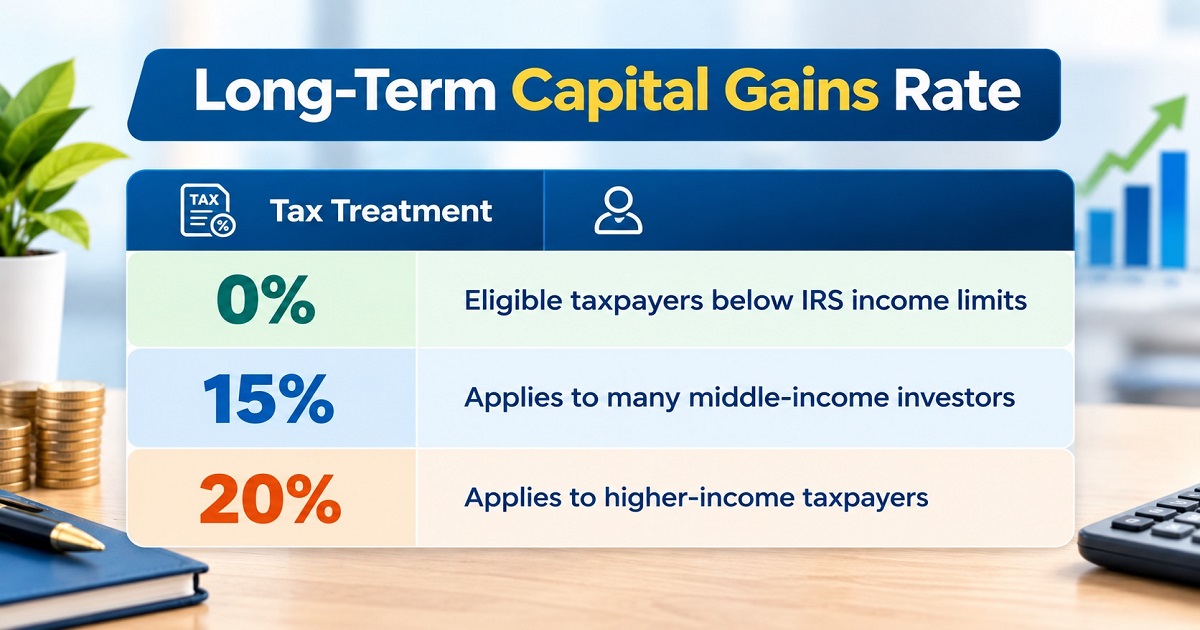
0% Capital Gains Tax Income Limits by Filing Status
| Filing Status | 0% Capital Gains Threshold |
|---|---|
| Single | Based on IRS annual threshold |
| Married Filing Jointly | Based on IRS annual threshold |
| Head of Household | Based on IRS annual threshold |
How Capital Gains Stack on Top of Taxable Income
When calculating your capital gains, your ordinary taxable income is taken into account. Qualifying long-term capital gains are first applied to the lower tax brackets, and the remainder of the 0% capital gains tax can be applied in those remaining brackets. The excess gains over the limit may be subject to higher capital gains rates if the total taxable income is above the amount.
How to Calculate Whether You Qualify for the 0% Capital Gains Rate
It’s important to compare your taxable income to the IRS long-term capital gains thresholds to decide if your investment gains will fall into the 0% capital gains tax rate. It will be based on your taxable income for the year and your filing status.
Step-by-Step Eligibility Calculation
Follow these steps:
- Identify your filing status (single, married filing jointly, or head of household).
- Calculate your taxable income after deductions.
- Add your qualifying long-term capital gains.
- Compare your total taxable income with the IRS capital gains threshold.
- Apply the correct capital gains tax rate based on your income level.
0% Capital Gains Tax Example: Single Investor
One investor has $35,000 of taxable income and sells long-term investments that he made a $5,000 profit on. Their combined income is now $40,000 that is subject to tax. If the investor is under the IRS 0% long-term capital gains limit, then they will only have to pay 0% federal capital gains tax on the qualifying gain.
0% Capital Gains Tax Example: Married Couple
The taxable income for a married couple filing jointly is $60,000, and they have a $10,000 long-term investment gain. Their total income that is subject to taxation is now $70,000. If the total is under the joint filer’s 0% capital gains tax rate, the gain could be eligible for the 0% federal rate.
Can You Pay 0% Capital Gains Tax on Stocks and Investments?
Yes, there are investors who can legally pay no federal capital gains taxes on their investments when they sell these investments if they qualify for the tax breaks outlined by the IRS.
Stocks, ETFs, and Mutual Funds
Holdings of stocks, ETFs, and mutual funds for over a year could be eligible for more favorable capital gains tax rates. The 0% rate is available to brokerage account investors who have amounts they can tax but are less than the amount necessary.
Tax Planning Before Selling Investments
When investors decide to sell, they make a careful plan to ensure that they sell at the most appropriate time, control taxable income and take into account other income sources. Dispersing investment sales over several tax years could be useful in keeping investment sales at a low capital gains classification.
Does the 0% Capital Gains Tax Rate Apply to Real Estate?
There are some gains on real estate that may be eligible for a 0% capital gains tax rate, based on the type of property, period of ownership, and income taxable. Profits from real estate that are earned when an asset is sold for an amount in excess of its “adjusted cost basis” are generally a form of capital gain.
Capital Gains Tax on Investment Property
Long term capital gains from rental property and real estate investments can occur when the investment is sold or disposed of after holding it for over a year. There are also depreciation recapture and other factors to keep in mind, though, that can be taxed outside of the regular capital gains regime.
Selling Your Primary Home vs Investment Property
The tax treatment of primary residence is different from that of investment property. The Internal Revenue Service (IRS) home sale exclusion may be able to provide tax relief for a portion of a home sale profit to eligible sellers. The investment property exclusion is not extended to investment properties and capital gains tax regulations are different.
How Retirees Can Use the 0% Capital Gains Tax Bracket
Retirees may have the opportunity to plan their taxes as they can have untaxable income during retirement. Some people may be able to achieve qualifying long-term gains in the 0% capital gains rate.
Why Retirement Years May Create Tax Planning Opportunities
There are opportunities for retirees to wait for the right time to sell investments, coordinate withdrawal from retirement accounts, and coordinate various income streams. Strategic planning can be used to help maintain income in taxable bracket choice zone.
Common Retirement Capital Gains Mistakes
Typical mistakes are trading a lot of investments in one year while missing out on other income, or not keeping long-term planning in mind. Good timing and knowledge of IRS regulations can be helpful to retired folks.
Legal Strategies to Reduce Capital Gains Taxes
Legal strategies for lowering capital gains taxes involve planning, recognizing and responding to when and how investment income is realized, and understanding IRS rules. There are a few different ways that a person who is eligible to pay taxes could reduce their total taxable amount.
Use the 0% Capital Gains Tax Bracket When Eligible
Those who fall into the 0% long-term capital gains brackets may be able to strategically time their investment sale in order to maintain their income within the thresholds. Other sources of income and splitting gains to other tax years could be beneficial to maintain the qualification.
Tax-Loss Harvesting
Tax Loss Harvesting is an investing strategy that involves selling assets that have lost value to be able to capitalize on money made elsewhere. Capital losses can offset capital gains and under IRS rules, some un-used capital losses might be able to be carried to future tax years.
Holding Investments Longer Than One Year
Length of time an investment is held may make a huge difference in tax implications. Typically, long-term capital gains treatment is applied to assets with a lifespan exceeding a year, leading to lower tax rates than short-term capital gains.
Other Taxes That May Apply Even If Your Capital Gains Rate Is 0%
A federal capital gains rate of 0% does not necessarily mean no taxes. There may be other taxes that will apply depending on your location and income level.
State Capital Gains Taxes
There are separate federal and state tax systems. There are some states with their own capital gains tax, other states with different regulations and no state income tax. Customers need to check their state requirements.
Net Investment Income Tax (NIIT)
In addition, the 3.8% Net Investment Income Tax (NIIT) might apply to some investment income for high-income taxpayers. This tax is in addition to the normal capital gains tax, and can be applied even if the other capital gains regulations are advantageous.
IRS Forms Used to Report Capital Gains
Correctly reporting capital gains is key to filing your federal tax return. The IRS mandates that taxpayers keep records of the investment sales, figure out the gains or losses and report them on their tax returns.
Form 8949
Sales and Other Dispositions of Capital Assets (Form 8949) is the form used to report individual investment transactions.
Schedule D (Form 1040)
It can be used to calculate the amount transferred to your main tax return.
Form 1040 Reporting
Capital gains will finally be reported on the federal income tax return (Form 1040).
Common Mistakes People Make With the 0% Capital Gains Tax Rate
It’s important to know the rules as a little bit of a mistake can result in an unwanted tax bill.
Confusing Gross Income With Taxable Income
Many tax payers only consider their salary or total earnings. But eligible for capital gain is the taxable income, not gross income.
Assuming All Investment Gains Qualify
There are generally only certain types of long-term capital gains that can benefit from the 0% rate. There may be other rules for short-term gains, some assets and special tax situations.
Ignoring State Taxes
The 0% federal capital gains rate does not necessarily apply to a taxpayer in his or her state of residence, depending on state tax laws.
Forgetting About Other Income Sources
Other money received, such as wages, including income from withdrawals on retirement funds, dividends or rent, may also boost taxable income and impact eligibility for the 0% capital gains rate.
Frequently Asked Questions About the 0% Capital Gains Tax Rate
What income qualifies for 0% capital gains tax?
Earnings within the IRS’s “0%” long-term capital gains bracket can qualify. The limit is based on your taxable income and filing status in the tax year.
Who qualifies for the 0% capital gains bracket?
Qualifying taxpayers may qualify if their long-term capital gains and their taxable income falls below the IRS threshold. The eligibility is different for single, married couples filing together, and heads of household.
Can retirees pay 0% capital gains tax?
Yes, a few retirees may be eligible if they fall within the 0% capital gains tax bracket. Tax planning opportunities can arise as a result of lower money years of retirement.
Can I sell stocks and pay no capital gains tax?
Yes, long-term stocks, ETFs or mutual funds can be sold and a federal capital gains tax won’t be levied on the sale if the investor’s taxable income falls within the 0% rate.
Does the 0% rate apply to real estate?
In some cases, it can be applied to long-term real estate gains, but the IRS rules on taxation depend on the type of property, the period of time that the property has been owned, and other things.
Is capital gains tax based on gross income or taxable income?
Capital gains tax rates are on taxable income NOT gross income. Eligible deductions and adjustments are subtracted from gross income on determining taxable income.
Final Takeaway: Understanding the 0% Capital Gains Tax Rate
Eligible taxpayers can benefit from a 0% capital gains rate by shielding themselves from federal taxes on certain long term investment gains, but there are several criteria. Whether you are in the zero percent bracket depends on your taxable income, filing status and IRS thresholds.
This benefit is generally granted on qualifying long term gains, and not short-term gains.