How to Choose IRS Filing Status in the USA (2026 Complete Guide)
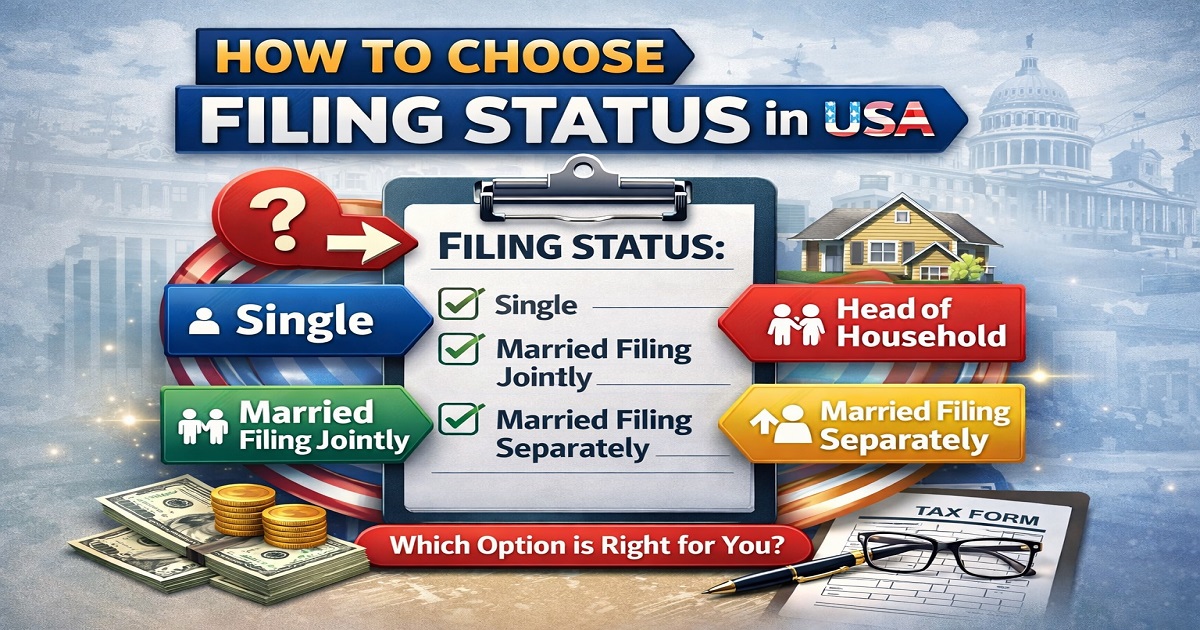
The type of IRS Filing Status to choose depends on the marital status at the end of the year and whether you have dependents to take care of because it determines the amount of standard deduction, tax rates, and credits. These five are Single, Married Filing Jointly, Married Filing Separately, head of house hold and Qualifying Surviving Spouse.
The Five IRS Filing Status
Single
Unmarried people or legally separated / divorced people that do not qualify to receive another status.
Married Filing Jointly (MFJ)
Married couples who are filing a single return. Typically, leads to a reduction in taxes.
Married Filing Separately (MFS)
Married couples which file two returns. It is usually applied when it leads to a reduced combined tax, or in order to escape the tax liability of a spouse.
Head of Household (HOH)
single people that paid over half of the price of maintaining a home with them and a deserving individual.
Qualifying Surviving Spouse (QSS)
A widower whose dependent child will be able to use joint return tax rates during two years after the death of a spouse.
The Choice of the Best Status
Determine Marital status
In case you were married at the end of the year (Dec 31), then you are deemed as married throughout the entire year.
Test Dependency
When you are unmarried and pay more than half the total household expenses on behalf of a dependent, then you probably have a Head of Household, which offers superior tax rates when compared to Single.
Compare Joint vs. Separate
married couples are to compare the overall tax liability of both cases.
Use IRS Tools
The best option is determined by using the official IRS What Is My Filing Status? interactive tool.
Indicators
In case there is more than one status, select the one that leads to lower tax.
Introduction to Filing Status in the USA
The IRS has created a categorization of how your income is taxed in the U.S. which is known as filing status. It is of great importance in your tax return and determines many things including the tax rates, or tax credit eligibility.
Importance of Choosing the Correct Filing Status
This is the reason why it is essential to choose the right filing status since it has a direct impact on the tax rate that you pay on your income and determines whether or not you qualify to receive certain types of tax credits, including the Earned Income Tax Credit (EITC) and Child Tax Credit. It makes you not to overpay taxes or to miss the opportunities to save some money.
Impact of Filing Status on Tax Rates and Eligibility
The IRS gives various tax rates depending on your status of filing. Making the wrong decision may lead to the payment of higher tax rate or even ineligibility of useful tax benefits thus paying more taxes than is required. This is why the selection of the appropriate status guarantees a correct and positive process of tax filing.
What Are the 5 Filing Statuses in the USA?
In the United States, there are five filing statuses which are considered by IRS, and each of them has impact on your tax rates, deductions, and credits eligibility. These are Single, Married Filing Jointly, Married Filing Separately, Head of Household as well as Qualifying Surviving Spouse. The selection of the right filing status may have a great impact on your tax filing.
Single Filing Status
Single status is when the persons are unmarried, divorced or separated by the law to the end of the tax year. This is the default filing status of anyone who fails to qualify to have other statuses and is mostly applicable to persons who have no dependents.
Married Filing Jointly
Married Filing Jointly gives married couples an opportunity to submit their tax returns jointly. It has a tendency of diminishing the tax rates, increasing the levels of deductibles, and qualifying in a number of tax credits. In order to be eligible the couple spouses need to consent to file jointly and the couple must be under legal matrimony or deemed married in the eyes of the IRS.
Married Filing Separately
Other married couples might reason behind Married Filing Separately because they do not want the other spouse to shoulder his/her tax liabilities. Nevertheless, this tax filing status normally imposes an increased tax rate and denies the opportunity to claim some tax credits such as the Earned Income Tax Credit (EITC).
Chairman of Household Status
To be eligible as the Head of Household, the taxpayer must be single or deemed single by the IRS and provide over a half of the expense of maintaining a house, in which case he meets the qualifications of the dependent. This status of filing is higher in standard deduction and improved rates of tax as compared to Single status.
Qualifying Surviving Spouse
Qualifying Surviving Spouse is given to widowed taxpayers who have passed the eligibility requirement that includes having a dependent child and owning a home. This status will enable a surviving spouse to receive the benefits of Married Filing Jointly benefits up to two years after death of the spouse on the benefit as long as the spouse has not remarried.
IRS Filing Status Requirements and Rules
There are special regulations that define the filing status that you are supposed to have. The marital status on the 31 st December of the tax year is a major factor in determining whether you are a filing or not. Moreover, there are some conditions that dependents must fulfill in order to be eligible to a particular status and IRS has guidelines on the living separately and divorced.
Marital Status on December 31
The marital status on the 31 st December is very important to establish your filing status. In case you are married during this date you will have a choice between Married Filing Jointly and Married Filing Separately. You are not married on December 31, you should file Single or Head of Household (assuming that you do not violate the requirements). The filing choice is also influenced by divorce or legal separation that should be done before the end of the year.
Qualifying Dependent, Qualifying Child, and Qualifying Relative
In order to claim a qualifying dependent, there are certain regulations regarding the qualifying children and the qualifying relatives. A qualifying child should be below 19 years or less than 24 years in case he or she is a full-time student and resides with you more than half a year. A qualifying relative need not reside with you, he or she merely must be a close family member or one whom you support financially over half a year. These dependents play a very important role in the status of Head of Household and tax credits such as the Child Tax Credit.
Impact of Being Divorced or Legally Separated
When you are divorced or separated by the end of the tax year under legal judgements, you are not able to file jointly with your ex-spouse. You have to file as Single, or, provided that you satisfy the criteria, Head of Household (in case you have dependent children). The status that you are under filing is whether you qualify to claim a dependent or not or whether or not you are financially responsible of your household.
How Unmarried for Tax Purposes Applies When Living Separately
You may be considered unmarried under tax purposes even though you are living with your partner even when you do not file the joint return with him. In case you are separate the last six months of the year and spend over half the amount of maintaining a home on a child or a dependent, you might be eligible to receive Head of Household status. But in the meantime, being separated even without satisfying the financial support and other requirements will not have an impact on your status of filing.
How Filing Status Affects Your Tax Return
The filing status is important in establishing the taxes to pay or the refund to get. Making the wrong filing status may result into unnecessary taxes, credits and even penalties. This is the way various filing statuses can affect your tax filing and the savings to be made.
Filing Status for Tax Return
The errors one can make when choosing the wrong filing status are to pay unnecessary taxes or to miss on other valuable deductions and credits. An example of this is when you file as Single when you might have been filing as Head of Household because you will end up paying higher tax rates and reduced standard deduction. On the other hand, when there is a marriage filing separately, more taxes are usually paid since there are few deductions and credits as compared to when it is under married filing jointly.
Filing Jointly vs. Separately: Tax Deductions and Tax Savings Comparison
The filing together, as a rule, has more tax advantages. The couples who file jointly are eligible to enjoy greater standard tax deductions and reduced tax rates, as well as, be in a position to claim more tax credits. Conversely, the lesser tax savings can be achieved on Married Filing Separately where some tax breaks such as Earned Income Tax Credit (EITC) cannot be taken advantage of, and others (student loan interest and the like) are restricted.
Standard Deduction and Filing Status
The standard deduction is higher in response to your filing status. As an example, a single filer and a Married Filing Jointly taxpayer should deduct 13850 and 27700, respectively, as their standard deduction in 2023. Filing as Head of Household gives a greater deduction of 20800. Standard deduction lowers your taxable income hence the greater the deduction, the lower the tax cost.
Tax Credits Eligibility
Eligibility to a number of tax credits is also based on your filing status, including:
Earned Income Tax Credit (EITC)
It is generally allowed to single or head of household filers with low to moderate-income, and the eligibility can be restricted in case you file Married Filing Separately.
Child Tax Credit
This is provided to individuals who are either married or are Head of Household and have children who are qualifying. The size of the credit differs in accordance with the income.
Dependent Care Credit
This credit is applicable in case you pay child or dependent care so that you can work or seek employment, but you have to meet the income and dependency requirements and it also is more favorable to those who are filing as Head of Household or Married Filing Jointly.
When making a decision on the filing status, you must ensure that you claim maximum tax deductions and credits to pay the lowest taxes.
How to Choose the Best Filing Status for Taxes
The variety of the best filing status is able to have a major influence on the number of tax you are going to pay. The tax brackets of each status, the requirements of each status can be understood, and this would lead to the most informed decision. Below is a tax break down on the tax bracket by the filing status and a guide on how to choose the best filing status depending on your individual situation.
Tax Bracket Breakdown for Each Status
Single
Tax rates on single filers vary between 10-37 per cent on income. This is mostly of the unmarried people or the divorced or the legally separated people.
Married Filing Jointly
This is a status that offers more favorable tax rates and standard deduction than the Single filers. The tax rates vary between 10 and 37 percent although income is pooled which may have tax saving benefits because of the broader brackets.
Married Filing Separately
It is a status that usually results in increased taxes, where the two spouses are reporting their income separately and are not able to claim some of the credits and deductions. Tax rates vary between 10 per cent and 37 per cent, however, the tax amount is usually more than that of Married Filing Jointly.
Head of Household
It is a better tax rate and higher standard deduction than the Single filers. Tax rates are between 10 and 35 percent and it is offered to unmarried people who have dependents.
Qualifying Surviving Spouse
This is a status that gives the widowed taxpayers to qualify as Married Filing Jointly within a period of two years after the death of the spouse. The bracket and deduction tax are equivalent to those of Married Filing Jointly.
How to Choose the Best Filing Status for Your Situation
Married: When married it is a good idea to file Married Filing Jointly since it has more tax benefits. But it can be selected as Married Filing Separately in case of any doubts concerning legal or financial separation. This may be helpful in the situations where one spouse has huge medical bills or other deductions which would be restricted by a joint return.
Divorced: In case of divorce, your status will be Single except in case you qualify as Head of Household. This will come in handy particularly when you have dependents and you bear a greater percentage in supporting their financial needs than half.
With Dependents: When you have dependents, you will have an opportunity to save a lot under Head of Household filing which includes higher standard deduction and lower tax brackets than Single filing. Make sure you are in compliance with the IRS requirements of supporting dependents like being in a position to support them more than half.
Tips for Filing Status for Dependents and How It Affects Your Return
Head of Household status would be the most beneficial in filing taxes with dependents in case you are not married but are giving substantial support to a qualifying dependent. This filing position may result in a greater standard deduction and reduced rates of tax. Moreover, depending on the children could qualify you to receive beneficial tax credits including the Child Tax Credit and the Earned Income Tax Credit (EITC).
How the Dependent Support Test Can Influence Filing Status
Dependent support test is very important in defining your filing status. In order to be considered as the Head of Household, one must pay over one half the price of maintaining a home with a qualifying dependent. In case you fail to pass this test, you will not qualify as Head of Household and would have to file under Single. The Internal Revenue Service (IRS) has certain regulations concerning the dependency of a person, such as children and some of the relatives, and they need to be scrutinized properly in order to make an appropriate choice of the filing status.
Common Filing Status Questions and Misconceptions
The right filing status is not always easy to select and most of the taxpayers indeed are in a dilemma of how the status affects their tax filing. The following are some of the general questions and misunderstandings concerning filing statuses.
What Are the 5 Filing Statuses?
The five filing statuses that are identified by IRS are:
Single: This is applied to unmarried people or those that are legally parted.
Married Filing Jointly: This is used by married couples who are filing a joint tax return.
Married Filing Separately: The married couples that wish to file separately.
Head of Household: To unmarried people that pay over half the cost of supporting a qualifying dependent in a home.
Qualifying Surviving Spouse: In the case of widow or widower with a dependent child, one is allowed to file as though they were married within a maximum of two years upon the death of the spouse.
What Filing Status Gets the Biggest Refund?
The married filing jointly is generally the most refunded as it has higher standard deduction and is entitled to more tax credits. Joint filing may lead to a reduced total tax liability, including such credits as the Earned Income Tax Credit (EITC) and Child Tax Credit.
Can I Claim Head of Household if Married?
No you can not say you are the Head of Household when you are married except that you are unmarried in the eyes of the IRS. In order to qualify, one should be living apart with his or her spouse during the six months of the year and also should be providing more than half the expenses of maintaining a home with a dependent. In the event that you are a married person and still qualify according to the requirements, then you can qualify to this status.
When Should Married Couples File Separately?
The married couples can file separately when one of the spouses has considerable deductions like in case of medical expenses or as a way of not being liable to the other spouse. But, the tax is usually increased when they file separately and couples are also disqualified to receive some credits.
Does Filing Status Affect Tax Brackets?
Yes, the types of tax bracket that you contribute to are directly dependent on your status regarding filing. As an example, the tax brackets and standard deduction of Married Filing Jointly are broader and bigger as compared to Single filers. This may lead to reduction in the tax rates and possibly a reduced tax bill.
How Does Filing Status Affect Deductions?
The status of your filing will affect your standard deduction which will decrease your taxable income. As an example, Married Filing Jointly has a larger deduction as compared to Single filers. There are statuses such as Head of Household which will offer better deductions than a Single filing.
What If I Qualify for More Than One Filing Status?
In case you are eligible to receive more than one filing status, then you need to select the one that will give you the most tax advantage. To take an example, when you are eligible to receive both Single and Head of Household, then filing as Head of Household is likely to offer a better standard deduction and tax brackets which will save you taxes. It is always a good idea to compare the advantages of both alternatives and select the one that will have the highest refund or lower tax obligation.
Filing Status for Special Circumstances
Some life circumstances may make the process of choosing the filing status difficult. This is the way that circumstances like the death of a spouse or the separation can affect your filing of the tax.
Filing Status if Spouse Died
In case your spouse had died in the tax year, you can still file the tax as a Qualifying Surviving Spouse up to two years following the death of your spouse provided you fulfill the following:
- You have a dependent child and have a home to take care of.
- You have not got married in that period.
- By filing as a Qualifying Surviving Spouse, you are being permitted to claim the same tax advantages as would be the case if you were filing Married Filing Jointly, such as the larger standard deduction and even more favorable tax brackets.
- This status assists widows and widowers to continue to receive tax benefits that they were entitled to receive when married which will be a great relief at a difficult period.
Filing Status if Separated but Not Divorced
In case you and your spouse are not divorced by the end of the year, but are separated, you will be considered to have the following filing status based on the circumstances of your living:
- In case you spent more than half the expenses of maintaining a home on a qualifying dependent and you lived a part of the year during the past six months of the year you could file as Head of Household.
- In case you are not yet divorced and do not qualify as the Head of Household, then you have to be married and file either as Married Filing Jointly or Married Filing Separately. Making a separate filing could reduce your deductions and tax credit.
- The qualification of a taxpayer as the Head of Household through the household expenses and paying more than half of the cost of maintaining a home.
How Household Expenses and Paying More Than Half the Cost of Keeping Up a Home Qualify a Taxpayer for Head of Household Status
Rent or mortgage, utility, property taxes and repairs.
Food, also grocery expenses.
Healthcare and other living expenses that are required.
You are also eligible to claim Head of Household status in case you are single or are thought to be single and pay more than a half of these expenditures to a dependent or relative who inhabits your home. Such status both gives a larger standard deduction and better tax brackets than Single filing, thus saving taxes.
Real-Life Examples
1. Single Filing Status
Case in point: Sarah is a 28 year old teacher who does not live with anyone and is unmarried. She is not a mother to any dependents. She is not married, does not have children or other dependents, which makes her file as Single. It is the easiest form of filing and is usually applied in case of people who do not have dependents and are not married.
2. Married Filing Jointly
Scenario: John and Emily are a husband and wife, having two children. Both of them are full-time and make joint filings. This will enable them to pool their incomes and could qualify to receive higher standard deduction and improved tax rates. Making joint filing will also enable them to claim on the different tax credits which include the Child Tax credit among others that can lower their tax liability.
3. Married Filing Separately
Scenario: Mark and Lisa are married, however, they are in a separation and choose to file separately as they cannot have the same financial situations. Mark is incurring huge medical expenses and would be interested in the deduction whereas Lisa does not want her finances to be mixed with reasons of her own. Nevertheless, making separate filing makes them ineligible to some tax benefits, such as the Earned Income Tax Credit (EITC).
4. Head of Household
Scenario: Maria is a full-time working single mother and has two children. She has to cover over fifty percent of the household costs. Consequently, Maria is eligible as Head of Household, under which she can avail a greater standard deduction and low tax rate in comparison to the Single status. She is also entitled to Child Tax Credit of her dependents.
5. Qualifying Surviving Spouse
Scenario: Linda is a woman with two children who has lost her husband. Due to this tragic event, she can be considered as the Qualifying Surviving Spouse status. This enables her to claim taxes as she had been married within the two years since her spouse had died hence she would enjoy the tax rates of Married Filing Jointly and receive any tax credit on her children.
These real life examples can be used to explain how various filing statuses can be applied to particular life situations, and how they will affect the taxes individuals and families must pay.
Real Case Studies of Choosing Filing Status in the USA
Case Study 1: Single Filing Status – Sarah’s Simple Tax Situation
Sarah is a 28 years old New York teacher who has a rented apartment, and lives alone. She is single and has neither children nor a spouse, and makes a living.
Filing Status: Single
The case of Sarah is simple and hence she uses the Single filing status in the process of filing her taxes. This is the status that is normally applied to people who are not married and those who have no dependents. Since Sarah is single, she can claim the standard deduction and does not need to be concerned with other complications that are associated with dependents and married status.
Tax Benefits
Sarah is eligible to claim the standard deduction of the single filer, and in this case, it is 13850 in 2025.
Her tax bracket is the Single filing bracket which is normally higher than the other filing statuses but it is the easiest and the most effective when a person is in her situation.
Tax Outcome
When she submits her filing as Single, Sarah is able to pay a fair amount of taxes which is corresponding to her income level. She is not eligible to get any extra credits but her filing status is favorable to her considering that she is unmarried and has no children.
Case Study 2: Married Filing Jointly – John and Emily’s Family Tax Benefits
Background
John and Emily have two children of ages 5 and 8, who are married and they both are full-time employees with John being an accountant and Emily being a nurse. They are in the suburbs and earn a salary of 120000 annually. They choose to do their filing as Married Filing Jointly in a bid to have the maximum benefits of tax.
Status of Filing: married filing jointly
John and Emily do it jointly since they are married and live together. By filing together they are able to pool their incomes and claim bigger deductions and credits as opposed to when they would file separately.
Tax Benefits
The 2025 amount of Standard Deduction on married couples that file jointly is 27,700.
They are eligible to the Child Tax Credit on each of their children making their taxable income a lot less.
They also have access to Earned Income Tax credit (EITC) that is also applicable to families with children that earn within a given income bracket.
Tax Outcome
John and Emily have lesser fees in taxes than they would have paid individually. They can claim tax credits by filing together which saves them on the total liability. They also are eligible to a bigger standard deduction and this aids in reducing their taxable income.
Case Study 3: Married Filing Separately – Mark and Lisa’s Separation
Background
Mark and Lisa are a married couple of 10 years with whom they are separating but not divorced yet. They have a single child and they are going to file taxes separately during that year because of their varying financial circumstances. Mark has high medical bills as he is suffering a long-term condition whereas Lisa is earning more and is not willing to share deductions.
Marital status: Married Filing Separately
Both Mark and Lisa are in the status of Married Filing Separately although they are separated because of their current marriage. This position will enable them to maintain their finances apart and this is significant since they attempt to clear their personal issues.
Tax Benefits
They do not qualify to have the Earned Income Tax Credit (EITC) because they have opted to file separately.
Mark is allowed to make medical deductions of any amount that is more than 7.5 percent of his income (according to the Medical Expense Deduction).
They are both allowed the standard amount of deduction on their filing status which is 13850 each.
Tax Outcome
The fact that he can file separately means that Mark is able to deduct his large medical bills something that would not have been the case had he filed as his wife. But, Lisa is deprived of tax credits that she would have received had they filed jointly e.g. Child Tax Credit. Their total tax liability is more than what it would have been had they filed jointly though it fits their personal scenario.
Case Study 4: Head of Household – Maria’s Single Parenting
Background
Maria is a 32-year-old single mother employed in the field of graphic designer as a full-time employee. She has two kids of age 4 and 7 years old. Maria is the main earner and she covers more than half the household cost such as rent, utilities and food and she asserts that both children are dependents. Being the head of the household, she makes her tax payments as a Head of Household.
Marital Status: Head of Household
Maria can be regarded as Head of Household since she is unmarried, spends over half of her household expenses and she has dependent children.
Tax Benefits
She qualifies to receive a higher standard deduction (20, 800 in 2025).
She is a recipient of the Child Tax credit on every one of her children which lowers her taxable income.
Her tax rate will be reduced than what she would have been when she is filing as Single, and she has other benefits like the Earned Income Tax Credit (EITC).
Tax Outcome
Maria also has a reduced tax liability under the Higher Standard deduction and the tax credits that she is entitled to because she is a head of household as opposed to the Single filing status. She gets very high savings and this enables her to invest in the future of her family.
Case Study 5: Qualifying Surviving Spouse – Linda’s Widowhood
Background
At the beginning of 2025, Linda lost her husband. The two children had two parents with Linda contributing over half the support in the house. Linda has a qualification of two years to receive the Qualifying Surviving Spouse status that enables her to claim herself as a married person.
marital status Qualifying Surviving Spouse
Linda claims as a Qualifying Surviving Spouse so as to enjoy the Married Filing Jointly tax rate. This condition is valid in a duration of two years after the death of her spouse, whereby she is entitled to receive the same benefits as she was having during the time when she was filing the same with her spouse.
Tax Benefits
Linda is subjected to the tax rates of Married Filing Jointly which are more liberal in terms of their standard deduction (27,700 in 2025).
She is also eligible to take the Child Tax Credit in her two children.
She will not be subjected to a higher tax bracket which will be associated with Single filing status.
Tax Outcome
Linda claims as a Qualifying Surviving Spouse and this means that she is able to tax less, she is able to enjoy the advantage of filing together and she is able to be financially secure in the year that follows the death of her husband. This filing position assists her in sustaining her children financially as well as living through the emotional widowhood.
Conclusion
The determination of the right filing status is essential towards the right tax filing. Not only does it have an effect on the taxes that you pay but it also determines your eligibility to tax credits and deductions. Your filing status will determine how you pay your taxes, the standard deduction you can take and whether you are eligible to take valuable credits such as Earned Income Tax Credit (EITC) or Child Tax credit. This is because not knowing your or misclassifying your status in filing may actually cost you a lot of money in paying taxes or even lead to penalties.
The correct filing status will have a strong impact on the total tax savings, which will enable you to have lower rates and deductions. In order to get the best back, it is always imperative to put into focus the personal situation of an individual, whether married or divorced or having dependants.
To have a more detailed explanation, please refer to the IRS tax interview or to IRS Publication 501 that will help you to better understand your tax situation and the requirements it has and the filing status that will be the most beneficial to you.
FAQs
What are the 5 filing statuses in the USA?
The IRS accepts five filing statuses, which are:
- Single
- Married Filing Jointly
- Married Filing Separately
- Head of Household
- Qualifying Surviving Spouse
What filing status gets the biggest refund?
As a rule, Married Filing Jointly is the one that offers the largest refund because this filing offers the highest standard deduction and lower rates of taxes, and it also has more tax credits. This is usually the case as it leads to maximum tax savings among married couples.
Can I claim head of household if I am married?
You cannot say that you are the Head of Household in case you are married unless you are regarded as unmarried by the IRS. In order to be eligible, you have to be separated at the end of the six months of the year with your spouse and you have to support more than half the expenses of maintaining a home to a qualifying dependent.
When should married couples file separately?
Married couples can opt to file individually in case one of the spouses is experiencing huge medical costs or other deductions that would have been constrained by a joint filing. This filing status, however, normally attracts more taxes and diminished eligibility to some credits.
How does filing status affect tax brackets?
The direct effect of your filing status on your tax brackets is its direct influence. To give an example, the Married Filing Jointly offers broader tax brackets whereas the Single filers offer smaller brackets and hence they may have higher tax rates. The type of filing that you use influences the amount of rate at which your income will be taxed.
What is the best filing status for married couples?
Most married couples are filers with Married Filing Jointly (which is the best status to opt). It has the greatest standard deduction, reduced tax rates and qualification to several tax credits. Nevertheless, in case of the financial conditions of one of the spouses, the couples should think of Married Filing Separately.
How do I determine if I qualify for head of household?
In order to be a Head of Household, you have to satisfy the following:
- Not married or not married by the IRS.
- Pay over 50 percent of the price of keeping a house.
- The dependent has to reside with you during more than half a year.
Can I file as a surviving spouse?
Yes, you can claim as a Qualifying Surviving Spouse during two years after the death of your spouse in case you are a widow or widower and you have a dependent child and you are not married again. This is a status that you enjoy the same tax benefits like Married Filing Jointly.